
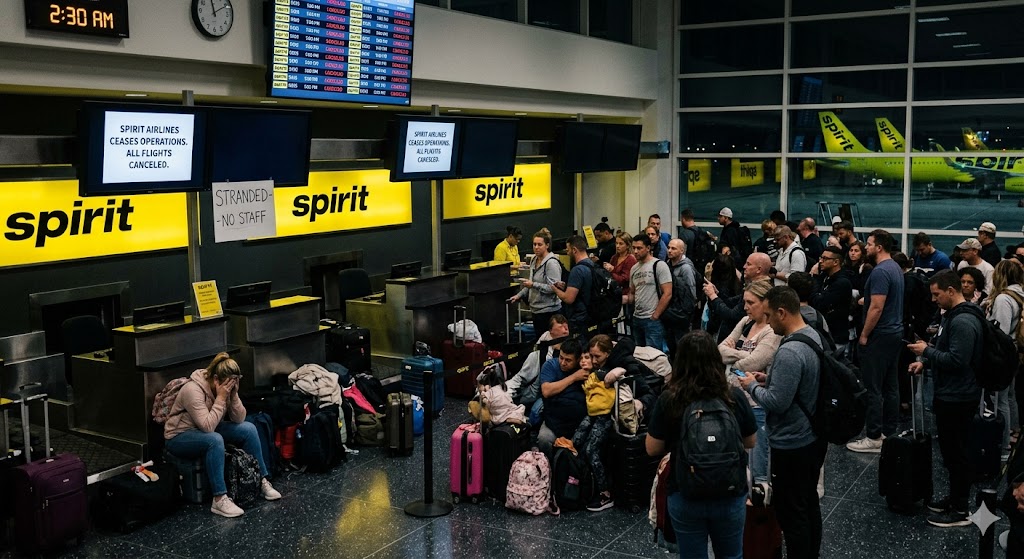
PHILADELPHIA – The bright yellow jets that democratized American air travel for over three decades have been permanently grounded. In a move that sent shockwaves through the aviation industry and left thousands of passengers stranded mid-journey, Spirit Airlines officially announced an “orderly wind-down” of all commercial operations effective at 3:00 a.m. ET on Saturday, May 2, 2026.
The collapse follows a frantic, last-minute attempt to secure a $500 million federal bailout from the Trump administration. Despite high-stakes negotiations involving the White House and Commerce Secretary Howard Lutnick, the deal reportedly fell apart when key bondholders—including heavyweights like Citadel and Ares Management—refused to yield their position to a government-backed loan.
Confusion at the Terminal: “I Missed the Announcement”
For many travelers, the news didn’t come via a push notification or an email, but through the sight of darkened check-in counters and “Canceled” status across airport departure boards.
At Philadelphia International Airport (PHL), traveler Yash Kothari arrived for an early morning flight only to find a ghost town where the Spirit ticket counter used to be. Kothari told reporters he had completely missed the 1:00 a.m. announcement that the company was shuttering after 34 years in business.
“There was no warning at the gate. No farewell. Just silence and a website update while we were sleeping,” said one frustrated passenger at Fort Lauderdale-Hollywood International, Spirit’s primary hub.
Why Spirit Failed: The Perfect Storm
The demise of the nation’s largest Ultra-Low-Cost Carrier (ULCC) was not a sudden event, but the culmination of a multi-year financial tailspin.
1. Failed Mergers and Debt
Spirit had been “bleeding” for years. After federal regulators blocked a merger with JetBlue in 2024 on antitrust grounds, Spirit was left with massive debt and no clear path to profitability. The airline filed for Chapter 11 bankruptcy twice in less than 18 months—first in November 2024 and again in August 2025.
2. The Iran War and Fuel Surges
While the airline attempted a “restructuring plan” in March 2026, the sudden outbreak of conflict in West Asia (Iran) caused a global surge in jet fuel prices. For a carrier operating on razor-thin margins, the “recent material increase in oil prices” was the final blow.
3. The Failed $500M Bailout
President Trump confirmed on Friday that a “final proposal” had been sent to the airline. The deal would have seen the U.S. government take a 90% equity stake in Spirit. However, creditors—preferring a liquidation of assets over a risky reorganization—rejected the terms.
“If we can’t make a good deal, no institution’s been able to do it,” Trump remarked shortly before the shutdown was finalized.
The Economic Ripple Effect
The shutdown is more than just a corporate failure; it is a seismic shift for the American traveler.
- Job Losses: Approximately 17,000 workers are now unemployed, including 14,000 direct employees (pilots, flight attendants, and mechanics) and thousands of contractors.
- Fare Hikes: Spirit served as a “pricing anchor.” Aviation experts at Cirium and CBS News warn that without Spirit’s competition, average round-trip fares on shared routes could jump by 23% or more heading into the peak summer travel season.
- Market Share: Spirit’s market share had already collapsed from over 5% in early 2025 to a mere 1.8% at the time of its closure.
| Key Statistics | Impact of Shutdown |
|---|---|
| Total Job Losses | 17,000+ |
| Fleet Status | All aircraft grounded/liquidating |
| Primary Hub | Fort Lauderdale (FLL) |
| Refund Policy | Automatic for credit/debit bookings |
Competitors Step In: American, United, and Frontier
As Spirit exits the stage, its rivals are moving quickly to absorb the displaced passenger volume—and the airline’s valuable airport slots.
- American Airlines: Announced fare caps on main-cabin tickets for routes where it competed directly with Spirit to prevent price gouging during the crisis.
- United Airlines: Stated it is “preparing to support Spirit customers and employees” by adding capacity on key routes.
- Frontier Airlines: Spirit’s long-time budget rival expressed readiness to accommodate travelers looking for “low-fare options” to fill the void left by the yellow-and-black jets.
What Should Impacted Travelers Do?
Spirit Airlines has transitioned its website into a “wind-down” portal. The company has issued the following guidance:
- Do Not Go To The Airport: All customer service counters are closed.
- Refunds: The airline claims it will automatically process refunds for tickets purchased directly through Spirit via credit or debit cards.
- Third-Party Bookings: If you booked through a travel agent or site like Expedia, you must contact them directly.
- Rebooking: Travelers are advised to book new flights through American, United, Frontier, or Southwest, as Spirit is no longer facilitating re-accommodation.
The era of the “no-frills” pioneer has ended. As the 17,000 employees of Spirit Airlines look for new roles and passengers scramble for new tickets, the aviation industry faces a summer of record-high prices and diminished competition. The “Pricing Anchor” has been lifted, and the cost of flying is likely to soar.
