
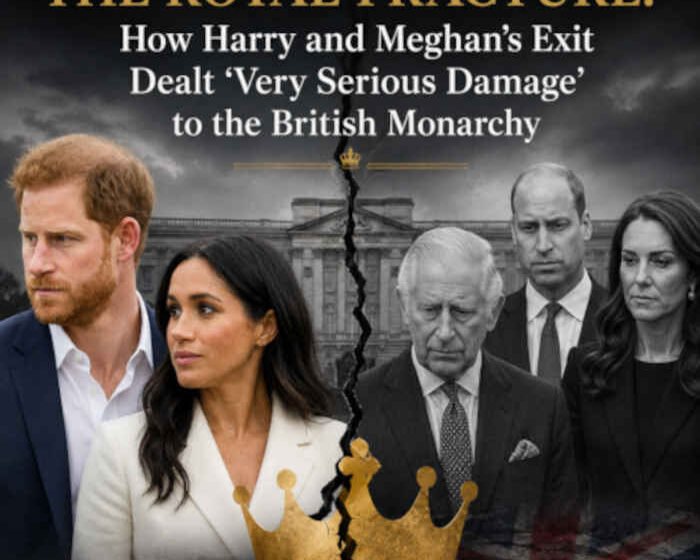
The Royal Fracture: How Harry and Meghan’s Exit Dealt ‘Very Serious Damage’ to the British Monarchy

LONDON — As Meghan Markle celebrates her 45th birthday, royal historians, commentators, and institutional observers are taking stock of the ongoing seismic shifts within the House of Windsor. Six years after Prince Harry and the Duchess of Sussex stepped back from their roles as senior working royals in early 2020, the long-term institutional fallout of their departure is becoming increasingly apparent.
According to prominent author and feminist historian Catherine Mayer—whose recent book Divide & Rule examines the dynamics surrounding royal women—the dramatic rupture between the Sussexes and the royal establishment has inflicted “very serious damage” on the monarchy’s global standing, particularly destroying its ability to resonate with younger, more diverse generations.
A Lost Bridge to Gen Z and Millennials
When Prince Harry married American actress Meghan Markle at St George’s Chapel in May 2018, the event was widely hailed as a watershed moment for the 1,000-year-old institution. As the first biracial member of the modern British royal family, an outspoken feminist, and a self-made professional, Meghan represented a powerful cultural bridge to a changing world.
However, the rapid breakdown of that relationship and the couple’s subsequent relocation to California signalled a structural failure to modernise.
“I believe that the rupture in the family that saw Meghan and Harry go to the United States has done very serious damage to the monarchy,” Mayer explained. “But to say that is not to say that I blame them for what happened. It’s often taken as a criticism: ‘Look what they’ve done to the monarchy.’ I think this has been very painful for everybody and for the institution, but you need only look at the latest polling on the popularity of the monarchy to see that it is losing ground.”
Public opinion metrics across the United Kingdom and the Commonwealth reflect a widening generational divide:
-
Demographic Support: Support for retaining a constitutional monarchy remains robust among citizens over 65 (hovering above 70%).
-
Youth Disengagement: Among 18-to-24-year-olds, enthusiasm for the Crown has plummeted, with a majority favoring an elected head of state or expressing complete apathy toward the institution.
-
The Diversity Gap: The departure of the Sussexes eroded goodwill among ethnic minority communities in the UK and across Commonwealth nations, where Meghan was once viewed as a modernizing ambassador.
Without Harry and Meghan active on the balcony, the remaining working monarchy under King Charles III has grown visibly older and narrower. The ongoing medical challenges faced by both the King and the Princess of Wales have further highlighted the institution’s limited operational capacity.
‘Patrimonarchy’ and the Media Machine
In Divide & Rule, Mayer argues that the clash between the Royal Family and Meghan Markle was not merely a personality conflict, but the predictable outcome of an entrenched “patrimonarchy”—a patriarchal system that historical institutions use to defend their power structures and pit prominent women against one another.
Mayer draws explicit parallels between modern royal women and historical figures like Anne Boleyn, Queen Victoria, and Princess Diana. The book illustrates how the British media and palace establishment established a rigid binary narrative:
| Royal Figure | Public Persona / Narrative | Systemic Result |
| Catherine, Princess of Wales | Dutiful, quiet, compliant, traditionalist | Positioned as the ideal institutional standard bearer |
| Meghan, Duchess of Sussex | Expressive, agency-driven, modern, American | Cast as an disruptive interloper |
“A trick patriarchy pulls is to set women against each other, placing them at opposite ends of an infernal seesaw, where, for one to rise, the other must,” Mayer notes.
This artificial rivalry created an environment where Meghan’s background, independent career, and Californian communication style—centered on emotional transparency and personal well-being—were viewed inside palace walls not as modern assets, but as existential threats to institutional discipline.
Divergent Royal Perspectives: Adaptation vs. Undermining
While critics like Mayer point toward systemic rigidity inside the Palace, other royal commentators contend that the Sussexes’ choices actively damaged an institution that tried to welcome them.
Royal analyst Hilary Fordwich argues that the couple’s media offensives—including their 2021 Oprah Winfrey interview, their 2022 Netflix docuseries, and Harry’s 2023 memoir Spare—represented a deliberate effort to undermine the monarchy.
“Harry and Meghan didn’t just make a silly mistake,” Fordwich stated. “They have undertaken a fundamentally damaging, deliberate strategy to undermine the royals, which is unforgivable. The royal family was most welcoming to Meghan, ‘bent the rules’ for her, made exceptions for her, but she thwarted it all.”
Royal expert Helena Chard reinforces that survival within “The Firm” requires absolute self-effacement and adaptability:
-
Adapting to the Machine: “The House of Windsor may appear rigid, but it has run like clockwork and survived through history,” Chard noted. “The one thing people marrying into The Firm have to learn is to adapt. Kate Middleton and Meghan both came in as outsiders, but one chose to learn the institution.”
-
The Cost of Friction: The inability or unwillingness to assimilate meant that rather than expanding the monarchy’s reach, the Sussexes’ exit forced King Charles III and Prince William to rely on a narrower, more disciplined core.
Security Feuds and Fragile Reconciliations
The practical realities of the Sussexes’ estrangement continue to play out over legal battles and security disputes.
Prince Harry’s ongoing legal challenges regarding his executive security detail while on British soil have remained a major point of friction. In July, security concerns prevented Meghan, Prince Archie, and Princess Lilibet from joining Harry for his full itinerary in the UK.
Despite the legal tension, quiet attempts at personal reconciliation have taken place behind closed doors:
-
Highgrove House Reunion: During a recent visit to mark the one-year countdown for the Invictus Games 2027 in Birmingham, Harry and Meghan made a discreet visit to Highgrove House for a private dinner with King Charles III and Queen Camilla.
-
Grandparent Connections: The meeting marked a rare opportunity for King Charles to spend time with his grandchildren, Archie and Lilibet, whom he had not seen in person for a prolonged period.
-
The Invictus Games 2027: Harry is reportedly hopeful that King Charles will attend the opening or closing ceremonies of the Birmingham Invictus Games next year—a move that would signal a public reconciliation while bolstering security arrangements.
However, observers note that any warmth between Harry and his father has not extended to his older brother, Prince William. The relationship between the Prince of Wales and the Duke of Sussex remains deeply fractured, leaving the future of the royal family divided across the Atlantic.
The Monarchy’s Uncertain Future
As King Charles continues his reign alongside Prince William and Princess Catherine, the long-term consequences of the 2020 rupture remain a defining challenge for the Crown.
The loss of Prince Harry and Meghan Markle was not merely the loss of two popular individuals; it was the loss of a modern narrative that briefly rendered the British monarchy relevant to a global, diverse audience. Whether the institution can rebuild trust with younger generations without the modernizing force the Sussexes once embodied remains one of the greatest existential questions facing the future of the House of Windsor.