
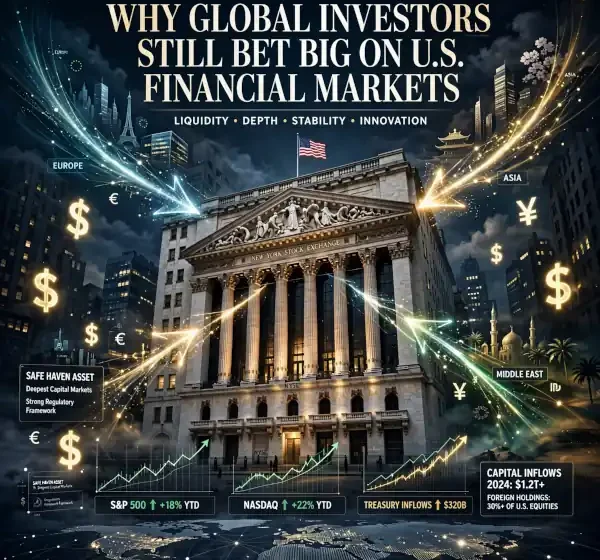

USA Business updates: In the main story, we have the breaking updates on why the world is investing in America. While domestic commentary often highlights political dysfunction and market volatility, international institutions are doubling down on American assets. Writing in August 2026, Citigroup Chair and CEO Jane Fraser outlined a striking reality: global capital is flowing into the United States at historic volumes. Foreign direct investment in U.S. markets, backed by the unmatched liquidity of Wall Street, has solidified the nation’s position as the primary destination for institutional capital.
For global fund managers and sovereign wealth funds, the central question of the next decade is not merely who invents breakthrough technologies, but who finances their deployment. Mobilising capital for artificial intelligence infrastructure, clean energy expansion, and industrial reshoring requires capital deployment scale that no other country can match. The American financial ecosystem provides this depth, offering reliable liquidity, strong legal protections, and dynamic private equity channels.
Quantifying the American Financial Hegemony in Global Capital
To understand why international investors remain bullish on the U.S. economy, one must look at global capital flows. According to data cited by Citi’s leadership, the U.S. share of global direct investment surged from 15% pre-pandemic to an average of 20% between 2024 and 2026. Furthermore, American stock exchanges now represent nearly 65% of total global market capitalisation, underscoring unprecedented institutional trust.
Despite persistent commentary regarding potential de-dollarisation, the U.S. dollar reserve currency status remains overwhelmingly intact. The broad dollar index hovers near a 40-year peak, while Bank for International Settlements (BIS) survey data reveals that approximately 90% of cross-border foreign exchange transactions continue to be denominated in U.S. dollars.
-
Direct Investment Leadership: The U.S. captures one-fifth of all global direct investment, outstripping competing emerging and developed markets combined.
-
Unrivalled Market Capitalisation: American equity markets account for 65% of the world’s public equity value, driven by massive technology and infrastructure valuations.
-
Dominant Currency Velocity: Nearly 9 out of 10 global financial settlements rely on the dollar, ensuring deep cross-border liquidity during economic shocks.
-
Venture Capital Supremacy: U.S.-based early-stage startups absorb 64% of all global venture capital funding, creating an unmatched engine for enterprise innovation.
Comparative Analysis of Global Investment and Capital Metrics
| Financial Metric | United States Position | Global Benchmark Context | Strategic Economic Takeaway |
| Global Direct Investment Share | 20.0% (2024–2026 Average) | 15.0% Pre-Pandemic Baseline | Capital concentration in U.S. assets is accelerating. |
| Global Equity Market Cap Share | ~65.0% | Rest of World Combined: ~35.0% | Deepest public markets for corporate capital raising. |
| Cross-Border Transaction Currency | ~90.0% Dollar-Denominated | BIS Central Bank Survey Standard | De-dollarisation claims conflict with trade settlement data. |
| Global Startup VC Funding Share | 64.0% | Europe & Asia Combined: ~36.0% | Dominance in commercialising high-growth technology. |
| Dollar Index Strength | Near 40-Year Highs | Multi-Decade Historical Average | Flight to safety remains centred on American Treasury debt. |
How Private Capital Drives Next-Generation Infrastructure Expansion
Mobilising capital at scale is essential for sovereign competitiveness in the modern industrial landscape. Financing hyper-scale AI data centres, modular nuclear reactors, and microchip fabrication facilities requires trillions of dollars in private credit and equity underwriting. American debt capital markets provide the necessary depth, enabling corporate borrowers to secure multi-billion-dollar syndications in days rather than months.
The multi-tiered pipeline of American finance allows small ventures to scale into multinational leaders. An entrepreneur can open a commercial account at a regional bank, secure seed funding from private funds, expand via institutional private debt, and eventually list on public exchanges. This seamless capital staircase enables rapid innovation cycles while allowing tens of millions of retail investors to participate in wealth creation through retirement funds.
-
AI & Technology Infrastructure: Unlocking private credit facilities to fund power grids, fibre networks, and GPU clusters.
-
Manufacturing Reshoring: Capitalising domestic semiconductor plants and automated logistics hubs under supply chain realignment initiatives.
-
Energy Sector Transformation: Deploying institutional infrastructure funds into natural gas, nuclear power, and renewable storage assets.
-
Democratized Wealth Creation: Channelling corporate earnings into 401(k) accounts, pension funds, and retail brokerage portfolios.
Institutional Trust as the Bedrock of American Economic Resilience
The durability of the U.S. financial ecosystem stems from its structurally transparent institutions. Rule of law, rigorous disclosure standards enforced by independent regulators, and transparent bankruptcy procedures give global investors confidence that their rights will be protected. Even during periods of heightened geopolitical tension or trade disputes, international capital flows into U.S. markets as a safe harbour.
Furthermore, the integration of American banking networks with international capital markets amplifies trade liquidity worldwide. Major global institutions like Citi facilitate cross-border transactions equivalent to whole national GDPs on a daily basis, sustaining supply chain stability across 180 countries. This institutional plumbing ensures that when global turbulence strikes, the flight to quality leads directly back to U.S. Treasury securities and high-yield commercial debt.
Frequently Asked Questions Regarding Global Capital Flows into the United States
Why is foreign direct investment in U.S. markets continuing to rise despite domestic political debates?
Global institutional investors prioritise liquidity, legal protections, and technological innovation. The United States offers the world’s deepest capital markets and legal certainty, making it the most reliable destination for long-term equity and debt deployment.
How valid are recent concerns regarding global de-dollarisation?
While alternative payment networks are growing, empirical data from the Bank for International Settlements confirms that approximately 90% of global transactions remain dollar-based. The broad dollar index remains near a 40-year high, reflecting persistent foreign reliance on dollar liquidity.
What role does private capital play in funding artificial intelligence and energy transition?
Building next-generation AI infrastructure and scaling energy capacity requires massive capital deployment. The U.S. market excels at mobilising private equity, venture funding, and corporate bond markets quickly to fund capital-intensive megaprojects.
How do retail investors benefit from international inflows into U.S. equities?
As international institutions buy American stocks and corporate debt, capital valuations rise across public indexes like the S&P 500. This capital growth directly expands retirement savings, 401(k) balances, and pension funds held by millions of individual households.
The ongoing flow of global capital into the United States underscores a clear reality: international investors retain deep structural confidence in the American economic model. While short-term political discourse often focuses on market volatility, foreign institutions recognise that no other nation offers the same combination of regulatory transparency, deep capital liquidity, and innovation scale. As the global race to fund AI infrastructure, clean energy, and re-shored manufacturing accelerates, the American financial engine remains the world’s primary capital allocator. To explore further market research and financial sector employment trends, visit our SEO Career & Job Portal, participate in investor policy discussions on our NT Live News Community Forums, or review global economic data via official publications on the Bank for International Settlements and Citigroup Perspectives.