What Space Scientist discovered after a Four-Ton SpaceX Rocket crashed into the Moon?

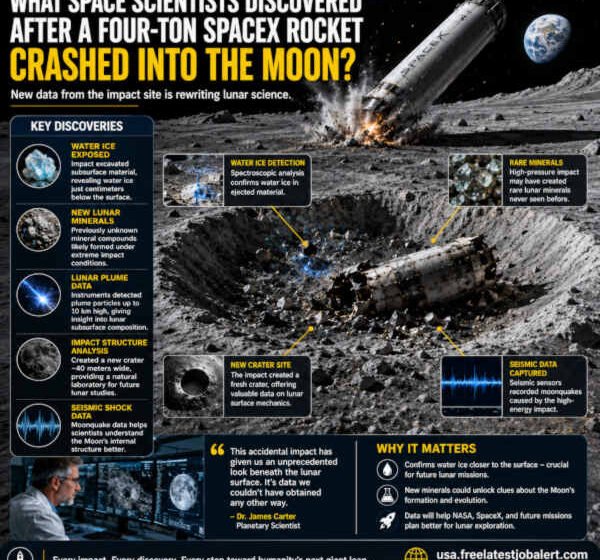
WASHINGTON: This news article blog deliver deatils about what scientists are learning after the SpaceX rocket crashed into the moon. THis in face a very unfortunate event, but still Elon is working very hard to curb such issues in the future. Travelling at a blinding 5,400 miles per hour, a four-ton upper stage of a SpaceX rocket slammed into the lunar surface, leaving behind a fresh impact crater and reigniting urgent debates over space junk, lunar environmental protection, and orbital stewardship. The rocket body, originally launched to deliver a pair of commercial lunar landers, spent months drifting in cislunar space before a combination of solar radiation pressure, solar wind activity, and complex gravitational dynamics tugged it onto an irreversible rendezvous with the Moon.
While an unintended collision, planetary scientists and aerospace engineers are seizing the rare event as an opportunistic scientific experiment. Unplanned kinetic impacts like this offer researchers a rare look into the structural composition of the lunar regolith, seismic propagation across the crust, and the chaotic nature of deep-space orbital decay. Yet beneath the scientific excitement lies a growing anxiety among space agencies worldwide: cislunar space is becoming crowded, and without clearer international rules, human-made space debris will increasingly scar the pristine lunar landscape.
How Solar Activity Redirected the SpaceX Rocket Mass
When the SpaceX upper stage completed its primary mission—deploying two robotic lunar landers intended to explore the Moon’s surface—it was left in a high, chaotic Earth-Moon transfer orbit. In higher Earth orbits, space hardware often exists in a complex gravitational tug-of-war between Earth, the Moon, and the Sun.
SpaceX scientists and independent orbital trackers noted that a major factor driving the rocket stage’s sudden fate was unexpected solar activity. Periodic outbursts of solar flare activity and coronal mass ejections alter the local space weather environment. Increased solar radiation pressure—the subtle force exerted by photons striking metal surfaces—gradually shifted the perigee and apogee of the spent rocket stage over time.
       +-------------------------------------------------------------+
       |             ORBITAL DECAY INTO LUNAR IMPACT                 |
       +-------------------------------------------------------------+
       | 1. Primary Mission: Payload Separation in Cislunar Orbit    |
       | 2. Solar Radiation Pressure & Solar Wind Distort Orbit Path |
       | 3. Earth-Moon Gravitational Tug-of-War Creates Instability  |
       | 4. Trajectory Capture: Trapped in Lunar Gravity Well        |
       | 5. High-Speed Impact: 4-Ton Rocket Hits Moon at 5,400 mph    |
       +-------------------------------------------------------------+
Over several months, these micro-perturbations added up. What was originally projected to remain in a long-term heliocentric or highly elliptical Earth orbit was nudged directly into the Moon’s gravitational well, setting up the 5,400 mph impact.
Turning Orbital Junk into Kinetic Experiments
While uncontrolled crashes are far from standard operating procedure, planetary scientists have a long history of making the best of unintended impacts. In fact, controlled rocket impacts date back to NASA’s Apollo program, when spent Saturn V S-IVB upper stages and Lunar Module ascent stages were deliberately crashed into the lunar surface to calibrate seismometers left behind by astronauts.
When a multi-ton object impacts the Moon at hypersonic speeds, several physical phenomena occur simultaneously:
-
Ejecta Plume Generation: The kinetic energy is released instantaneously upon impact, blasting thousands of kilograms of pristine sub-surface soil (regolith) into the vacuum above the surface.
-
Excavation of Pristine Material: Solar radiation and cosmic rays constantly weather the top layer of lunar soil. An impact excavates pristine, unweathered material from meters beneath the surface, exposing fresh minerals to spectrographs aboard orbiting satellites.
-
Seismic Wave Propagation: The impact shockwave ripples through the lunar crust, providing researchers with acoustic data that reveals structural densities and geologic fault lines within the upper mantle.
Orbital observatories—including NASA’s Lunar Reconnaissance Orbiter (LRO) and international spacecraft—were alerted prior to the predicted crash window to search for the impact flash, monitor the resulting dust plume, and image the newly formed crater once the dust settled.
The Physics of a 5,400 MPH Impact
To understand why scientists find kinetic impacts so illuminating, consider the energy transfer involved. A four-ton metal structure striking solid basalt and compressed regolith at 5,400 mph releases kinetic energy equivalent to several tons of TNT.
| Parameter | Measurement / Value |
| Impact Mass | ~4,000 kg (4 metric tons) |
| Impact Velocity | ~5,400 mph (~2.4 km/s) |
| Crater Diameter (Estimated) | 15 to 25 meters (50–80 feet) |
| Ejecta Distribution | Radial plume extending several kilometers |
| Primary Energy Source | Pure Kinetic Energy ($E_k = \frac{1}{2}mv^2$) |
Because the upper stage is essentially a hollow cylinder made of thin-walled tanks rather than a dense metallic meteorite, the resulting crater features unique geometry. Past rocket impacts have produced double craters or unusually shallow depressions due to the crushable, low-density structure of the striking body. By studying these specific crater shapes, scientists refine their impact physics models, helping them better interpret thousands of natural meteorite craters across the solar system.
The Growing Concern Over Cislunar Debris
Despite the valuable scientific data extracted from the event, the incident highlights a troubling reality: human activity around the Moon is expanding faster than the regulatory frameworks governing it.
For decades, space debris discussions focused almost exclusively on Low Earth Orbit (LEO), where defunct satellites and spent rocket boosters pose collision risks to crewed space stations and satellite constellations. However, as nations and private companies launch dozen of lunar landers, orbiters, and communication relays in preparation for long-term lunar bases, cislunar space is becoming noticeably cluttered.
Key Factors Driving Lunar Garbage Accumulation
-
Lack of Natural Removal Mechanisms: Unlike Low Earth Orbit, where atmospheric drag eventually burns up dead satellites, the Moon has no atmosphere. Anything that strikes or lands on the Moon stays there forever unless actively retrieved.
-
Unpredictable Cislunar Dynamics: High Earth and lunar orbits are notoriously unstable due to the complex gravitational interplay between Earth, the Moon, and the Sun. Satellites left in disposal orbits often drift unpredictably over years or decades.
-
Heritage Site Vulnerability: Historic artefacts—including the Apollo landing sites, early robotic survey landers, and scientific packages—have no physical shields protecting them from high-velocity debris ejected by nearby impacts.
Science communicators and astronomers emphasise that while the Moon is covered in millions of natural impact craters, uncontrolled artificial impacts carry risks of damaging operational spacecraft or contaminating biologically sensitive regions like the water-ice-rich craters of the lunar South Pole.
Environmental Stewardship and the Future of Cislunar Governance
The crash of the SpaceX upper stage serves as a wake-up call for aerospace corporations, space agencies, and international legal bodies. Existing treaties, such as the 1967 Outer Space Treaty, establish general liability for space objects but provide few concrete guidelines for managing spent rocket stages operating beyond Earth orbit.
Proposed solutions currently being evaluated by international space coalitions include:
-
Mandatory End-of-Life Disposal Burns: Requiring deep-space upper stages to reserve enough propellant to perform a final disposal burn, driving them into intentional heliocentric (solar) orbits far away from the Earth-Moon system.
-
Enhanced Tracking Networks: Deploying deep-space radar and optical tracking systems specifically designed to monitor objects drifting in cislunar space, preventing sudden surprise impact predictions.
-
Planetary Protection Zones: Establishing international “keep-out” zones around historical artifacts and sensitive scientific sites, ensuring rogue debris does not threaten future lunar habitats or research bases.
As humanity prepares to return astronauts to the Moon and establish a permanent presence on the lunar surface, learning from accidental collisions becomes essential. The four-ton piece of SpaceX hardware that slammed into the lunar soil at 5,400 mph may have provided a fascinating flash of scientific insight today, but it also stands as a powerful reminder: keeping cislunar space clean is just as vital as protecting our home planet.