
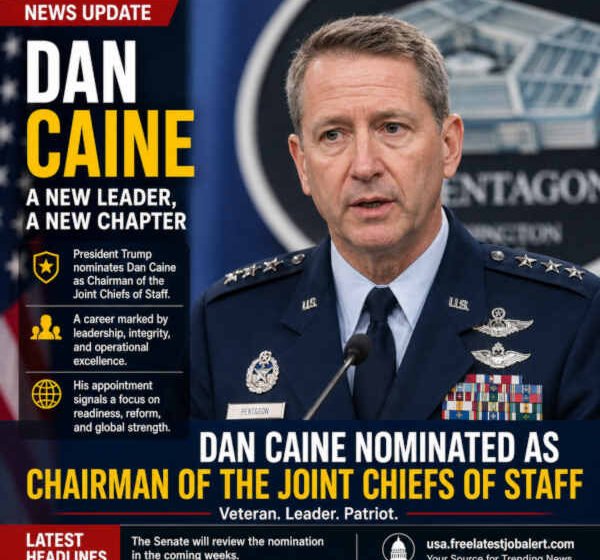
Dan Caine seeks Exit strategy From Iran War as U.S. Military Options Reach Limit| Everything you need to Know

WASHINGTON: Another law and government news arrived in the USA, Dan Caine WANTS Off Ramp as America military defence option reached the limitation., da Five months after the initiation of sustained military strikes against Iran, Chairman of the Joint Chiefs of Staff General Dan Caine has privately communicated to senior White House officials and Cabinet members that the United States urgently needs a strategic “off-ramp”.
As the war drags on—becoming increasingly costly and drawing heightened scrutiny from the American public. Gen. Caine has warned that available U.S. military options are reaching their operational limits. According to intelligence and defence sources, Caine’s central message to the administration is clear: airpower alone is unlikely to force Tehran into the peace agreement demanded by President Donald Trump, and escalating the conflict further risks severe military and geopolitical backfires
Why Airpower Has Hit a Wall? What does Dan Caine think of this?
When U.S. combat operations began, President Trump signalled that a campaign of heavy aerial bombardment and maritime coercion would swiftly pressure Iranian leadership to sign a new deal—one strictly barring Iran from acquiring nuclear weapons and curtailing its ballistic missile network.
However, after more than 150 days of continuous strikes targeting command facilities, missile launch sites, and proxy networks, Tehran has refused to capitulate.
Gen. Caine’s recent internal assessments highlight several key operational constraints:
-
Hardened Underground Targets: Key elements of Iran’s nuclear and ballistic missile infrastructure remain buried deep underground within reinforced mountain complexes, resisting standard precision-guided air munitions.
-
Asymmetric Persistence: Despite extensive damage to primary command nodes, decentralised regional units continue launching low-cost drones and anti-ship missiles, disrupting global shipping lanes in the Strait of Hormuz.
-
Munition Stockpile Strain: High-rate consumption of advanced precision-guided missiles and air-defence interceptors is straining military readiness, forcing defence planners to consider global stockpile reserves.
-
No Ground Troop Appetite: President Trump has repeatedly rejected the prospect of deploying U.S. boots on the ground for a full-scale land invasion. Without ground forces to secure targets, air strikes can degrade—but not permanently dismantle—hardened assets.
Recognising these dynamics, Gen. Caine has engaged in private sidebar discussions with Vice President JD Vance, Secretary of State Marco Rubio, CIA Director John Ratcliffe, and Secretary of Defence Pete Hegseth to build an interagency consensus on a diplomatic exit strategy.
Who Is General Dan Caine?
General John Daniel “Dan” Caine serves as the 22nd Chairman of the Joint Chiefs of Staff, making him the highest-ranking military officer in the United States and the principal military advisor to the President.
Background, Early Life, and Faith
Born into a dedicated military family, Dan Caine grew up as the son of an Air Force fighter pilot who flew F-4 Phantoms. Caine followed his father’s footsteps into military aviation, describing tactical flying as “our family business.”
Raised in traditional American military communities with strong Christian heritage and institutional values, Caine’s faith and worldview were heavily shaped by the code of honor and discipline at the Virginia Military Institute (VMI), where he graduated in 1990 with a Bachelor of Arts in Economics. Throughout his career, colleagues have described Caine as a deeply principled, measured, and steadfastly apolitical officer who views his duties through a lens of stewardship and protection of service members.
9/11 Defence of Washington, D.C.
On September 11, 2001, then-Major Dan Caine was serving as an F-16 pilot with the District of Columbia Air National Guard. Following the terrorist attacks on the World Trade Center and the Pentagon, Caine was one of four military pilots ordered to scramble jets into the sky over Washington, D.C., with orders to intercept and protect the nation’s capital.
Citizen-Soldier and CIA Leadership
Unlike traditional four-star generals who spend four uninterrupted decades on active duty, Caine built a unique profile as a “citizen-soldier.” Between 2009 and 2016, he served as a part-time member of the Air National Guard while working in the private sector as a successful entrepreneur and venture investor.
He later returned to full-time military service, holding high-level roles in special operations, including Assistant Commanding General of Joint Special Operations Command (JSOC) and Associate Director for Military Affairs at the Central Intelligence Agency (CIA).
How Dan Caine Met Donald Trump: The 2018 Iraq Meeting
The story of how Dan Caine became President Trump’s top military officer traces back to December 2018, during Trump’s first term in office.
President Trump made an unannounced holiday visit to Al Asad Airbase in Iraq to meet with U.S. troops and commanders involved in the campaign against ISIS. At the time, Caine was a one-star brigadier general serving as a deputy commander for special operations.
During a briefing, Trump expressed frustration with the slow pace of military operations against remaining ISIS strongholds. Caine delivered a direct, no-nonsense tactical assessment, telling the President that if military commanders were given broader authority and rules of engagement, the remaining ISIS territory could be cleared in a matter of days.
Trump was immediately captivated by Caine’s direct demeanor and memorable F-16 fighter pilot call sign: “Razin” (a play on “Raising Caine”). Trump frequently recounted the meeting in public speeches over the following years, praising Caine as a “real general, not a television general.”
When President Trump returned to the White House in 2025, he broke decades of Pentagon tradition by selecting Caine—who had retired as a Lieutenant General—to serve as Chairman of the Joint Chiefs of Staff, recalling him to active duty and elevating him to four-star rank.
The Interagency Strategy: Crafting a Diplomatic Exit
Now facing a complex standoff with Iran, Gen. Caine is leveraging his credibility with President Trump to steer national security policy toward a pragmatic resolution.
Rather than publicly opposing executive policy, Caine is working quietly within the administration’s national security apparatus to outline realistic parameters:
-
Protecting Military Readiness: Highlighting that prolonged air campaigns deplete critical munitions needed for global deterrence.
-
Establishing Achievable Metrics: Defining success through verifiable diplomatic freezes on Iranian nuclear enrichment rather than demanding total military capitulation.
-
Coordinating Cabinet Alignment: Ensuring that State, Defence, and Intelligence leaders present unified, realistic options during White House briefings.
As discussions continue behind closed doors, Caine’s effort to find an off-ramp reflects the classic perspective of a combat-tested fighter pilot: knowing not just how to enter a fight, but how to manoeuvre out before running out of fuel. Whether Washington can convert current military leverage into a durable diplomatic deal will determine how and when the five-month conflict comes to an end.
Here, the details of Dan Caine, who he is, what he seeks, and the latest USA news updaets is provided. For more such interesting, latest American news updates, stay connected with us and don’t forget to share and like.