
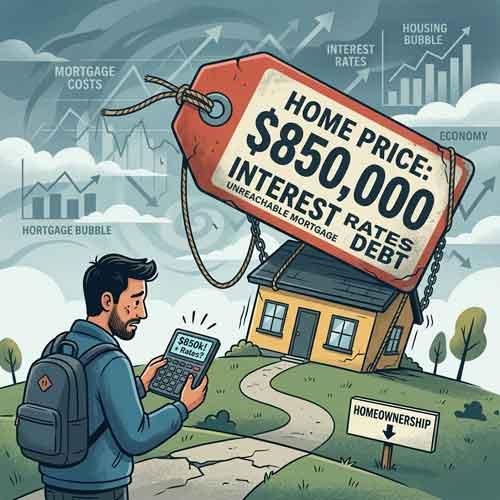
The Cost of the American Dream: Why You Need $109,152 to Buy a Home Right Now
San Francisco: For generations, the roadmap to the American Dream was straightforward: get a solid job, save a bit of cash, and buy a home with a neat front yard. Today, that roadmap feels like it requires a rocket booster.
According to recent data from the National Association of Realtors (NAR), homebuyer affordability declined for the fifth consecutive month. The new reality is stark: Americans must now earn an annual income of $109,152 to qualify for a standard mortgage on a median-priced single-family home.
If that number makes your wallet sweat, you are not alone. The housing market has evolved into a high-stakes arena where record-high home prices and stubborn mortgage rates collide. Yet, if we look beneath the intimidating headlines, the macroeconomic reality shows a much more nuanced story.
The Anatomy of the $109,152 Income Goal
How exactly did the real estate market arrive at a six-figure salary requirement for a typical home? The National Association of Realtors determines this threshold using a specific calculus that mirrors real-world lending requirements.
The math relies on three core variables:
- The Median Price Tag: The national median price for an existing single-family home reached $446,400.
- The Interest Rate: The average interest rate on a 30-year fixed mortgage hovered at 6.57%.
- The Down Payment: The calculation assumes a standard 20% down payment paid upfront, which amounts to $89,280.
[Median Home Price: $446,400] ──> [20% Down Payment: $89,280]
                                          │
                                          ▼
[30-year Fixed Mortgage at 6.57%] ──> [Required Income: $109,152]
When banks evaluate a mortgage application, they generally ensure your monthly housing payment does not consume more than 25% to 28% of your gross monthly income. When you combine a $446,400 price tag with a mid-6% interest rate, the monthly principal and interest payment lands right in the zone where a six-figure salary becomes the absolute barrier to entry.
The Great Irony: Why Affordability is Secretly Improving
While a five-month decline in month-over-month affordability sounds grim, looking at the broader timeline reveals an unexpected twist. On an annual basis, the housing market is actually showing signs of healing.
NAR Chief Economist Lawrence Yun noted that overall housing affordability improved compared to the previous year. While that sounds like a contradiction, the underlying economic logic makes sense.
“Affordability is better than a year ago because wage growth is outpacing home price growth,” Yun explained.
A year prior, mortgage rates pushed closer to the 7% mark, and household incomes had not yet caught up with pandemic-era inflation. Today, a robust labor market and steady salary increases give buyers a slightly stronger financial footing, even as nominal home prices continue to tick upward.
The Real Culprit Behind High Prices
It is easy to point fingers at mortgage rates or greedy sellers, but the real driver of the modern real estate crisis is a simple concept from Econ 101: supply and demand.
The U.S. housing market suffers from a chronic shortage of inventory. Many homeowners who locked in ultra-low 3% mortgage rates between 2020 and 2021 are unwilling to sell their properties. Doing so would mean giving up their current rate to borrow at more than 6%. This dynamic has effectively frozen existing inventory.
[Low Current Mortgage Rates (3%)] ──> [Homeowners Stay Put] ──> [Choked Housing Inventory]
                                                                        │
                                                                        ▼
[All-Time High Prices ($446,400)] <── [Stiff Buyer Competition] <───────┘
Total housing inventory dipped 0.6% in June compared to May, leaving the market with a tight 4.6-month supply. Without a steady influx of new homes hitting the market, buyers must compete for a limited pool of properties, which keeps prices at record highs.
Regional Breakdown: Where Your Dollar Stretches (and Shrings)
The $109,152 income requirement is a national average, but real estate is inherently local. Depending on your zip code, that six-figure salary will either make you wealthy or leave you out of the market entirely.
Data from the National Association of Realtors highlights a stark regional divergence in single-family median home prices:
| U.S. Region | Median Single-Family Home Price | Market Dynamics |
|---|---|---|
| The Northeast | $564,800 | The most expensive region; sales rose 2.1% as wealthy buyers shrugged off higher costs. |
| The West | $633,600 | High cost barrier, but saw the largest year-over-year affordability improvement due to strong local wage gains. |
| The South | $377,700 | Relatively stable pricing, though sales dipped 3.6% month-over-month as buyers hit pause. |
| The Midwest | $346,600 | The most affordable region in the country, making it a primary target for budget-conscious buyers. |
First-Time Buyers Face the Hardest Climb
The current real estate environment has created a sharp divide between two types of consumers: repeat buyers who hold existing equity, and first-time buyers trying to get a foot in the door.
If you already own a home, the recent run-up in real estate values is great news. The typical U.S. homeowner accumulated roughly $128,000 in housing wealth over the past six years alone. Sellers routinely roll that equity directly into their next purchase, allowing roughly 25% of all buyers to pay entirely in cash and bypass mortgage rates altogether.
First-time buyers do not have that luxury. They must save for a down payment using post-tax wages while navigating high rents. Despite these headwinds, first-time buyers accounted for 33% of all existing-home sales in June, proving that demand remains resilient despite steep financial hurdles.
Actionable Strategies for Hopeful Homebuyers
If your current income sits below the $109,152 mark, your homeownership goals are still achievable. Navigating a challenging housing market simply requires adjusting your financial strategy.
1. Reconsider the 20% Down Payment Standard
The 20% down payment assumption used by the NAR keeps monthly payments low and eliminates Private Mortgage Insurance (PMI). However, it is not a legal requirement. Conventional loans allow down payments as low as 3% to 5%, while FHA loans require 3.5%. Entering the market with less down means a higher monthly payment, but it lets you buy a home much sooner.
2. Look Closely at Condominiums and Co-ops
If single-family homes feel out of reach, alternatives offer an excellent entry point. The national median price for condominiums and co-ops sat at $380,000—significantly lower than the $446,400 price tag of single-family homes. Condos build equity over time, which you can eventually leverage to buy a larger home down the road.
3. Explore House Hacking
House hacking involves buying a multi-unit property or a home with a rentable basement or spare rooms. The rental income generated from tenants offsets your monthly mortgage payment. Lenders often let you count projected rental income toward your qualifying income requirements, helping you bridge the gap if your salary falls short.
Looking Ahead: Will the Housing Market Cool Down?
Predicting the future of real estate is notoriously difficult, but the path forward depends heavily on future inventory levels.
If building activity increases and more existing homeowners decide to list their properties, price growth will naturally moderate. However, if inventory remains tight, home values will likely continue to trend upward, driven by steady wage growth and a resilient economy.
Buying a home today requires patience, strict budgeting, and a clear understanding of your local market conditions. The financial bar is high, but with the right strategy, homeownership remains a realistic target.