
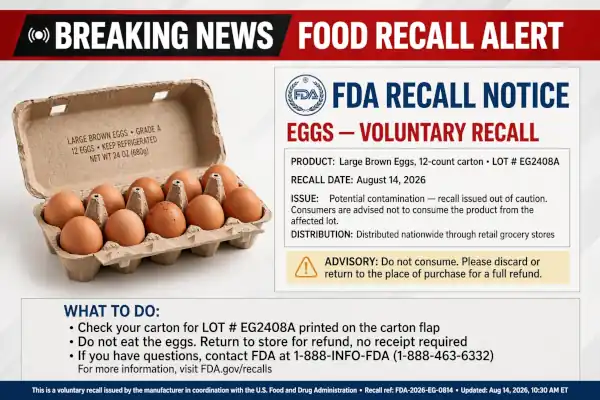
Texas Egg Recall Upgraded: FDA Declares Highest Class 1 Health Risk

The U.S. Food and Drug Administration (FDA) has escalated its national public health alert by assigning a Class 1 risk classification to nearly 1.6 million dozen Texas-produced eggs. The urgent designation follows an ongoing multistate Salmonella Enteritidis outbreak linked to Midwest Poultry Services facilities in Texas, which has triggered dozens of hospitalizations across several states.
A Class 1 designation represents the federal government’s most severe recall status, warning of a reasonable probability that consuming contaminated products will cause serious adverse health consequences or death. With affected cartons distributed through major retail grocers like Kroger and Brookshire’s, food safety regulators and health officials urge households and commercial kitchens to immediately inspect their refrigerators.
Scope of Midwest Poultry Services Contamination and Outbreak Scale
Federal health agencies initiated intensive traceback and laboratory testing after public health departments documented widespread gastrointestinal illnesses. Environmental swabs and third-party laboratory whole-genome sequencing confirmed that on-farm egg isolates from two Texas facilities matched the active clinical outbreak strain.
The recall encompasses 1,589,577 dozen white shell eggs and brown cage-free shell eggs produced between June 6 and July 3. Retail cartons carrying sell-by or best-by dates ranging from July 20 to August 17 reached restaurant suppliers and grocery shelves across the South and Southwest.
Epidemiological data compiled by the Centers for Disease Control and Prevention (CDC) confirms at least 98 laboratory-confirmed Salmonella infections across 17 states. Among interviewed patients, 91 percent reported consuming eggs shortly before symptom onset, leading to 26 hospitalizations.
Retail Distribution Channels and Impacted Supermarket Chains
The affected eggs entered broad regional supply chains through wholesale food service distributors and major grocery retailers. Consumers purchased the contaminated cartons under diverse private and commercial brand labels, including Kroger, Simple Truth Cage-Free, Brookshire’s, Country Morning, and Sunups.
-
Kroger Supermarkets: Impacted store locations throughout Texas and Louisiana.
-
Brookshire Grocery Company: Outlets across Texas, Louisiana, Arkansas, Oklahoma, New Mexico, and Mississippi.
-
Independent Retailers: Regional markets, local food cooperatives, and smaller food service vendors.
-
Institutional Food Service: Commercial dining facilities, catering operations, and restaurant networks operating in the southern corridor.
Identifying Recalled Packaging Codes and Julian Dates
Consumers should not rely on visual inspection, smell, or shell appearance to determine bacterial safety, as Salmonella bacteria do not alter egg odor or taste. The FDA advises shoppers to check the date-coding ink stamp printed on the side panel of the carton.
Recall Verification Code Checklist:
- Plant Identification Numbers: P-1950 or 0840962
- Julian Date Manufacturing Codes: 157 through 184
- Expiration Window: Sell-by / Best-by dates between July 20 and August 17
- Egg Types: Grade A White Shell & Brown Cage-Free Shell
If a carton displays either plant code alongside a Julian date within the 157 to 184 range, consumers must immediately discard the eggs or return them to the purchase location for a full refund.
Summary Comparison: Outbreak Data and Regulatory Timeline
| Timeline & Metric | Investigation Findings | Regulatory Action |
| Production Window | June 6 to July 3 | Eggs distributed across southern supply lines. |
| Voluntary Recall | July 22 | Midwest Poultry Services halts Texas distribution. |
| CDC Case Count | 98 confirmed infections (17 states) | 26 hospitalizations documented by health authorities. |
| FDA Risk Classification | Upgraded to Class 1 | Highest federal recall risk level enacted. |
| Primary Brands | Kroger, Simple Truth, Brookshire’s, Sunups | Retail pull notices and customer alerts issued. |
Frequently Asked Questions Regarding the Texas Egg Recall
What makes a Class 1 FDA recall different from lower classifications?
The FDA reserves Class 1 status for situations involving high-risk contamination where exposure to a violative product carries a reasonable probability of causing severe health injury, systemic infection, or death. Class 2 and Class 3 recalls address lower-level hazards that cause temporary or medically reversible consequences.
What are the primary symptoms of Salmonella food poisoning?
Infection symptoms typically develop between 6 hours and 6 days after consuming contaminated food. Common signs include severe diarrhea, abdominal cramping, fever above 102°F, nausea, and vomiting. Young children, elderly adults, and individuals with weakened immune systems face elevated risks of life-threatening bloodstream infections.
Can cooking recalled eggs thoroughly make them safe to eat?
Health authorities strictly advise against consuming recalled eggs, even if thoroughly cooked. Cross-contamination during handling, cracking, or surface contact in household kitchens poses substantial contamination risks.
How should consumers sanitize storage areas after handling recalled eggs?
Individuals who stored recalled cartons should dispose of the eggs inside sealed plastic bags. Wash refrigerator drawers, shelving, countertops, and utensils with hot, soapy water or a diluted bleach sanitizing solution to prevent secondary bacterial spread.
Food safety vigilance remains the most effective defense against widespread foodborne illness outbreaks. Consumers who purchased shell eggs in the South and Southwestern United States should check their carton codes and seek immediate medical evaluation if experiencing persistent gastrointestinal symptoms after eating poultry products. For comprehensive historical data on food safety standards, explore the Salmonella Infection Overview on Wikipedia. You can also look up real-time product safety alerts through our Google Search Directory or join ongoing public health discussions at the NT Live News Forum.