
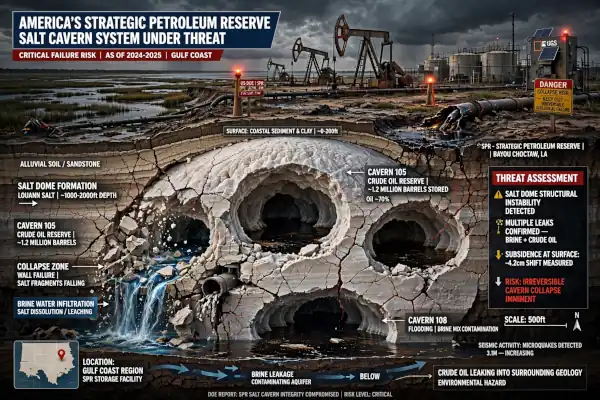
SPR Cavern Damage Risks: Aggressive Drawdowns Threaten America’s Emergency Oil Reserves with Irreversible Geological Collapse

HOUSTON — Deep beneath the coastal plains of Texas and Louisiana, America’s premier energy defense network is encountering an unprecedented geological hazard. As the United States Strategic Petroleum Reserve (SPR) is drawn down to its lowest levels in four decades amid heightened geopolitical tensions and military escalation in the Middle East, petroleum geologists and energy infrastructure engineers warn that the physical salt caverns holding the crude face permanent, irreversible structural damage.
This operational strain arrives as American consumers grapple with record-breaking fuel costs at retail pumps. With the national average for regular gasoline reaching a mid-August peak of $4.07 per gallon, intense pressure to suppress domestic energy prices has pushed extraction rates beyond the original engineering limits of the subterranean storage network.
+-------------------------------------------------------------------------+
|                  STRATEGIC PETROLEUM RESERVE: VITAL METRICS             |
+-------------------------------------------------------------------------+
| Total Authorized Capacity:   ~714 Million Barrels                       |
| Current Inventory Level:     ~311 Million Barrels (40-Year Low)         |
| Geomechanical Failure Floor: ~170 Million Barrels ("Dead Pool" Line)    |
| Primary Facility Sites:      Bryan Mound, Big Hill, West Hackberry,     |
|                              Bayou Choctaw (60 Caverns Total)           |
| Extraction Process:          Freshwater / Unchecked Solution Leaching   |
+-------------------------------------------------------------------------+
The Geotechnical Engineering of Subterranean Salt Domes
The Strategic Petroleum Reserve relies on deep geological salt domes located along the Gulf Coast rather than conventional above-ground metal storage tanks. Developed in the late 1970s following the 1973–1974 Arab oil embargo, these underground facilities provide secure, high-volume crude containment shielded from weather disasters and military strikes.
The reserve’s 60 storage caverns are situated thousands of feet below the surface across four strategic hubs:
-
Bryan Mound (Freeport, Texas)
-
Big Hill (Winnie, Texas)
-
West Hackberry (Lake Charles, Louisiana)
-
Bayou Choctaw (Baton Rouge, Louisiana)
Engineered by solution mining—injecting high-pressure water to dissolve solid halite rock—each cylindrical cavern can measure up to 200 feet in diameter and extend over 2,000 feet vertically, creating a storage volume large enough to hold over 10 million barrels of crude oil per unit.
Halite salt was chosen because of its unique mechanical property known as viscoplastic creep. Under thousands of pounds of lithostatic pressure from overlying sediment, the rock salt behaves like a slow-moving, self-healing plastic. If micro-fissures or structural stress fractures form, the surrounding salt compresses to seal the voids, preventing hydrocarbons from leaking into adjacent freshwater aquifers. Furthermore, the natural geothermal heat gradient within the salt dome generates continuous thermal convection, keeping heavy and light crude fractions thoroughly mixed.
The Physics of Solution Leaching: How Extractions Dissolve Cavern Walls
The vulnerability of the SPR stems directly from its rapid-drawdown extraction mechanism. Because the caverns lack downhole mechanical submersible pumps, emergency releases require high-pressure injection of raw water or semi-saturated brine into the bottom of the cavern.
Because crude oil has a lower specific gravity than water, the injected water creates an upward hydraulic piston, displacing the oil through extraction piping into interstate pipelines and marine export terminals.
       [ FRESHWATER INJECTION ]            [ CRUDE OIL TO REFINERIES ]
                  │                                     ▲
                  ▼                                     │
       ┌──────────────────────┐              ┌──────────────────────┐
       │ High-Pressure Pumping│              │ Pipeline Manifolds   │
       └──────────┬───────────┘              └──────────┬───────────┘
                  │                                     │
                  │   ═══════════════════════════════   │
                  │     CAPROCK & SEDIMENTARY LAYER     │
                  │   ═══════════════════════════════   │
                  ▼                                     │
            ┌─────────────────────────────────────────────────┐
            │                                                 │
            │            STORED CRUDE OIL LAYER               │
            │           (Displaced Upward to Wellhead)        │
            │                                                 │
            │ - - - - - - - - - - - - - - - - - - - - - - - - │
            │                                                 │
            │            WATER / BRINE INTERFACE              │
            │   (Eats Away Cavern Walls via Dissolution)      │
            │                                                 │
            │ - - - - - - - - - - - - - - - - - - - - - - - - │
            │          INSOLUBLE MINERAL SLUDGE LAYER         │
            │       ("Dead Pool" - Abrasive Anhydrite)        │
            └─────────────────────────────────────────────────┘
Every time fresh or under-saturated water enters a cavern, it dissolves additional salt from the walls. This unintended enlargement—termed secondary leaching—causes progressive geometric degradation:
-
Structural Over-Enlargement: Caverns were originally engineered to endure a maximum of five lifecycle drawdown-and-refill cycles. Frequent emergency releases have pushed numerous Gulf Coast caverns into their sixth or seventh major cycle.
-
Ceiling Spalling and Collapse: Water injection alters the stress equilibrium at the cavern roof. Without upward hydrostatic counter-pressure, slabs of dense salt rock fracture and plunge thousands of feet, risking the destruction of hanging well casing strings.
-
Pillar Thinning and Cavern Coalescence: Excessive leaching thins the structural salt “web” separating neighboring caverns. If this barrier breaches, catastrophic fluid migration and massive pressure drops would permanently destroy multiple storage vaults simultaneously.
The 170-Million-Barrel “Dead Pool” Operational Threshold
Geomechanical engineers and energy analysts emphasise that the reserve cannot be depleted down to the last drop. The SPR features a hard operational floor estimated around 170 million barrels, below which withdrawals become hazardous or impossible.
| Storage Status | Volume Range | Physical Integrity & Risk Level |
| Nominal Capacity | 600M – 714M Barrels | Optimum hydrostatic balance; minimal wall stress; low salt creep. |
| Operational Strain | 300M – 450M Barrels | Accelerated creep rates; reduced sustained pump-out velocities. |
| Critical Danger Zone | 170M – 300M Barrels | Severe secondary leaching; wall thinning; roof spalling hazards. |
| “Dead Pool” Boundary | Below 170M Barrels | Unusable mineral sludge; immediate threat of structural collapse. |
When crude levels drop near the 170-million-barrel line, several structural failure modes activate:
-
Brine Coning & Well Fouling: High-velocity displacement creates localised vortexing, sucking abrasive brine, anhydrite sand, and heavy chemical sludge directly into surface intake manifolds.
-
Accelerated Cavern Closure: Leaving caverns depleted of crude removes internal hydrostatic counter-pressure. Surrounding rock formations exert intense confining stress, causing cavern walls to compress inward by several percentage points annually, warping steel casing strings and permanently eliminating volume.
Geopolitical Ramifications and Strategic Vulnerability
The Strategic Petroleum Reserve was established under the Energy Policy and Conservation Act (EPCA) of 1975 to serve exclusively as an emergency buffer during global supply cutoffs. Using the reserve as a sustained price-suppression mechanism introduces national security liabilities.
                    GEOPOLITICAL SUPPLY DISRUPTION
                  (Middle East Instability / Blockades)
                                │
                                ▼
                   RECORD RETAIL GAS PRICES ($4.07)
                                │
                                ▼
                  ACCELERATED EMERGENCY DRAWDOWN
                                │
                                ▼
                   SPR CAVERN GEOLOGICAL DAMAGE
              • Salt Leaching & Roof Collapse
              • Loss of Hydrostatic Equilibrium
              • Casing Shear and Well Failure
                                │
                                ▼
                 REDUCED SURGE DRAWDOWN CAPACITY
           (Vulnerability to Extended Global Energy Shocks)
If global chokepoints—such as the Strait of Hormuz or the Suez Canal—face long-term disruption, America’s ability to respond will depend on its maximum daily withdrawal capacity.
While baseline figures assume a maximum surge delivery rate of 4.4 million barrels per day, physical degradation, cavern decommissioning, and low inventory levels have already lowered maximum sustained daily outflow rates. Damaged wellheads and structural stability limits make achieving design-capacity flow rates during a catastrophic shortfall practically impossible.
Replacement Costs and Technical Challenges
Restoring degraded salt dome storage capacity requires extensive capital investment and years of engineering lead time. Under the Department of Energy’s Life Extension Phase II program, maintenance backlogs have steadily grown due to marine corrosion and high equipment turnover.
Replacing a single damaged cavern requires:
-
Multi-Year Leaching Timelines: Solution-mining a new 10-million-barrel cavern requires 3 to 7 years of continuous freshwater circulation and dedicated offshore disposal pipelines for billions of gallons of hypersaline brine.
-
Capital Outlays: Developing replacement subterranean salt facilities costs hundreds of millions of dollars per cavern in federal appropriations.
-
Crude Acquisition Logistics: Refilling the stockpile requires purchasing hundreds of millions of barrels of specific sweet and sour crude blends on open commodity markets without triggering sharp spikes in global oil pricing.
Until federal energy policy balances short-term consumer fuel stabilization against long-term subterranean geomechanics, every barrel extracted during high-rate drawdowns brings America’s strategic oil fortress closer to permanent geological failure.