
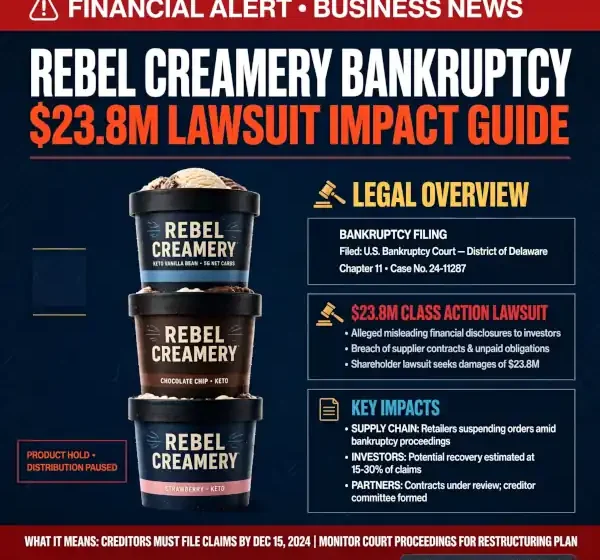

Rebel Creamery, the popular Utah-based low-carb dessert brand, has officially filed for Chapter 11 bankruptcy protection after a federal court ordered the company to surrender $23.785 million in profits over an intellectual property and trade dress infringement lawsuit. The brand, widely recognized for its keto-friendly pints in national retail chains like Walmart, Target, and Kroger, faced a devastating legal defeat against New York-based premium rival Van Leeuwen. This corporate restructuring case illustrates how severe legal penalties and trade dress litigation can disrupt commercial consumer packaged goods (CPG) operations across Tier-1 retail markets.
The legal battle centered around distinctive packaging aesthetics, resulting in an injunction that barred Rebel from selling products in its infringing containers. Navigating commercial litigation liabilities and restructuring under US bankruptcy courts underscores the operational complexities modern retail brands face when protecting brand identity.
The Legal Dispute: Van Leeuwen vs. Rebel Creamery Trade Dress Verdict
Van Leeuwen filed its federal trademark and trade dress lawsuit against Rebel Creamery in 2021, asserting that the Utah manufacturer intentionally mimicked its iconic minimalist packaging. Van Leeuwen’s trade dress consists of a signature monochrome, pastel-colored pint container with matching lids, distinctive black script lettering, and a clean aesthetic designed to stand out on crowded supermarket shelves.
US District Judge Eric Komitee delivered a decisive ruling concluding that the evidence demonstrated willful infringement and dilution of Van Leeuwen’s protected trade dress. Consequently, the court ordered Rebel to cease selling its current pint packaging, execute a complete product redesign, and disgorge nearly $24 million in net profits generated from the infringing trade dress.
Van Leeuwen Aesthetic (Pastel + Script + Monochrome)
                  │
                  ▼
Rebel Packaging Redesign (2021 Alleged Infringement) ──► Federal Lawsuit Filed
                  │
                  ▼
District Court Ruling: Willful Trade Dress Dilution ($23.785M Awarded to Van Leeuwen)
                  │
                  ▼
Rebel Creamery Chapter 11 Filing (District of Utah Bankruptcy Court)
Chapter 11 Filing Details: Financial Assets and Liabilities
Faced with an immediate $23.8 million civil judgment, Rebel Creamery sought relief under Chapter 11 in the US Bankruptcy Court for the District of Utah. Chapter 11 protection allows the business to maintain everyday retail distribution and fulfill supermarket purchase orders while restructuring its debt obligations and executing mandatory packaging overhauls.
| Bankruptcy Metric / Case Detail | Official Court Record Data | Strategic Business Impact |
| Filing Entity | Rebel Creamery LLC (Utah) | Primary manufacturer of low-carb keto ice cream |
| Jurisdiction | US Bankruptcy Court for the District of Utah | Chapter 11 corporate reorganization proceedings |
| Estimated Total Assets | $10,000,000 to $50,000,000 | Manufacturing inventory, brand equity, distribution contracts |
| Estimated Total Liabilities | $10,000,000 to $50,000,000 | Includes the $23.785M federal court judgment |
| Primary Creditor & Adversary | Van Leeuwen Ice Cream LLC | Secured/unsecured judgment holder following trade dress verdict |
| Core Supermarket Retailers | Walmart, Target, Kroger | Nationwide distribution network remains active during restructuring |
Understanding Trade Dress Infringement in CPG Retail
Trade dress protects the overall commercial look and visual presentation of a product that signifies source identity to consumers. When competing brands adopt confusingly similar color palettes, typography, and container contours, consumers face point-of-sale confusion.
-
Distinctive Visual Elements: Van Leeuwen established brand equity through simple pastel colors, monochrome lids, and elegant black script fonts.
-
Proof of Intentional Copying: Judge Komitee highlighted trial evidence proving Rebel intentionally adopted these visual cues to capture premium market share.
-
Mandatory Packaging Redesign: The injunction requires Rebel to remove all infringing inventory and transition to entirely unique product containers.
-
Financial Disgorgement: Federal courts can mandate the total forfeiture of corporate profits derived directly from infringing product designs.
Corporate Risk Management and Commercial Liability Protections
For growing consumer brands, intellectual property litigation and trade dress disputes represent catastrophic balance sheet risks. Manufacturing companies and retail suppliers must utilize comprehensive commercial liability strategies to guard against unexpected intellectual property judgments and legal defense costs.
Securing specialized errors and omissions (E&O), directors and officers (D&O), and commercial umbrella liability policies helps buffer enterprise balance sheets when commercial disputes arise. Furthermore, regular trademark clearinghouse audits and structural design reviews prevent infringement claims before packaging reaches store shelves.
-
Conduct Pre-Market Visual Audits: Clear packaging designs with specialized trademark counsel prior to manufacturing mass inventory.
-
Maintain Intellectual Property Insurance: Procure commercial liability insurance policies that cover legal defense expenses in trade dress and copyright disputes.
-
Establish Liquidity Reserves: Maintain operational contingency funds to protect supply chain logistics if emergency product redesigns become necessary.
Frequently Asked Questions Regarding Rebel Creamery’s Bankruptcy
Why did Rebel Creamery file for Chapter 11 bankruptcy?
Rebel Creamery filed for bankruptcy after a federal judge ordered the company to pay $23.785 million in profits to rival Van Leeuwen for intentionally copying its packaging design.
Will Rebel Ice Cream still be available in grocery stores?
Yes, Chapter 11 bankruptcy allows Rebel Creamery to continue operating and supplying retailers like Walmart, Target, and Kroger while reorganizing its debts and redesigning its pints.
What is trade dress infringement?
Trade dress infringement occurs when a company copies the distinctive visual appearance, packaging, or design of a competitor’s product, leading to consumer confusion in the marketplace.
What was unique about Van Leeuwen’s packaging design?
Van Leeuwen’s packaging features a minimalist, monochrome pastel-colored pint with matching lids and black script lettering, which the court ruled was diluted by Rebel’s infringing containers.
Corporate governance, intellectual property defense, and brand management play crucial roles in scaling retail enterprises. To understand the statutory foundations of commercial visual identity and intellectual property, review the background on Trade Dress on Wikipedia as well as the fundamentals of corporate restructuring under Chapter 11 Bankruptcy on Wikipedia. Enterprise founders, retail suppliers, and CPG executives seeking commercial liability protection and business asset risk strategies can explore dedicated resources through the Insurance Quotes Google Search Index and the Insurance USA Commercial Portal. To engage with retail strategists, discuss brand protection case law, and follow corporate restructuring updates, visit the active discussions on the NTLiveNews Business Forums.
The Chapter 11 bankruptcy of Rebel Creamery highlights the vital importance of protecting intellectual property and maintaining rigorous trade dress compliance in consumer retail markets. While the financial penalty of $23.785 million forces a major restructuring for the low-carb ice cream manufacturer, ongoing supermarket distribution allows the brand an opportunity to stabilize operations under a redesigned package. As emerging brands scale across major retail channels, investing in comprehensive trademark clearance, distinct visual branding, and commercial risk mitigation remains the cornerstone of long-term corporate survival.