
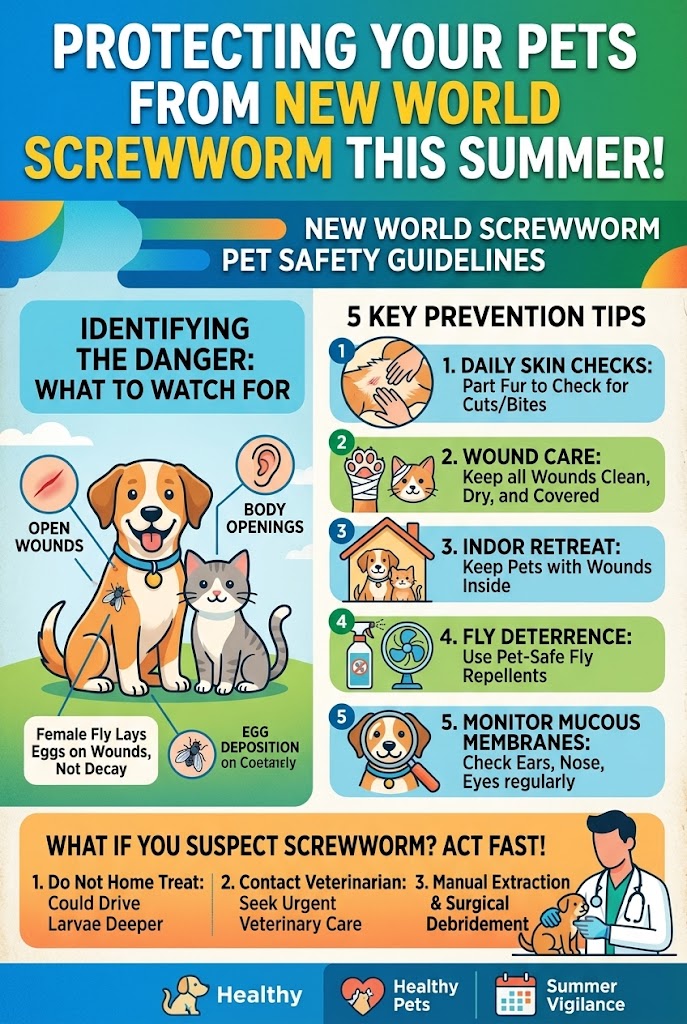

USA top stories: New World Screwworm Pet Safety Alert: They Are Back! Fleas-eating Parasite That Drives Hosts Mad Re-Emerges This Summer. A fearsome parasite, called the New World Screwworm, that eats the live flesh from living creatures, including pets and livestock, has made a resurgence this summer and pet owners, livestock producers and agricultural authorities throughout America are on high alert. The parasitic worm has made its official return after it was found on a dog this summer; this is the first documented appearance of the pest in almost ten years after a regional occurrence was wiped out in the Florida Keys.
Now, as temperatures soar to the height of the summer months, agricultural authorities and veterinarians have issued a widespread alert to the public, as farmers are already dealing with localised threats like crop pests threatening more than 80% of Florida’s strawberry production; now they also face the threat of these gruesome worms.
Because the parasitic organism attacks living flesh, it is vital to know all you can about its life cycle, how it’s detected and how to prevent and manage it if necessary to protect your beloved pets and farm animals.
What Exactly IS a Screwworm?
This isn’t your typical, everyday household maggot or blowfly. In reality, the screwworm parasite is actually the larva of the Cochliomyia hominivorax, a species that is uniquely predatory and is an obligatory parasite, unlike its fly brethren who lay eggs almost exclusively on carrion or dead tissue.
The female screwworm is genetically predisposed to find warm-blooded animals with open wounds or exposed mucosal linings.
According to the U.S. Department of Agriculture (USDA), it’s a serious agricultural pest. The “screwworm” nickname refers to its morphology and method of movement.
The tiny larva contains dark, spiny tubes, and rows of raised spines line its body. These spines look a bit like those on a wood screw, and when the larva “eats,” it burrows its way deep into flesh in a rotating, drilling fashion. A Pathological Life Cycle for an Infestation. This parasite causes a traumatic infestation of flesh.
The problem begins with any open, warm wound, including something as simple as a tick bite, the sting from a thorny plant, an incision from surgery, a small nick on the nose or even the unhealed navel cord on a newborn.
It isn’t too hard to see how this leads to a disaster if left unchecked. After it is attracted by the smell of blood or body fluid, a pregnant female screwworm will deposit 100-400 long white eggs onto the wound’s edge. A short time after, after it becomes warm enough to make conditions optimal, those eggs will hatch into microscopic larvae within 12 to 24 hours. Then, after the eggs hatch into tiny larvae that will move in toward the flesh. They can begin to eat.
They will then continue to drill deeper as they become larger, grow, moult into three stages, and get to adult size over the course of about 5 to 7 days.
At the end of this period, the larva will leave the host, burrow into the soil and enter the pupal stage before emerging as the fly ready to breed once again. Myth vs. Fact – What You Need To Know about NWS and Spread. There have been many misleading and frightening claims about NWS making their way through social media. Animal owners need to be educated about how the screwworm can or can’t affect their animals or family.
Fact: NWS IS NOT contagious. The screwworm is a parasitic insect and NOT a disease; thus, it cannot spread from animal to animal via direct contact, and humans will NOT catch screwworm from handling or being around infested animals. Fact: it MUST involve direct contact of eggs with an open wound. The only way to contract screwworm is for the female screwworm to lay eggs directly onto an open, living wound of the host, and the parasitic larvae will eventually hatch into the feeding stage. Characteristics Of Screwworm Wound Unlike typical scrapes and cuts which usually scab and heal from the inside out, a screwworm-infested wound is characterized by the following: 1. A distinct, pungent, foul odor a screwworm infestation results in a strong, unpleasant odor that emanates from the wound, as the maggots secrete enzymes that digest living flesh.2. An expanding, oozing pocket The edge of the wound tends to be swollen and inflamed and expands outwards, while the middle becomes a deep, raw pocket3. An animal experiencing intense pain and discomfort. The affected animal will be very uncomfortable, showing extreme restlessness and continuously picking or licking the affected area as though attempting to get something out of the flesh. The complete extermination of the New World Screwworm from the United States is one of modern agricultural science’s most remarkable accomplishments, achieved through the revolutionary Sterile Insect Technique (SIT).
Developed by U.S.
Department of Agriculture entomologists, SIT requires that millions of screwworm flies be raised in specialised labs and irradiated, making them unable to reproduce, without otherwise affecting their mating instincts. The irradiated male screwworms were then flown across the infested regions and released en masse. Because female screwworms only reproduce once, those that mated with irradiated males produced infertile eggs, collapsing the entire species’ life cycle. As a result of these efforts, the United States was declared screwworm-free in 1966, and a barrier zone of sterile releases was established in southern Mexico to prevent re-infestation.
Historical Impact Of The New World Screwworm Year Milestone / Outbreak Event Impact & Management Strategy 1950s-1966 Complete U.S.
Eradication Campaign: Successful implementation of Sterile Insect Technique (SIT). 2016-2017 Florida Keys Outbreak: First recurrence since the 1950s in a wild population of key deer. Localised sterile fly releases and topical treatments used to eradicate it. This Summer Reemergence (First Domestic Dog Case): urgent public notification, monitoring and immediate containment measures.
Source: AI news