
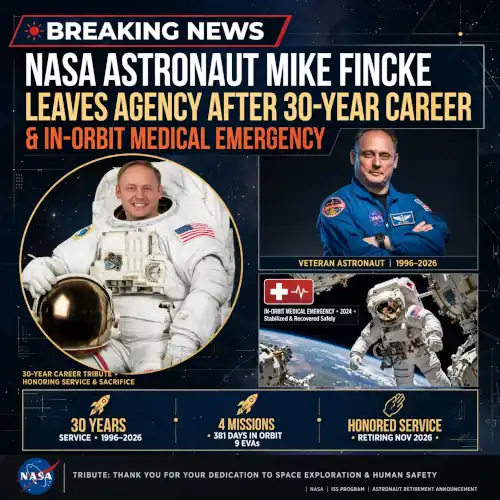
NASA Astronaut Mike Fincke Leaves Agency After 30-Year Career and In-Orbit Medical Emergency

When NASA astronaut Mike Fincke unclipped his seatbelt inside the SpaceX Crew Dragon Endeavour after splashing down in January 2026, he closed a chapter on an unprecedented moment in orbital spaceflight. Months after experiencing an unexpected medical issue aboard the International Space Station (ISS) that prompted NASA’s first formal orbital medical evacuation, the veteran spacefarer has officially stepped down from the agency. His departure marks the conclusion of a remarkable three-decade career spanning four spaceflights, 549 days in weightlessness, and nine historic spacewalks.
The retirement of one of NASA’s most experienced long-duration flyers highlights the evolving operational, physical, and financial realities of deep space missions. As public space agencies and commercial spaceflight operations expand human presence toward the Moon and Mars, space exploration medical emergency procedures and specialized commercial spaceflight risk management frameworks are moving to the forefront of aerospace policy.
The Orbital Incident: How a Sudden In-Space Medical Scare Prompted an Unprecedented Station Evacuation
On January 7, 2026, while serving as a flight engineer for Expedition 73 and as commander of Expedition 74 aboard the ISS, Fincke experienced a sudden, alarming medical symptom after dinner. The 59-year-old retired U.S. Air Force colonel suddenly lost the ability to speak for approximately 20 minutes. Although he experienced no physical pain, his fellow crewmembers recognised the distress instantly and mobilised with ground flight surgeons to stabilise his condition.
Flight surgeons utilised on-board diagnostic equipment, including the space station’s advanced ultrasound machine, to run initial scans while Fincke’s condition stabilised. Although immediate danger passed, flight medical managers determined that comprehensive evaluation required advanced imaging tools not present in microgravity. On January 15, 2026, Fincke and his three SpaceX Crew-11 crewmates—NASA astronaut Zena Cardman, JAXA astronaut Kimiya Yui, and Roscosmos cosmonaut Oleg Platonov—returned safely to Earth roughly a month ahead of schedule.
-
Rapid Crew Mobilisation: All six station crewmates responded within seconds to initiate emergency medical check protocols.
-
Real-Time Telemedicine: Flight surgeons at Johnson Space Center guided remote medical imaging from 250 miles above Earth.
-
Precautionary Evacuation: Mission leaders chose early departure to ensure complete diagnostic evaluations on terra firma.
-
Unresolved Aetiology: Subsequent earthly medical tests ruled out heart attacks or choking, leaving microgravity-induced physiological anomalies as key research focal points.
Decades in Orbit: A Comparative Look at Mike Fincke’s Spaceflight Milestones
Fincke’s departure closes out one of the most prolific flight logs in American human spaceflight history. Selected in NASA’s 16th astronaut class in 1996, he bridged multiple technological generations, flying aboard Russian Soyuz vehicles, the Space Shuttle, and modern commercial crew capsules. He currently ranks fourth among all NASA astronauts in cumulative time spent in space.
In addition to his flight hours, Fincke served five years supporting Boeing’s Commercial Crew Development program, contributing directly to spacecraft flight software, systems integration, and astronaut safety protocols. His comprehensive background made him a foundational pillar for both government orbital operations and private commercial spaceflight astronaut training initiatives.
| Spaceflight Mission | Launch Vehicle / Spacecraft | Mission Role | Key Achievements & Duration |
| Expedition 9 (2004) | Soyuz TMA-4 | Science Officer & Flight Engineer | 187 days in orbit; conducted 4 spacewalks for station maintenance. |
| Expedition 18 (2008) | Soyuz TMA-13 | Station Commander | 178 days; prepared ISS for expansion from 3-person to 6-person full crew operations. |
| STS-134 (2011) | Space Shuttle Endeavour | Mission Specialist | Final flight of Shuttle Endeavour; delivered Alpha Magnetic Spectrometer. |
| SpaceX Crew-11 (2025–2026) | SpaceX Dragon Endeavour | Pilot & Expedition 74 Commander | Logged 549 cumulative spaceflight days; executed successful precautionary medical departure. |
Engineering Resilience: Managing Flight Risk, Aerospace Liability, and Astronaut Health Protocols
Fincke’s emergency underscored critical realities regarding human physiology during extended exposure to weightlessness. Extended missions expose the human body to fluid shifts, muscle atrophy, bone density decay, and cardiovascular stressors. As commercial space stations prepare to replace the ISS by the end of the decade, private enterprises are studying this incident to build robust aerospace health insurance frameworks and emergency medical response guidelines.
NASA Administrator Jared Isaacman praised Fincke’s 30-year legacy, noting his pivotal contributions to long-duration spaceflight risk mitigation and the preparation of the upcoming Artemis lunar generation. Flight surgeons continue studying microgravity health telemetry to refine long-term health monitoring standards for deep-space transit vehicles.
-
Integrated Medical Telemetry: Future commercial and NASA spacecraft will incorporate automated physiological monitoring systems.
-
On-Board Diagnostic Redundancy: Next-generation stations will carry compact MRI and portable CT technology to diagnose neurovascular events in orbit.
-
Specialised Insurance & Liability: Private spaceflight operators are standardising specialised astronaut disability and retirement planning models to protect commercial crews.
-
Aerospace Engineering Consulting: Veteran astronauts like Fincke provide invaluable flight-testing expertise for private space firms developing next-gen human-rated capsules.
Frequently Asked Questions Regarding Astronaut Health and Space Evacuation Protocols
What specific medical event caused Mike Fincke’s early return from the ISS?
Fincke experienced a sudden 20-minute episode where he was unable to speak while aboard the ISS on January 7, 2026. While his condition stabilised rapidly and tests ruled out a heart attack, NASA opted for a precautionary evacuation to perform advanced hospital diagnostics on Earth.
How does NASA protect astronaut medical privacy during mission emergencies?
NASA maintains strict medical privacy policies that treat detailed clinical diagnostic data as confidential personal health information. While flight status impact and broad physiological findings are shared for scientific advancement, individual personal diagnoses remain private to ensure crewmembers feel safe reporting subtle symptoms without fear of public exposure.
How will Mike Fincke’s retirement impact future commercial crew development?
With 30 years of experience across four spacecraft types, Fincke’s operational knowledge remains a major asset for aerospace consulting firms. His work on Boeing’s Starliner, SpaceX’s Dragon, and NASA’s Artemis program helps shape training safety standards for government and commercial spacefarers alike.
Mike Fincke’s storied career demonstrates how technical expertise, cool-headed leadership, and rigorous safety procedures safeguard human life during complex space missions. As he transitions into private life and prospective consulting roles, his legacy continues to guide engineers and flight surgeons preparing for human journeys to the Moon and beyond. Ensuring crew health, advancing orbital telemedicine, and building robust risk management frameworks will remain the foundation of human expansion into the cosmos.
Explore Further & Join the Discussion:
-
Search for the latest career updates and government announcements on Job Alerts Google Search.
-
Connect with space enthusiasts and discuss orbital safety topics at the NT Live News Community Forums.
-
Review detailed career flight logs and spaceflight histories via the official Michael Fincke Wikipedia Biography and NASA Astronaut Directory.