
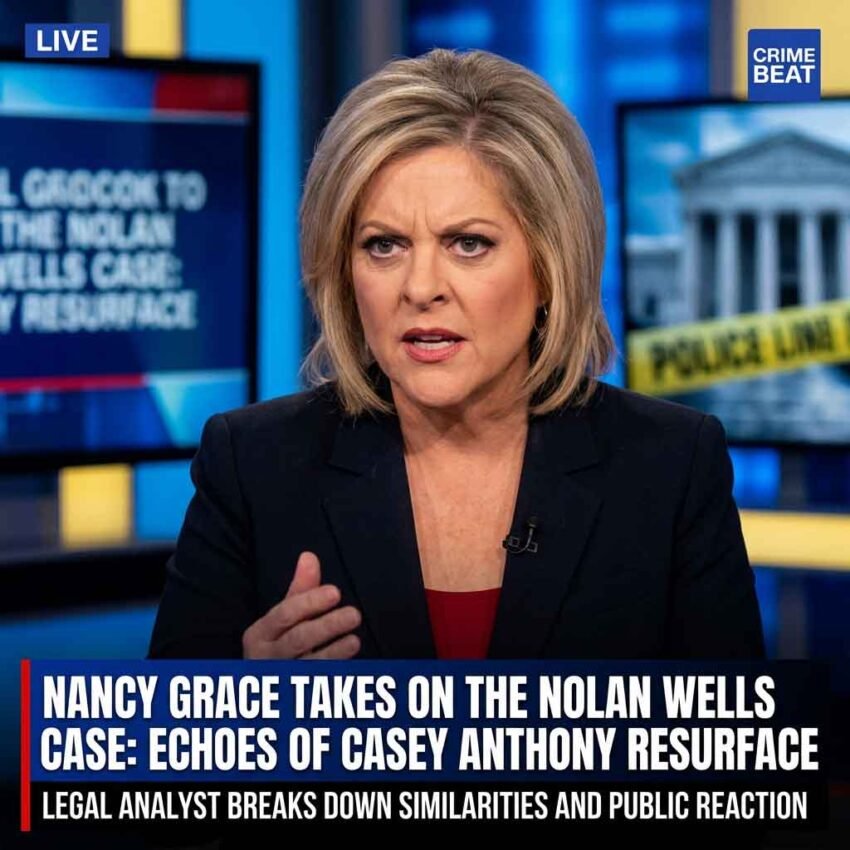
Nancy Grace Is On The Nolan Wells Case — And That Actually Might Change Things
For decades, TV viewers across America have recognised the signature style of Nancy Grace. With her distinctive hair, fiery Southern drawl, and uncompromising attitude, the former Atlanta prosecutor turned legal commentator built her career on a simple premise: when the official story does not make sense, you start asking uncomfortable questions out loud.
Her aggressive approach has drawn both praise and criticism over the years. Yet, few can deny her ability to grab a local headline, throw it into the national prime-time spotlight, and keep it there until someone provides real answers.
That dynamic is playing out again in Mississippi. Grace focused her vocal scepticism on the baffling death of 18-year-old Nolan Xavier Wells. Her involvement generated significant conversation, particularly across social media and Black digital spaces.
When a small-town investigation appears to rush toward a tidy conclusion, national media attention can completely alter the trajectory of a case.
Who Was Nolan Xavier Wells? The Human Story Behind the Headlines
Before analyzing the legal strategy and forensic details, it is crucial to remember the young man at the center of this tragedy.
Nolan Xavier Wells was an 18-year-old freshman at Southwest Mississippi Community College in Summit, Mississippi. A talented wide receiver on the college football team, Nolan had big dreams of transferring to a Division I program.
Those who knew him best describe a young man whose personality lit up every room he entered. His head coach, Les George, recalled how Nolan would regularly swing by his office just to sit on the couch and chat. His mother, Christine Wonsley, remembered him as a warm, protective, and gentle spirit who took pride in lifting up those around him.
On the evening of July 3, 2026, Nolan cooked a baked salmon dinner for his parents after his mother completed a long workday. The next morning, July 4th, he set off with three white acquaintances for a holiday boat trip to Horn Island—an undeveloped barrier island located roughly eight to ten miles off the Mississippi Gulf Coast.
It was supposed to be a simple afternoon of sun, sand, and holiday celebration. Instead, Nolan never made it back to the mainland alive.
The Red Flags That Simply Do Not Add Up
When three people go out on a boat with a fourth person and return without him, alarm bells naturally ring. When those three individuals bring back the missing person’s cell phone and car keys while he remains stranded miles out at sea, those alarm bells turn into siren blares.
Local authorities initially suggested that Nolan chose to stay on the island and planned to catch a ride back with another boat. They quickly floated the theory that he likely drowned and indicated that they did not suspect foul play.
However, civil rights attorney Ben Crump, civil rights leader Rev. Al Sharpton, and independent investigators quickly pointed out major flaws in that explanation:
- The Deleted Digital Footprint: Nolan’s mother discovered that messages and Snapchat photos from July 4 had been removed from his phone—a device that was retrieved from his companions. For a social 18-year-old on a holiday trip, an empty digital footprint raises immediate red flags.
- The Physical Condition of the Victim: Nolan was an athletic, healthy college athlete who knew how to swim. Horn Island was packed with holiday boaters on July 4th, making an unnoticed struggle in shallow waters highly improbable.
- The Timeline Anomalies: His companions departed Horn Island around 4:31 PM, according to GPS data gathered by state marine resources officials. Yet, his family was not alerted until hours later, near 11:00 PM.
- Water Recovery Dynamics: Search crews found Nolan’s body on July 6. Family members and search personnel from the United Cajun Navy questioned why his body was not recovered earlier if he had drowned near the shore on July 4.
These unanswered questions created growing frustration for a family seeking clear answers.
The “Nancy Grace Effect”: Love Her or Hate Her, She Demands Answers
Enter Nancy Grace.
Just four hours after mourners laid Nolan to rest at his funeral service in Mississippi, Grace aired a dedicated, one-hour special episode of Crime Stories.
True to form, she did not mince words. She walked her audience through the known facts, pointed out logical gaps in the official police narrative, and directly challenged local law enforcement’s early assumptions.
Official Narrative: "No foul play suspected; likely an accidental drowning."
     │
     ▼
Key Contradictions Raised by Critics & Analysts:
 ├─ Digital Evidence: Photos & Snapchat messages wiped from Nolan's phone.
 ├─ Personal Items: Car keys and phone left with companions, not with Nolan.
 ├─ Physical Ability: Athletic swimmer on a crowded beach with zero eye-witness drowning reports.
 └─ Timeline Delays: Hours elapsed between boat departure and emergency reporting.
The response on social platforms was swift. Clips from her broadcast spread rapidly across TikTok, X (formerly Twitter), and Instagram. Musician and content creator Vincint noted on social media that when Nancy Grace takes an interest in a case, local officials suddenly realize they can no longer handle things quietly behind closed doors.
Many marginalized communities have historically viewed prime-time true crime shows with some skepticism. However, Grace has earned respect for her willingness to use her platform to challenge official reports, dismantle bureaucratic delays, and highlight cases involving Black victims that might otherwise lose national attention.
Why Media Scrutiny Matters in the Deep South
To understand why national media attention carries so much weight in this case, one must consider the historical context of Mississippi.
During Nolan’s funeral, Rev. Al Sharpton referenced historic civil rights cases, reminding the congregation that trust between local law enforcement and Black communities in the Deep South has often been strained by premature conclusions.
When small jurisdictions handle high-stakes cases, early classification of an incident as an “accidental drowning” can limit the initial scope of an investigation. Key forensic steps—such as securing immediate cell tower data, preserving digital evidence, and conducting specialized forensic autopsies—can sometimes be delayed or overlooked.
National media coverage changes that environment instantly. When national commentators analyze every update, several changes typically follow:
- Increased Prosecutorial Accountability: Local district attorneys face greater pressure to present evidence directly to a grand jury rather than closing a file quietly.
- Federal and State Oversight: Agencies like the FBI or state bureaus of investigation are more likely to step in or offer technical support when national attention builds.
- Digital Forensic Rigour: Subpoenas for deleted phone records, cloud backups, and boat GPS tracking receive top priority from tech companies and state labs.
Poking Holes in the Narrative: The Logic of “Crime Stories”
What makes Grace’s coverage effective is not just her impassioned delivery; it is her background as a prosecutor. She breaks down cases using basic legal logic that resonates with everyday viewers.
During her coverage of the Nolan Wells case, she focused on several core logical inconsistencies:
- Who cleared the phone data? If Nolan was stranded on an island, how did his phone data get wiped while the device was in the possession of others?
- Why leave personal belongings behind? If a person intends to stay behind on a barrier island to secure another ride, why would they hand over their cell phone and car keys to departing friends?
- Where are the witnesses? Horn Island on the Fourth of July is crowded with recreational boats. If an 18-year-old athlete suffered a medical emergency or drowned in open water during peak daylight hours, why did no surrounding boaters observe distress signs?
Asking these questions on national television obligates authorities to provide clear, evidence-based answers.
What Must Happen Next to Ensure Justice
As public interest in the Nolan Wells case grows, investigators must focus on concrete forensic evidence rather than speculation. Legal experts and civil rights leaders point to several necessary steps:
- Complete Cloud Data Recovery: Forensic specialists must extract original cloud backups to recover any deleted text messages, Snapchat video clips, or location metadata from July 4.
- Thorough Vessel Inspections: Investigators need to review all GPS positioning records, engine runtime logs, and hull forensics for every boat tied to the outing.
- Comprehensive Toxicology and Autopsy Reports: State medical examiners and independent forensic pathologists must complete full toxicological screenings and tissue analyses to establish an undisputed cause of death.
- Grand Jury Presentation: Local prosecutors should present all findings—including witness statements and digital records—to a grand jury for a thorough, transparent review.
A Mother’s Plea and a Community’s Search for Truth
At the core of this national discussion is a grieving family looking for answers.
“We just want to know what happened and why our baby didn’t come home,” Christine Wells-Wonsley shared at a news conference in New York alongside Ben Crump. Her demand is straightforward: a thorough, unbiased, and transparent investigation that accounts for every detail of her son’s final hours.
Nancy Grace’s decision to cover the case brings national focus to that search for answers. Her involvement ensures that the questions surrounding Nolan Xavier Wells’s death will be examined closely, helping to ensure that the full truth is brought to light.
For a deeper look into the public reaction and the family’s emotional plea for a transparent investigation, watch ‘This is not how I wanted the world to meet my son’: Mother of Nolan Wells. This video provides essential context on the family’s call for answers and attorney Ben Crump’s involvement in seeking justice for Nolan Wells.