
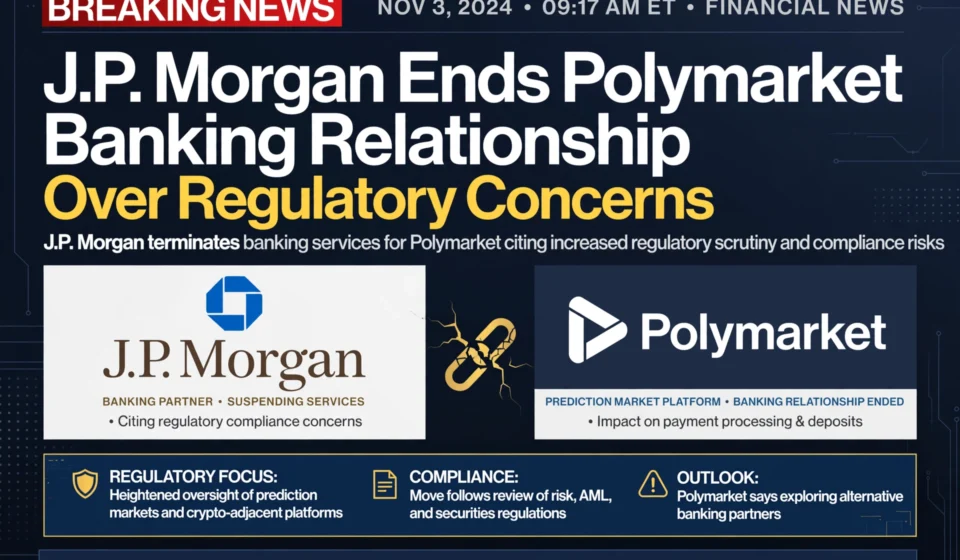
J.P. Morgan Ended Polymarket Banking Relationship but Why. Full details inside

Breaking USA News: This breaking USA Nes artixcl e deliver all about the JP Moregan Ending ply market, key takeaways, operational workaround details, and more related news articles. JPMorgan Chase terminated its direct banking and core depository relationship with prediction market giant Polymarket following mounting compliance uncertainties and regulatory pressure surrounding event-contract trading venues.
The nation’s largest bank notified Polymarket in October 2025 that it would need to transition its primary operational accounts to another financial institution. Polymarket subsequently established depository arrangements with an alternative lender.
The move highlights the institutional friction confronting decentralised finance and event-market operators as they scale into mainstream finance. Even as trading volumes surge into the hundreds of billions and valuations multiply, premier Wall Street lenders remain cautious about balance-sheet exposure to platforms navigating unresolved state and federal legal battles.
Key Takeaways
-
Core Banking Discontinuation: JPMorgan gave notice to Polymarket in October 2025 to relocate its primary fiat accounts, citing broader regulatory and policy concerns.
-
Selective High-Value Ties: The separation was operational rather than absolute. JPMorgan maintains commercial touchpoints with Polymarket, has invited its leadership to speak at private client events, and remains in dialogue regarding potential underwriting roles for an eventual initial public offering (IPO).
-
Regulatory Ambiguity: The platform operates in a contested legal nexus spanning CFTC derivative oversight, federal anti-money laundering (AML) mandates, and aggressive state-level consumer protection enforcement.
-
Institutional Capital Growth: The banking shift coincided with Polymarket seeking to raise over $1 billion at a valuation exceeding $20 billion, following strategic backing from Intercontinental Exchange (ICE).
The Anatomy of the Decision
The decision by JPMorgan Chase to sever direct depository services reflects standard risk-management calculus inside Tier-1 banking institutions. Under federal banking regulations—including guidance from the Office of the Comptroller of the Currency (OCC) and the Federal Reserve—large financial institutions face significant scrutiny regarding high-risk cash flows, crypto-adjacent operations, and gaming-adjacent funds.
When a sector encounters aggressive regulatory enforcement or state-level legal challenges, banks frequently initiate “de-risking” procedures to insulate their retail depository divisions from secondary compliance liabilities.
Despite the depository exit, Polymarket has disputed the characterisation of a total fracture. A company spokesperson noted that Polymarket continues to maintain close and active working relationships with JPMorgan across multiple corporate entities, operational arrangements, and fund flows. Furthermore, JPMorgan invited Polymarket CEO Shayne Coplan to address high-net-worth investors at private client conferences, including its February flagship event in Miami.
This selective engagement illustrates Wall Street’s dual approach: maintaining distance from direct compliance exposure in day-to-day banking while preserving lucrative investment banking and advisory relationships for future capital-markets events.
The Regulatory Backdrop: CFTC, State AGs, and the Gambling Question
The fundamental catalyst behind the institutional caution is the fluid regulatory landscape governing prediction markets.
Polymarket originally faced regulatory action from the Commodity Futures Trading Commission (CFTC) in January 2022, when the agency issued a $1.4 million settlement order accusing the company of offering unregistered event-based binary options contracts to domestic retail participants. While the platform subsequently restricted direct U.S. access, it moved back toward U.S. market integration under evolving federal regulatory frameworks.
However, federal jurisdictional clarity has not settled the issue at the state level. Attorneys General across multiple states—including New York and Minnesota—alongside private consumer-protection class actions, have challenged prediction markets. These legal actions allege that binary contracts tied to sporting matches, pop culture awards, and election margins bypass state sports wagering taxes, self-exclusion registries, and mandatory responsible gaming protocols.
For Tier-1 depository banks, providing primary fiat settlement to a platform subject to active state gaming lawsuits introduces legal friction.
Payment Rails and Operational Workarounds
To maintain seamless trading operations and liquidity, prediction markets rely on a multi-tiered infrastructure of third-party payment rails and fintech intermediaries.
-
Fiat Ingress and Egress: Retail users interact with fiat on-ramps and payment processors such as MoonPay and Aeropay, which convert standard bank transfers and credit transactions into digital asset balances (such as USDC).
-
Decentralised Settlement: The core settlement layer operates on public blockchain networks (primarily Polygon), allowing contracts to clear without relying on a single bank’s internal ledger.
-
Secondary Tier Banking: Institutional balances and corporate reserves are distributed across regional, digital-asset-friendly lenders and specialised custodian institutions willing to underwrite complex regulatory risk profiles.
While this modular architecture insulates end users from disruptions, Tier-1 banking links remain the gold standard for institutional market makers who require rapid, multi-million-dollar wire settlements to maintain narrow bid-ask spreads.
Valuation Growth vs. Banking Headwinds
The depository shift has not halted Polymarket’s commercial momentum. Bolstered by historic trading volumes exceeding $250 billion across the prediction market ecosystem, the company has attracted major institutional backing.
| Metric / Event | Detail |
| Current Target Valuation | ~$20 Billion |
| Proposed Funding Round | Over $1 Billion |
| Strategic Backer | Intercontinental Exchange (ICE) — $1.6B cumulative commitment |
| Ecosystem Notional Volume | >$250 Billion (2026 YTD) |
| Primary Settlement Currency | USDC on Polygon |
The involvement of Intercontinental Exchange (ICE)—the parent company of the New York Stock Exchange—underpins the industry’s institutional trajectory. ICE’s multi-stage investment validates the proposition that event-based contracts represent a new asset class for data discovery and risk hedging rather than mere novelty wagering.
Broader Implications for the Prediction Economy
JPMorgan’s termination of Polymarket’s core depository accounts serves as a case study in the institutional maturation of frontier financial technology.
-
Dual Track Banking: High-growth financial platforms increasingly operate under a bifurcated banking model: specialised mid-sized banks and fintech processors manage operational fiat handling, while Tier-1 bulge-bracket institutions focus on equity underwriting, mergers and acquisitions, and wealth management.
-
The Urgency of Unified Federal Rules: As long as designated contract market (DCM) derivatives rules conflict with state gambling definitions, traditional banks will remain hesitant to offer standard cash-management suites.
-
Institutional Viability: The persistence of Wall Street interest—evidenced by JPMorgan’s continued interest in underwriting roles and ICE’s direct equity stakes—indicates that major finance considers prediction markets a permanent fixture of capital markets.
The resolution of ongoing state enforcement actions and CFTC reviews will dictate whether prediction platforms can eventually re-enter mainstream money-centre banks or whether they will permanently rely on dedicated, crypto-native banking architecture.