
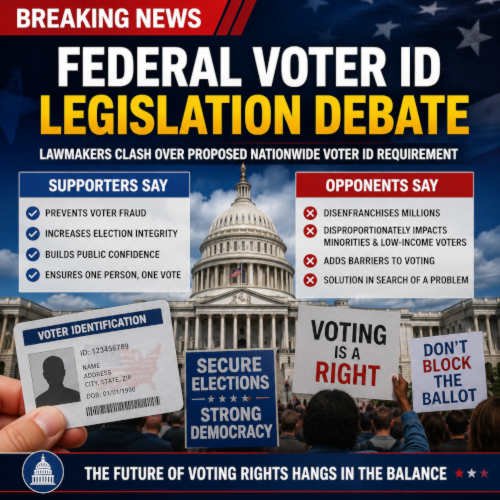
Federal Voter ID Legislation Debate: Senate Bows to Reality as Trump’s Voting Bill Collapses Before Recess

WASHINGTON — The U.S. Senate bowed to political reality at 4:36 a.m. on Saturday, August 8, 2026, officially adjourning for its summer recess and allowing bleary-eyed lawmakers to leave Capitol Hill without taking concrete steps toward passing the sweeping election restriction package demanded for months by President Donald J. Trump.
For months, Senate leadership and conservative advocates had insisted they would work continuously to enact structural changes to federal election administration. President Trump had repeatedly framed the legislation centred around strict national voter identification and documentary proof of citizenship standards—as an indispensable prerequisite for Republican victory in the upcoming 2026 midterm elections.
Instead, lawmakers departed Washington with virtually nothing to show for their marathon negotiation sessions, save for a performative pre-dawn procedural vote on a scaled-back version of the bill. That vote, conducted in the quiet hours of Saturday morning before an exhausted chamber, served primarily to confirm what senior Senate strategists had acknowledged privately for weeks: proponents lacked the necessary votes to overcome procedural hurdles, let alone secure passage.
Even the most vocal Senate champions of the proposed mandates eventually conceded the inescapable arithmetic. With the party’s narrow Senate majority hanging in the balance ahead of the November elections, lawmakers across the ideological spectrum grew eager to abandon what had clearly become a futile legislative effort, opting instead to return home to their respective states to campaign for re-election.
Pre-Dawn Recess Ends Months of High-Stakes Pressure
The pre-dawn adjournment marked a stark resolution to a high-pressure legislative campaign that had consumed Capitol Hill throughout the summer. For months, the White House had deployed an aggressive public and private arm-twisting operation, urging Senate leaders to push the voting measure across the finish line by any means necessary.
President Trump had tied the legislation—frequently referred to in broader conservative circles as the SAVE America Act—to core administration priorities, suggesting at various intervals that failing to pass the bill would compromise the integrity of the 2026 midterms. White House communications repeatedly emphasized that mandatory photo identification and physical documentation of citizenship at registration were common-sense measures needed to safeguard public confidence in election outcomes.
However, as the summer debate dragged on, procedural realities within the Senate proved insurmountable. Under standard parliamentary rules, overcoming a filibuster requires 60 votes—a threshold far out of reach given unified Democratic opposition and deep skepticism among a key subset of moderate and institutionalist Republicans.
Attempts to navigate around the 60-vote requirement continuously stalled. Proposals to adjust budget reconciliation rules to include non-budgetary voting mechanisms were repeatedly rejected by parliamentary experts, while calls to eliminate the legislative filibuster altogether were rejected by senior leaders who warned of the long-term institutional risks for future majorities.
Senate Leadership and the Mathematical Reality
Throughout the grueling legislative process, Senate Majority Leader John Thune maintained a firm position grounded in vote counts rather than political rhetoric. Thune repeatedly pointed out to colleagues and White House officials alike that the necessary votes simply did not exist within the chamber to push through the strict voter identification legislation.
Speaking to reporters on Capitol Hill prior to the adjournment, Thune noted that leadership had given advocates ample floor time to make their case and build consensus. Yet, despite weeks of floor speeches, committee markups, and late-night leadership huddles, the whip count remained unchanged.
“For better or worse, I’m the one who has to be the clear-eyed realist about what we can achieve here,” Thune observed during a news briefing leading up to the final vote, emphasizing that procedural posturing could not alter fundamental arithmetic.
The divergence between White House expectations and Senate realities created visible friction within the party. While conservative populists demanded that leadership keep the Senate in session indefinitely to force a prolonged “talking filibuster,” experienced floor managers recognized that such a strategy would only delay recess without changing a single Senator’s position.
By scheduling the early Saturday morning vote on a diluted compromise draft focused strictly on voter photo ID, leadership effectively allowed lawmakers to record their positions before bringing the debate to a decisive halt.
Analysis of the National Policy Standoff
The legislative impasse in Washington reflects a much larger, ongoing federal voter id legislation debate that has polarized national politics for years.
Proponents of federal standards argue that inconsistent state laws create vulnerabilities in federal elections. They contend that requiring government-issued photo identification and proof of legal status—such as a birth certificate or passport—is a reasonable step that aligns voting with everyday activities like air travel, banking, or entering federal facilities.
Conversely, opponents, including state election administrators, civil rights organizations, and Senate Democrats, contend that federal mandates impose unmanageable operational burdens on state election offices. Critics point out that millions of eligible American citizens—particularly young voters, elderly residents, rural citizens, and low-income individuals—lack immediate access to certified citizenship documents or updated photo IDs.
Furthermore, election officials across several states warned that implementing radical changes to registration rules just months before the 2026 midterms would cause severe administrative disruption, long lines at polling stations, and widespread confusion among poll workers.
| Policy Provision Under Review | Proponent Perspective | Opponent Perspective |
| Documentary Proof of Citizenship | Prevents non-citizen registration and boosts voter trust. | Disenfranchises voters lacking passports or official birth certificates. |
| Strict Mandatory Photo ID | Ensures personation fraud is eliminated nationwide. | Disproportionately affects low-income, student, and elderly populations. |
| Restrictions on Mail-In Balloting | Enhances chain-of-custody security for physical ballots. | Reduces voter turnout and accessibility for rural and elderly citizens. |
| Federal Overhaul of State Rules | Establishes uniform integrity standards across all 50 states. | Infringes on state constitutional authority over election administration. |
Midterm Campaigning Takes Precedence
As dawn approached on Saturday, the desire to escape the Capitol pressure cooker surpassed the inclination for further debate. With the 2026 midterm campaign cycle in full swing, incumbents from both parties were anxious to return to their home states to engage directly with voters.
For vulnerable Senate Republicans running in competitive states, the failure of the voting bill brings a mixture of relief and political challenge:
-
Relief from Controversial Votes: Lawmakers running in purple states avoid being forced to vote on restrictive provisions that could alienate independent voters in general election matchups.
-
Primary Election Scrutiny: However, failure to deliver on the president’s top priority leaves some incumbents exposed to primary challenges or criticism from grassroots conservative groups.
-
Democratic Campaign Messaging: Senate Democrats immediately capitalized on the bill’s collapse, framing the outcome as a victory for voter access and institutional norms against executive overreach.
With Congress now in recess until September, the legislative window for altering federal election rules prior to the November 2026 midterms has effectively closed. Election directors in all 50 states require months of lead time to print ballots, train election staff, and update registration databases—making any late-summer or early-autumn federal statutory changes operationally impossible to execute for the upcoming election cycle.
White House Strategy Shift and Executive Options
With legislative avenues blocked in the Senate, attention has shifted to potential executive or legal actions from the White House. President Trump has publicly signaled that he may seek to implement elements of his voting agenda through executive orders or legal challenges targeting state registration practices.
However, constitutional scholars and election law experts note that Article I, Section 4 of the U.S. Constitution grants primary authority over the “Times, Places and Manner” of holding elections to state legislatures, subject only to federal statutory standards enacted by Congress. Past executive efforts to unilaterally mandate voting qualifications have faced swift court injunctions.
As senators board flights back to their districts, the legislative standoff stands as a clear reminder of the limits of presidential pressure in a divided Senate. For now, the rules governing how Americans cast their ballots in the 2026 midterm elections will remain governed by existing state laws and federal statutes.
Frequently Asked Questions (FAQs)
Q1: Why did the Senate adjourn without passing the voting legislation?
A: Senate leaders lacked the 60 votes required to bypass a Democratic filibuster. With several Republican senators also expressing reservations or recognising the mathematical impossibility of passage, Majority Leader John Thune allowed a procedural vote before adjourning the chamber for summer recess.
Q2: What was the main focus of the proposed bill?
A: The proposed legislation sought to impose strict national voter identification standards and require documentary proof of U.S. citizenship (such as a passport or birth certificate) at the time of voter registration for federal elections.
Q3: Can these voting changes be implemented in time for the 2026 midterms?
A: No. State election officials and legal experts have repeatedly stated that changing voter registration and identification rules so close to the November 2026 election is operationally unfeasible due to ballot printing, software updates, and poll worker training requirements.
Q4: How does the federal voter ID legislation debate impact the upcoming elections?
A: The federal voter ID legislation debate serves as a focal point for campaign messaging. Conservatives emphasise election integrity to energise turnout, while progressives and voting rights advocates highlight voter access and state autonomy.
For further legislative analysis and background footage on congressional voting debates, if you have a YouTube account or don’t have one, you can watch on YouTube by searching for House Passes SAVE Act Coverage. This broadcast outlines the underlying congressional debate and procedural hurdles surrounding federal voter eligibility requirements leading up to the Senate standoff.