
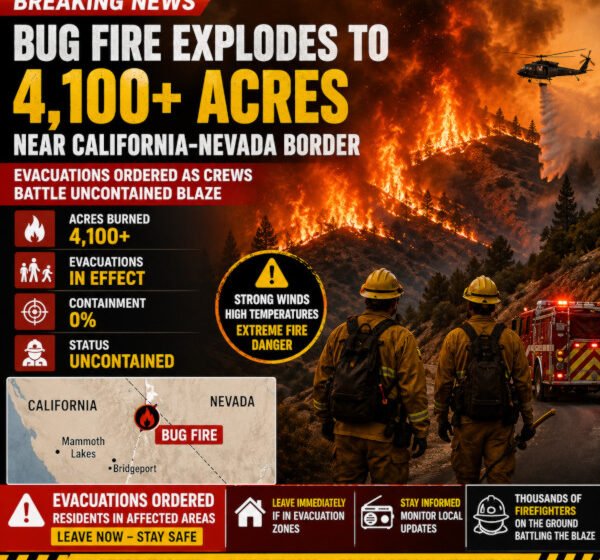
Bug Fire Explodes to 4,100+ Acres Near California-Nevada Border: Evacuations Ordered as Crews Battle Uncontained Blaze

Fueled by searing heat advisory temperatures and dry brush, the Bug Fire expanded rapidly across more than 4,180 acres overnight along the California-Nevada border, triggering immediate mandatory evacuations for communities northwest of Reno while shuting down U.S. Highway 395 in both directions near Bordertown.
Emergency response teams confirmed Sunday morning that despite the fire’s rapid growth across Lassen, Sierra, and Washoe counties, firefighters have managed to protect residential areas, with zero structures lost and no reported injuries so far.
Bug Fire Incident Overview
| Incident Parameter | Current Status & Details |
| Incident Name | Bug Fire |
| Date & Time Ignited | Saturday, August 8, 2026, at 4:08 PM PDT |
| Location | East of Route 395 near Bringman Rd (Lassen/Sierra Counties, CA & Washoe County, NV) |
| Estimated Size | 4,182 acres |
| Containment | 0% |
| Lead Jurisdictions | Bureau of Land Management (Carson City District), CAL FIRE, Washoe County Emergency Management |
| Primary Threats | Cold Springs, Canyon Hills, White Lake, local utility corridors |
| Road Closures | U.S. Highway 395 closed in both directions between Bordertown and Hallelujah Junction |
| Structures Destroyed / Injuries | 0 reported |
Rapid Ignition and Explosive Overnight Growth
The wildland fire ignited late Saturday afternoon, August 8, in a rural corridor of Lassen County, California, just east of U.S. Route 395 and south of Bringman Road. Initial dispatch reports at 4:12 PM PDT mapped the fire at approximately 50 acres. However, driven by persistent triple-digit heat and dry, gusty afternoon winds, the fire burned aggressively through dense sagebrush and dry grass.
Aerial reconnaissance flights monitored a dramatic surge in acreage throughout Saturday evening:
-
4:12 PM: First response units report 50 acres burning in light fuel.
-
6:08 PM: Fire behavior intensifies, swelling the footprint to 800 acres.
-
6:37 PM: Flight mapping data indicates rapid expansion to 2,467 acres.
-
7:11 PM: Intel aircraft confirm the perimeter surpassed 4,182 acres, pushing eastward directly toward populated subdivisions in Washoe County, Nevada.
By nightfall, thick plumes of dark smoke were visible across the Greater Reno-Sparks metropolitan area, filling the North Valleys with heavy haze and prompting regional air quality advisories.
Evacuation Orders, Warnings, and Emergency Shelters
As flames moved toward the Nevada state line, public safety officials in both California and Nevada issued coordinated evacuation notices to protect lives in the fire’s potential path.
Mandatory Evacuation Orders (“LEAVE NOW”)
Law enforcement officers executed immediate mandatory evacuation orders for residents in the following zones:
-
Washoe County, NV: Portions of the Cold Springs community, the Canyon Hills development, and residential areas bordering White Lake.
-
Lassen County, CA: Evacuation Zone LAS-671-B.
Evacuation Warnings (“BE PREPARED TO LEAVE”)
Precautionary warnings were issued for surrounding neighborhoods to ensure residents with pets, livestock, or mobility challenges could relocate early:
-
Washoe County, NV: Residential areas directly north of Cold Springs.
-
Lassen County, CA: Evacuation Zone LAS-671-A.
-
Sierra County, CA: Evacuation Zone SIE-E025.
Emergency Shelter Facilities
Washoe County Human Services, in coordination with the American Red Cross, established a public emergency shelter to assist displaced families and companion animals:
-
Primary Shelter Location: North Valleys Library, 1075 North Hills Blvd, Reno, NV 89506.
-
Large Animal & Livestock Relocation: Washoe County Regional Animal Services advised livestock owners to utilize the Reno-Sparks Livestock Events Center for horses and farm animals.
Firefighting Operations and Ground Challenges
More than two dozen fire crews, supported by heavy ground apparatus and air assets, worked through the night to establish control lines around vulnerable structures in Cold Springs. The Bureau of Land Management (BLM) Carson City District assumed primary operational jurisdiction, collaborating closely with CAL FIRE, the US Forest Service, and municipal departments from Reno and Washoe County.
Strike teams faced severe operational hurdles during the initial attack phase:
-
Extreme Fuel Dryness: Months of above-average summer heat reduced fine brush and cheatgrass moisture levels to near zero, allowing embers to spot hundreds of yards ahead of the main fire front.
-
Complex Topography: Steep, rocky hillsides along the California-Nevada line restricted direct bulldozer access, forcing hand crews to cut containment lines manually.
-
Air Support Visibility: Dense ground smoke hampered fixed-wing air tankers during late afternoon retardant drops, though helicopters equipped with night-vision capabilities continued water drops along critical ridges.
“Our absolute focus during the first 12 hours has been point protection for homes in Cold Springs and securing the Highway 395 transportation corridor,” stated incident communications officers on Sunday morning. “Crews worked tirelessly overnight under hazardous conditions to hold the fire at key geographical barriers.”
Transportation Delays and Regional Infrastructure Impacts
The fire’s rapid march toward the state line forced the Nevada Department of Transportation (NDOT) and the California Department of Transportation (Caltrans) to institute emergency highway closures:
-
U.S. Highway 395: Closed in both directions near Bordertown, severing a primary commuter and freight artery connecting Northern Nevada with Northeastern California. Motorists traveling between Reno and Susanville are advised to detour via Interstate 80 and California State Route 70.
-
Power Grid Monitoring: NV Energy reported monitoring high-voltage transmission lines in the vicinity of the burn perimeter. While a temporary outage impacted nearly 3,000 customers in southeast Reno on Saturday, utility officials restored power overnight and confirmed main supply lines to Cold Springs remain operational.
Weather Forecast: Heat Advisory Exacerbates Fire Risk
Firefighting operations continue under challenging weather conditions across the Eastern Sierra and Great Basin regions. The National Weather Service (NWS) in Reno maintained a Heat Advisory in effect through Monday morning, warning of widespread moderate-to-major heat risks.
NWS Weather Outlook for Bug Fire Incident Zone:
├── Daytime Highs: 97°F to 102°F
├── Overnight Lows: 55°F to 70°F
├── Relative Humidity: Single digits to low teens (8% - 14%)
└── Wind Profile: Southwest afternoon gusts 20 - 25 mph
The combination of extreme heat and afternoon wind gusts poses a constant threat of re-ignition along uncontained flanks, increasing the likelihood of sudden fire runs during peak afternoon heating hours.
Essential Safety Protocols for Area Residents
Emergency management agencies urge residents throughout Washoe, Lassen, and Sierra counties to remain vigilant and strictly observe all official directives.
Pre-Evacuation Checklist for Warning Zones
-
Prepare a Go-Bag: Gather essential prescription medications, legal documents, cash, identification, mobile chargers, and three days of water and non-perishable food.
-
Secure Home Exteriors: Move flammable patio furniture, wooden toys, and firewood piles away from exterior walls. Close all windows, doors, and fireplace dampers.
-
Vehicle Preparation: Park vehicles facing outward in driveways with keys in the ignition and garage doors set to manual operation in case of power failure.
-
Pet Relocation: Keep domestic pets indoors and restrained so they can be loaded into vehicles instantly if an evacuation order is triggered.
Looking Ahead
Fire officials plan to deploy additional hand crews, heavy dozers, and specialized strike teams throughout Sunday as regional air assets resume retardant and water drops. A formal Incident Management Team (IMT) is expected to assume command of the Bug Fire to coordinate multi-state resources, establish firm containment lines, and evaluate when it is safe for evacuated Cold Springs residents to return to their homes.