
Jeff Bezos Invests in $2.6 Billion AI Startup Working With Nvidia and Meta

CAMBRIDGE, UK: Amazon founder Jeff Bezos has further deepened his strategic presence in the artificial intelligence hardware ecosystem. Through his venture firm Bezos Expeditions, the billionaire entrepreneur joined a massive $450 million Series B funding round for CuspAI, a Cambridge-based generative AI startup now valued at $2.6 billion.
The investment highlights an escalating race among venture capital firms, tech giants, and semiconductor leaders to eliminate critical hardware bottlenecks threatening the future of global AI infrastructure.
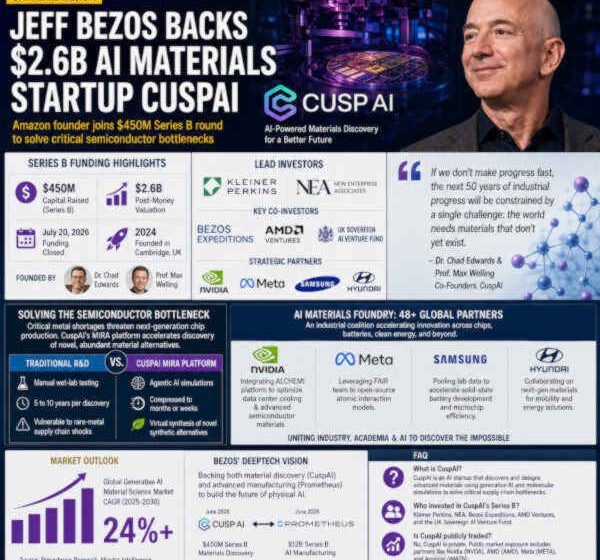
The $2.6 Billion Valuation Surge: Inside CuspAI’s Series B Round
The $450 million Series B round, closed on July 20, 2026, marks a meteoric rise for CuspAI. Founded in 2024 by Dr Chad Edwards and Prof. Max Welling, the company was valued at roughly $520 million in late 2025. Achieving a fivefold valuation jump to $2.6 billion in less than a year underscores the intense investor demand for generative AI material science solutions.
                 [ CUSP AI SERIES B FUNDING OVERVIEW ]

  +-----------------------+---------------------------------------------+
  | Metric / Parameter    | Value / Details                             |
  +-----------------------+---------------------------------------------+
  | Capital Raised        | $450 Million (Series B)                     |
  | Post-Money Valuation  | $2.6 Billion                                |
  | Lead Investors        | Kleiner Perkins, New Enterprise Assoc. (NEA)|
  | Key Co-Investors      | Bezos Expeditions, AMD Ventures,            |
  |                       | UK Sovereign AI Venture Fund                |
  | Core Platform         | MIRA (AI-driven materials search engine)    |
  | Key Partners          | Nvidia, Meta Platforms, Samsung, Hyundai    |
  +-----------------------+---------------------------------------------+
The funding round was co-led by premier Silicon Valley venture capital firms Kleiner Perkins and NEA (New Enterprise Associates). Alongside Bezos Expeditions, additional strategic backing came from AMD Ventures and the UK government’s Sovereign AI Venture Fund.
Solving the Semiconductor Bottleneck: How MIRA Works
While the tech industry has made tremendous leaps in GPU compute density, hardware manufacturers are encountering severe raw material shortages. Advanced semiconductor manufacturing relies heavily on scarce, costly elements such as gallium, tantalum, iridium, and ruthenium. The International Energy Agency (IEA) has warned that critical metal shortfalls could delay next-generation chip production before the end of the decade.
┌────────────────────────────────────────────────────────────────────────┐
│                   TRADITIONAL vs. AI MATERIAL DISCOVERY                │
├───────────────────────────────────┬────────────────────────────────────┤
│ 🧪 Traditional R&D                │ 🤖 CuspAI MIRA Platform            │
│ • Manual wet-lab testing          │ • Agentic AI simulations           │
│ • 5 to 10 years per discovery     │ • Compressed to months or weeks    │
│ • Vulnerable to rare-metal supply │ • Virtual synthesis of novel       │
│   chain shocks                     │   synthetic alternatives           │
└───────────────────────────────────┴────────────────────────────────────┘
CuspAI addresses this friction point with its proprietary platform, MIRA (described as a “search engine for advanced materials”). Using agentic AI models and molecular-level simulations, MIRA allows researchers to virtually design, evaluate, and verify novel chemical compounds tailored for specific industrial requirements.
Instead of spending years in physical wet labs synthesising candidates one by one, chipmakers can use MIRA to discover synthetic, abundant alternatives in weeks.
The AI Materials Foundry: Nvidia, Meta, and 45+ Partners Join Forces
In tandem with its funding round, CuspAI announced the launch of the AI Materials Foundry, an industrial coalition consisting of more than 48 global technology, automotive, and research organisations.
Key partners participating in the alliance include:
-
NVIDIA Corporation: Integrating its ALCHEMI atomic-simulation platform to optimise data centre cooling and advanced semiconductor materials.
-
Meta Platforms: Leveraging its FAIR (Fundamental AI Research) team to open-source atomic interaction models.
-
Samsung Electronics & Hyundai Motor Group: Pooling lab data to accelerate solid-state battery development and microchip efficiency.
“If we don’t make progress fast, the next 50 years of industrial progress will be constrained by a single challenge: the world needs materials that don’t yet exist,” noted CuspAI co-founders Dr. Chad Edwards and Prof. Max Welling. “Combining frontier agentic AI with deep domain expertise is the only way to overcome known material limits.”
Market Outlook: High-Growth Intersection of Generative AI and DeepTech
Industry analysts from Precedence Research and Mordor Intelligence project that the global generative AI material science market will expand at a compound annual growth rate (CAGR) exceeding 24% through 2030.
Jeff Bezos’s investment in CuspAI complements his broader DeepTech venture portfolio. In June 2026, Bezos Expeditions participated in a $12 billion Series B round for Prometheus, an AI venture focused on early-stage manufacturing and physical prototyping. By backing both material-level discovery (CuspAI) and advanced automated fabrication (Prometheus), Bezos is positioning his capital at the centre of next-generation physical AI manufacturing.
Frequently Asked Questions (FAQs)
What is CuspAI, and what problem does it solve?
CuspAI is a Cambridge, UK-based artificial intelligence startup that utilises generative AI and molecular simulation software to discover and design advanced materials. It solves critical supply chain bottlenecks in semiconductor manufacturing, energy storage, and clean tech by finding alternative, synthetic materials to replace scarce elements like gallium and iridium.
Who are the main investors in CuspAI’s Series B round?
CuspAI’s $450 million Series B round was led by Kleiner Perkins and NEA. Major participants included Jeff Bezos’s venture fund (Bezos Expeditions), AMD Ventures, and the UK government’s Sovereign AI Venture Fund.
Is CuspAI publicly traded on the stock market?
No, CuspAI is currently a privately held company. Investors looking for public market exposure to the AI material science ecosystem often look at participating developmental partners like Nvidia (NASDAQ: NVDA), Advanced Micro Devices (NASDAQ: AMD), Meta Platforms (NASDAQ: META), and Amazon (NASDAQ: AMZN).