


Pillsbury roll recall news: Finding a crunchy texture in a freshly baked dinner roll is usually a sign of a perfect crust. However, discovering that the crunch comes from literal shards of glass is a complete nightmare.
Food giant General Mills recently faced this situation, initiating a massive voluntary recall of nearly 736,000 Pillsbury frozen bread rolls. The U.S. Food and Drug Administration (FDA) issued an official notice warning commercial kitchens and food service operators that these popular frozen dough products might contain “potential foreign material”—specifically, glass.
For commercial kitchens, restaurants, and catering services that rely on the iconic Pillsbury Doughboy to keep labor costs down, this announcement is a significant operational disruption.
Let’s break down the details of this recall, examine the exact products affected, and look at what businesses need to do right now to ensure customer safety and protect their operations.
The Breakdown: What Exactly Is Being Recalled?
This is not a case of a few misplaced boxes. The scope of the General Mills Pillsbury roll recall is extensive, covering exactly 735,840 individual pieces of pre-portioned frozen dough.
According to official recall notices archived by the U.S. Food and Drug Administration (FDA), the distribution strategy targeted commercial food service operations rather than the frozen aisles of local supermarkets. If you are a consumer with a tube of retail Pillsbury crescent rolls in your home refrigerator, you can rest easy—your Saturday morning breakfast routine is safe.
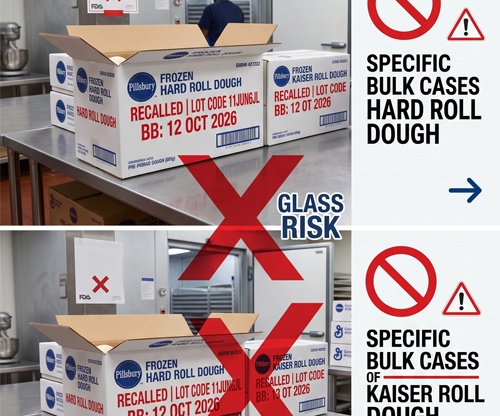
The hazard rests entirely within two specific bulk-packaged products designed for commercial kitchens:
1. Pillsbury Bread Rolls Hard Roll Dough
- Total Affected Units: 554,400 individual rolls
- Case Count: 3,080 commercial cases (packaged with 180 units per case)
- Unit Weight: 2.25 ounces per roll
- FDA Recall Tracking Number: H-1154-2026
- Key Identification Markers: “Better if Used By” dates of October 12, 2026 (associated with Lot Code 11JUN6JL) and October 13, 2026 (associated with Lot Code 12JUN6JL).
2. Pillsbury Bread Rolls Kaiser Roll Dough
- Total Affected Units: 181,440 individual rolls
- Case Count: 1,260 commercial cases (packaged with 144 units per case)
- Unit Weight: 2.5 ounces per roll
- FDA Recall Tracking Number: H-1155-2026
- Key Identification Markers: “Better if Used By” date of October 13, 2026 (associated with Lot Code 12JUN6JL).
Commercial operators should immediately check their freezer inventory against these exact parameters to prevent accidental preparation.
Mapping the Recall: Where Did the Dough Go?
Food supply chains in the United States are incredibly complex, moving products from centralized manufacturing hubs to regional distribution points within hours. General Mills initiated the logistics for this voluntary recall on June 19. However, tracking the final destination of these cases required a multi-state mapping effort by federal authorities.
The FDA public alert lists 19 states where the contaminated frozen dough cases were officially distributed:
- Southern Region: Arkansas, Florida, Georgia, Louisiana, South Carolina, and Tennessee.
- Northeast & Mid-Atlantic: Maine, New York, Pennsylvania, and Virginia.
- Midwest: Indiana, Missouri, and Ohio.
- Southwest & West: New Mexico, Oklahoma, Texas, California, Washington, and Wyoming.
Because these bulk products go through major food service distributors (like Sysco or US Foods) before reaching individual restaurant kitchens, the physical footprint spans across corporate cafeterias, hotel banquet halls, and local diners throughout these regions.
Anatomy of an FDA Class II Designation
When a major food brand announces a contamination risk, the FDA evaluates the hazard level to assign a formal recall classification. In this instance, federal authorities designated the General Mills Pillsbury roll recall as a Class II recall.
Understanding what this regulatory term actually means helps put the risk into perspective:
FDA Classification Standard: The FDA defines a Class II recall as a situation in which use of, or exposure to, a violative product may cause temporary or medically reversible adverse health consequences, or where the probability of serious adverse health consequences is remote.
While a Class II designation means the immediate threat of critical or fatal injury is considered statistically low, the structural physical risk of swallowing glass fragments is still highly dangerous.
Ingesting sharp foreign matter can cause lacerations in the mouth, throat, or upper gastrointestinal tract. Because these dough products are shipped raw and frozen, the manufacturing error occurred early in the blending phase, meaning fragments could be baked directly inside the dense crumb of the roll, hidden from view.
The Supply Chain Problem: How Glass Gets Into Dough
For many, the central mystery of a food safety alert like this is simple: How does glass even get into an industrial dough mixer? Modern industrial food facilities are mostly stainless steel, automated assembly lines, and high-strength plastics.
While General Mills has not publicly detailed the mechanical failure behind this incident, industry standards show that foreign object contamination typically stems from a few specific operational vulnerabilities:
- Component Failures: Automated overhead lighting fixtures, inspection protective shields, or glass faces on monitoring equipment can shatter due to physical impacts or extreme thermal shifts.
- Raw Material Verification: Large-scale commercial baking requires massive bulk shipments of foundational ingredients like flour, sugar, and yeast. If a supplier experiences a primary structural failure at their own processing mill, raw physical contaminants can slip through initial staging hoppers undetected.
- Sifting Equipment Gaps: While industrial operations route dry goods through high-performance vibrating sifters and inline magnets, non-ferrous materials like glass fragments or heavy plastics require advanced optical sorting tech or x-ray inspection systems to catch them.
When a failure occurs, protocol dictates an immediate shutdown of the affected production line, a full physical isolation of the inventory batch, and a thorough mechanical audit to protect consumer health.
Operational Action Plan for Food Service Operators
If you manage a restaurant, run a corporate cafeteria, or supervise a university dining facility in one of the 19 affected states, you cannot afford a passive approach to inventory management.
Protecting your guests and shielding your business from liability requires a deliberate, documented action plan:
- Conduct a Complete Freezer Audit: Immediate Priority.
Examine your deep-freeze storage space thoroughly. Do not rely solely on digital inventory sheets; physically inspect every bulk case of Pillsbury Hard Rolls or Kaiser Rolls. Look for the specific lot codes (11JUN6JL or 12JUN6JL) and October 2026 expiration dates stamped on the outer cardboard packaging. - Quarantine Suspect Product Instantly: Prevent Accidental Use.
If you locate an affected case, move it away from your active prep area immediately. Wrap the box in bright tape and mark it with a clear, highly visible note reading: “DO NOT BAKE – RECALLED PRODUCT.” This ensures a line cook won’t accidentally pull it during a busy weekend rush. - Document and Log the Inventory Data: Liability Protection.
Take clear photos of the case labels, showing the visible UPC code, lot stamp, and expiration dates. Log the exact number of unused boxes left in your possession. This clear documentation is essential for securing financial credits from your commercial distributor. - Coordinate with Your Vendor for Safe Disposal: Final Resolution.
Contact the customer support line of your primary broadline food distributor or reach out to General Mills commercial care directly. Follow their official instructions to arrange for proper product disposal or managed return pickup, and secure your inventory credit.
The Broader Context: A Challenging Era for Food Manufacturing
This Pillsbury recall is not an isolated event; it reflects a broader, ongoing challenge across the modern food processing industry. Over the past few years, several high-profile manufacturers have had to recall major product lines due to physical contamination issues.
For instance, Ajinomoto Frozen Foods had to pull millions of pounds of frozen fried rice and ramen dishes from store shelves due to similar concerns over glass fragments. Not long after, retail giant Aldi had to issue an urgent recall across several states for its popular vanilla crème brûlée desserts over structural defects in the glass packaging jars.
These recurring issues highlight the intense pressure on modern supply chains. High production volumes, labor constraints, and complex ingredient sourcing mean that even small, brief equipment failures can quickly turn into multi-state recall logistics.
For major brands like General Mills, the financial cost of pulling 736,000 rolls is only part of the problem. The real challenge is protecting the long-term reputation of brands that commercial kitchens trust every day for safety and consistency.
Final Takeaway for Food Service Teams
In the food service industry, trust is the ultimate currency. While pre-portioned dough products offer incredible convenience and labor efficiency, keeping a close eye on food safety protocols remains your best defense against unexpected operational risks.
If your kitchen handles commercial Pillsbury dough, take a few minutes today to check your freezers, verify your lot numbers, and make sure your inventory is completely clear. Staying proactive ensures your kitchen continues to run smoothly, safely, and without any unwanted surprises in the bread basket.