

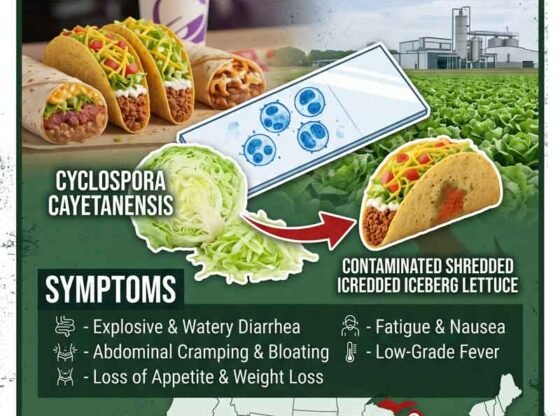

US Taylor Farms news: Fresh produce safety has officially re-entered the spotlight, and not for a new health trend. Federal health investigators announced that a massive, multi-state parasitic outbreak has been traced directly to shredded iceberg lettuce supplied by agricultural industry giant Taylor Farms.
The contaminated greens made their way into food prep lines at Taco Bell locations across several states, triggering thousands of documented illnesses.
As the Centres for Disease Control and Prevention (CDC) and the Food and Drug Administration (FDA) ramp up their traceback efforts, the fast-food chain is scrambling to secure its regional supply chains. The incident highlights the high-stakes logistical vulnerabilities that exist within modern, centralised mass agriculture.
The Scale of the Spreading Crisis
The raw data surrounding this public health event outlines a rapidly moving situation. According to official reports from regional health departments and federal tracking databases, confirmed and highly suspected cases have surged dramatically.
The epicentre of the crisis sits firmly within the Midwest, where local health networks are feeling the strain. In Michigan alone, the Department of Health and Human Services (MDHHS) has reported more than 4,301 cases, with over 101 hospitalisations documented so far.
The outbreak footprint has officially crossed state boundaries, leaving a distinct trail of illness through at least five key states:
- Michigan: The hardest-hit state, dealing with dense geographic clusters of infection.
- Ohio: Multiple localised food safety investigations underway.
- Indiana: Tracking active infections tied back to regional transit corridors.
- Kentucky: Health clinics reporting an unseasonal spike in digestive complaints.
- West Virginia: The southeastern limit of the primary confirmed distribution zone.
While consumer focus centers heavily on Taco Bell locations in these five states, the CDC warns that the underlying distribution of the tainted supplier batch may ripple further out. Health agencies across 34 states are currently tracking related symptoms to ensure the containment strategy remains effective.
What is Cyclospora and why is it in the news?
The microscopic culprit behind this widespread agricultural panic is Cyclospora cayetanensis, a protozoan parasite that causes a severe intestinal illness known as cyclosporiasis.
Unlike typical bacterial food poisoning caused by E. coli or Salmonella—which frequently stems from improper meat handling or undercooking—Cyclospora is uniquely tied to fresh produce. It is frequently introduced via agricultural irrigation water or field runoff contaminated with human faecal matter.
Once ingested, the parasite anchors itself to the cellular walls of the small intestine. This results in a suite of gastrointestinal symptoms that are difficult to ignore:
Primary Symptoms of Cyclosporiasis:
- Prolonged, explosive, and watery diarrhea
- Severe abdominal cramping, intense bloating, and increased gas
- Significant loss of appetite and unexpected, rapid weight loss
- Chronic fatigue, persistent nausea, and a low-grade fever
Compounding the problem for public health investigators is the parasite’s extended incubation timeline. Symptoms typically take anywhere from two days to two weeks to surface after exposure. This delay creates a significant reporting lag. It means a consumer suffering today is actually paying the price for a taco they ordered weeks ago.
Taylor Farms Under Scrutiny How?
Federal investigators used targeted consumer data to isolate the common thread. Epidemiologists interviewing hundreds of infected individuals noticed an undeniable statistical trend: a vast majority reported eating at Taco Bell. When looking closer at the shared ingredients across different menu items, shredded iceberg lettuce consistently sat at the top of the list.
The trail led directly to the commercial processing network of Taylor Farms. Based in Salinas, California, Taylor Farms operates as one of the largest fresh-cut vegetable processors in North America. They supply millions of salad kits, greens, and pre-chopped vegetables to global restaurant groups and supermarket chains every week.
FDA traceback data indicates that the specific batch of contaminated lettuce originated from a farming facility in Mexico. The agency is now actively investigating whether this specific product reached other regional restaurant supply lines or retail grocery shelves.
Corporate Actions and Industry Affects
Taco Bell moved quickly to distance its brand from the spreading public relations nightmare. The chain announced a voluntary and complete removal of all potentially impacted lettuce from the affected regional territories.
| Action Step | Operational Timeline | Current Status |
|---|---|---|
| Voluntary Removal | Immediate upon FDA notification | Completed across 5 Midwest states |
| Supply Replacement | 24-Hour turnaround window | Alternative suppliers deployed regionally |
| National Purge | Indefinite suspension | Tainted supplier batch cut from nationwide system |
In a formal press statement, Taco Bell corporate communications asserted:
“The health and safety of our guests is our absolute top priority. Out of an abundance of caution, we have indefinitely removed the affected ingredient from our supply chain nationwide.”
The corporate swiftness makes sense. Food service brands have spent years cultivating modern digital images, and structural supply issues like a parasitic outbreak threaten to revive outdated jokes about fast-food digestion. Similar agricultural contamination events have hit major brands historically, such as past Cyclospora concerns at casual dining chains or regional E. coli concerns involving onion supplies at other national fast-food chains.
Meanwhile, representatives from the broader agricultural industry, including the International Fresh Produce Association, have urged caution against early panic. They point out that patient recall during interviews can be highly imperfect, noting that the complex lifecycle of Cyclospora makes tracking exact farm-level origins notoriously difficult.
USER Guidelines to stay aware
If you live in the Midwest or have recently travelled through the Indiana, Ohio, or Michigan corridors, public health agencies recommend monitoring your health closely. Because Cyclospora is a tough protozoan parasite, it easily resists standard household chemical washes and chlorine treatments.
For standard fresh produce prepared at home, the Michigan Department of Health and Human Services recommends washing all items under clean, briskly running water. While this physical rinsing helps remove surface dirt, cooking food to an internal temperature of at least 158°F is the only definitive way to completely eliminate the parasite. Since nobody wants to eat boiled or grilled iceberg lettuce on a taco, complete avoidance of flagged supply batches remains the best approach.
If you experience sudden, persistent gastrointestinal distress that mirrors the symptoms outlined by the CDC, do not wait for it to clear up naturally. Standard over-the-counter anti-diarrheal medications will not eliminate the parasite. Contact a primary healthcare provider immediately, ask specifically about Cyclospora testing, and report your exposure to local health authorities to help speed up ongoing contact tracing.