
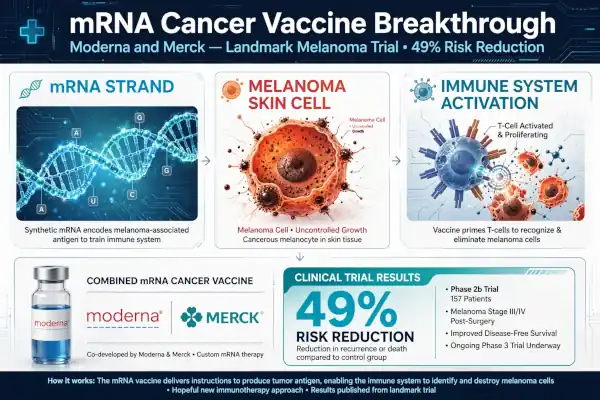
A new frontier in oncology is moving rapidly from laboratory promise to clinical reality. As cancer medicine accelerates toward precision, patient-tailored treatments that train the body’s own defences, biotechnology leaders Moderna and Merck have announced compelling late-stage trial results for an mRNA-driven cancer therapy. The data indicates that pairing a custom-built mRNA vaccine with a standard immunotherapy significantly improves survival and keeps advanced melanoma at bay far longer than current standard-of-care treatments alone.
The clinical update focuses on Intis mRNA-1910, Moderna’s investigational, individualised neoantigen therapy administered alongside Merck’s blockbuster checkpoint inhibitor, pembrolizumab (marketed globally as Keytruda). For patients diagnosed with high-risk melanoma who underwent surgical resection, the combination dramatically lowered the risk of cancer recurrence and distant metastasis compared to receiving Keytruda by itself.
A Tailored Blueprint Against Malignancy
Traditional cancer treatments like chemotherapy and radiation often act as blunt instruments, attacking rapidly dividing cells throughout the entire body while inflicting severe collateral damage on healthy tissue. In contrast, the approach pioneered by Moderna and Merck relies on absolute biological personalisation.
Every tumour carries a unique set of genetic mutations known as neoantigens—molecular flags that distinguish malignant cells from healthy tissue. However, because cancer cells originate within the host, they frequently evade detection by the body’s surveillance systems.
Moderna’s intismeran acts as an intelligent decoder ring for the immune system. Once a surgeon removes a patient’s tumour, researchers sequence the tumor’s DNA alongside healthy tissue to identify the exact neoantigen mutations driving that individual’s malignancy. Bioinformatic algorithms then select the most immunogenic targets, and Moderna synthesises a custom mRNA strand encoding those specific genetic flags.
When injected, the mRNA instructs the patient’s cells to produce harmless copies of those neoantigen markers, effectively presenting a “most wanted” poster to cytotoxic T cells.
The Power of the Dual-Action Mechanism
While immunotherapy trains and multiplies the specialised T-cell army required to hunt down microscopic cancer cells left behind after surgery, Keytruda ensures those immune cells can actually strike.
Cancer cells survive in large part by weaponising natural biological brakes. They express proteins such as PD-L1 that bind to PD-1 receptors on T cells, effectively sending a “do not attack” signal that renders the immune system blind and paralysed.
-
Keytruda (Pembrolizumab): Blocks the PD-1 pathway, taking the brakes off the immune system and exposing hidden cancer cells.
-
Intismeran (mRNA Therapy): Serves as the steering wheel and accelerator, mobilising targeted immune soldiers trained on the exact mutational profile of the tumour.
Together, the dual therapy provides both the targeted direction and the uninhibited immune power required to locate and eliminate stray malignant cells before they establish new colonies throughout the body.
Key Clinical Trial Findings
The study evaluated 1,137 patients diagnosed with stage 2 through stage 4 melanoma who had already undergone surgical removal of their primary tumours. Participants were randomly assigned to receive either the combination of intismeran and Keytruda or single-agent Keytruda for approximately one year.
+-----------------------------------------------------------------------------+
|                         LATE-STAGE CLINICAL SUMMARY                         |
+-----------------------------------------------------------------------------+
| Target Population:  | Patients with resected Stage 2 to Stage 4 Melanoma    |
| Sample Size:        | 1,137 participants across global clinical centers     |
| Treatment Arm:      | Custom mRNA (intismeran) + Pembrolizumab (Keytruda)   |
| Control Arm:        | Pembrolizumab (Keytruda) monotherapy (Standard)       |
| Key Endpoints:      | Recurrence-Free Survival (RFS) & Distant Metastasis   |
+-----------------------------------------------------------------------------+
Patients receiving the combination therapy demonstrated:
-
Extended Recurrence-Free Survival: A statistically significant reduction in the rate of cancer returning in local or regional tissue.
-
Reduced Distant Metastasis: A notable decrease in tumour spread to distant vital organs such as the lungs, liver, and brain—the primary driver of melanoma-related mortality.
-
Consistent Tolerability: The safety profile remained manageable, with adverse events largely consistent with the known profiles of the individual agents.
Speed, Scalability, and the mRNA Advantage
One of the historical hurdles facing personalised cancer vaccines has been the turnaround time. In aggressive cancers like advanced melanoma, waiting months for a custom formulation can allow micrometastases to take root.
The mRNA platform circumvents the bottlenecks of traditional biologics. Because mRNA is synthesised through chemical and enzymatic processes rather than grown in cell cultures, Moderna can manufacture an individualised batch of intismeran in just a few weeks from a tumour biopsy. This rapid production cycle makes precision immunotherapy clinically viable for real-world oncology schedules.
What Lies Ahead
While Keytruda has been standard therapy for advanced melanoma since its initial approvals in 2014 and expanded adjuvant indications in 2019, intismeran remains an investigational therapy undergoing global regulatory evaluation.
The success of this combination in melanoma lays the operational and scientific groundwork for expanding mRNA therapies into other mutation-heavy solid tumours, including non-small cell lung cancer, bladder carcinoma, and renal cell cancer. As data continues to mature, this milestone marks a decisive shift in modern medicine: transforming oncology from reactive tumour suppression into proactive, immune-driven eradication.
