
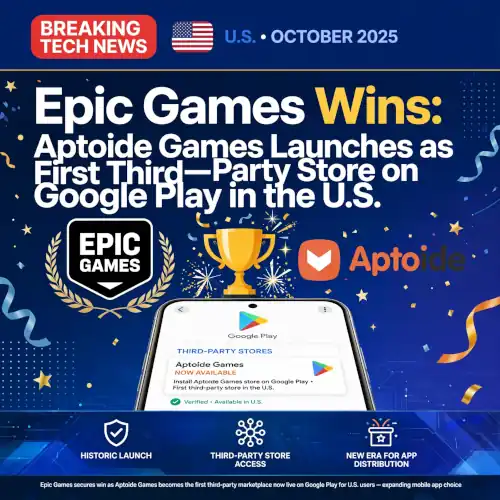
Epic Games Wins: Aptoide Games Launches as First Third-Party Store on Google Play in the U.S.

USA tech News: In a landmark shift for the mobile ecosystem, Lisbon-based app marketplace Aptoide Games has officially launched inside the Google Play Store in the United States. This marks the first time in over a decade that Android users can search for, discover, and install a direct competitor’s app store straight from Google’s official marketplace without bypass mechanisms or security warnings.
The historic rollout is a direct enforcement outcome of Epic Games’ landmark antitrust victory against Google. Following rulings issued by U.S. District Judge James Donato in California, Google was legally mandated to tear down its anti-competitive walls, allow third-party storefronts onto Google Play, and dismantle its forced billing exclusivity.
The Legal Catalyst: How Epic Games Broke Google’s App Store Monopoly
The arrival of Aptoide Games on Google Play represents the culmination of a multi-year legal war initiated by Epic Games, the creator of Fortnite.
[2020] Epic sues Google over Play Store monopoly & 30% cut
  │
[2023] Jury returns unanimous verdict: Google violated antitrust laws
  │
[2024] Judge Donato issues permanent injunction ordering Play Store access
  │
[2025-2026] Appeals fail; Court rejects weak settlement attempts
  │
[August 2026] Aptoide Games officially goes live on US Google Play
In late 2023, a federal jury found Google guilty on all 11 counts of maintaining an illegal monopoly through anti-competitive deals. The trial revealed secret Google initiatives—such as “Project Hug” (paying top game publishers hundreds of millions of dollars to keep their titles exclusive to the Play Store) and “Project Banyan” (incentivizing hardware manufacturers like Samsung to limit rival stores).
In response to the jury’s verdict, U.S. District Judge James Donato issued a comprehensive injunction. Although Google attempted to delay implementation through Ninth Circuit appeals and proposed settlements, the courts held firm, forcing Google to open its Play Store catalog in the U.S. to approved third-party marketplaces.
Enter Aptoide Games: A Decadelong Comeback
While industry observers expected Epic Games or Microsoft to be the first to launch a competing store within Google Play, Portuguese marketplace Aptoide took the inaugural spot.
Founded in 2009, Aptoide was distributed through Android’s early open channels before Google tightened Play Store rules to prohibit competing app stores. Over the intervening decade, Aptoide grew into a massive global platform boasting over 25 million monthly active users, though reaching U.S. Android users required complex APK downloads and security warning overrides.
“More than ten years ago, Android users lost the ability to discover alternative app stores through Google Play. Today, that changes. Users gain more choice, developers gain additional distribution opportunities, and Android becomes a more open and competitive ecosystem.”— Paulo Trezentos, CEO and Co-Founder of Aptoide
Aptoide Chief Operating Officer Álvaro Pinto echoed the sentiment, emphasizing that “developers should have multiple ways to reach users, and users should have genuine freedom to choose where they discover applications.”
How Google Play’s Third-Party Store Integration Works
Under the court-ordered guidelines, Google created the Play Catalog Access program. This framework allows vetted third-party app stores to be hosted on Google Play while setting technical and financial guardrails.
Key Rules and Requirements for Alternative Stores:
-
One-Click Installation: Users search for “Aptoide Games” on Google Play, hit install, and receive a fully functional alternative storefront on their app grid.
-
No Mandatory Google Billing: Third-party stores are not forced to link to Google Play’s proprietary billing system, allowing storefront operators and game developers to keep higher revenue margins.
-
Upfront and Recurring Fees: Google charges store operators an upfront registration fee of $15,000 plus an annual fee of $5,000 to cover security screening and background checks.
-
Independent Payment Processing: Alternative stores can implement their own payment gateways, loyalty bonuses, and reward mechanisms directly within their apps.
Sideloading vs. Direct Google Play Store Integration
For years, Google defended its app distribution policies by arguing that Android was inherently “open” because users could sideload APK files. However, sideloading required navigating system security menus, bypassing scary OS warning dialogs, and manually updating files.
The table below contrasts the historic sideloading experience with the new court-mandated Google Play integration:
| Feature / Metric | Traditional APK Sideloading | Direct Google Play Store Listing |
| Discovery Channel | Third-party web browser / external link | Direct search within the Google Play Store |
| Installation Steps | 5 to 7 manual steps (settings, permissions, prompts) | Single tap on “Install” |
| Security Friction | OS warnings (“Unknown Sources”, “Harmful File”) | Standard Google Play security vetting |
| Automatic Updates | Manual file replacement or custom updater background permission | Native background app updates |
| User Drop-Off Rate | High (50%+ abandon rate due to security prompts) | Standard app installation drop-off rate |
| Payment Options | Developer/Store-defined payment gateways | Store-defined gateways (No mandatory Google 30% cut) |
What This Means for Gamers, Developers, and Tech Giants
The arrival of Aptoide Games is the first domino in what is expected to be a total restructuring of the $100+ billion mobile app economy.
┌─────────────────────────────────────────────────────────────────┐
│                  REVOLUTION IN MOBILE DISTRIBUTION               │
└─────────────────────────────────────────────────────────────────┘
         │                                       │
         ▼                                       ▼
  FOR DEVELOPERS                          FOR USERS & GAMERS
  • Lower take-rates (below 30%)          • Frictionless store discovery
  • Direct payment processing options     • Exclusive in-game bonuses
  • Alternative promotional channels      • Lower price points for IAPs
1. For Mobile Game Developers
Mobile developers are no longer trapped by Google’s standard 15–30% take rate. On platforms like Aptoide Games, developers can negotiate custom revenue-sharing terms, offer alternative payment methods, and participate in localized marketing pushes that were previously impossible under Google’s restrictive policies.
2. For Gamers and Consumers
Android owners in the U.S. gain immediate access to over 295,000 games listed in Aptoide’s catalog. Because alternative stores do not pay Google’s heavy commission fees, developers can pass those savings along to gamers in the form of cheaper in-app purchases (IAPs), exclusive virtual items, and targeted loyalty reward programs.
3. The Wave of Upcoming Rival Stores
Aptoide Games is merely the trailblazer. With the legal precedent fully operational, industry giants are preparing to deploy their own native Android storefronts:
-
Epic Games Store Mobile: Epic is preparing to launch its popular desktop and mobile store directly within U.S. Google Play.
-
Microsoft Xbox Mobile Store: Microsoft is building a dedicated mobile gaming hub designed to feature Xbox first-party mobile titles like Call of Duty Mobile and Candy Crush alongside third-party games.
-
Amazon Appstore: Amazon can now seamlessly deliver its app ecosystem directly through Google Play rather than requiring pre-installation deals with OEMs.
Global Impact and the Future of Mobile Monopolies
While Judge James Donato’s current order directly impacts the U.S. market, the global implications are already unfolding.
In the European Union, the Digital Markets Act (DMA) has forced Apple and Google to allow alternative app stores and sideloading. However, the U.S. court ruling goes a step further by forcing Google to host those competing app stores inside its own primary marketplace.
As additional storefronts go live inside Google Play throughout 2026, pressure will build on regulators worldwide—and on Apple’s iOS ecosystem—to adopt similar open distribution standards. The era of the single, walled-garden app store on mobile devices has officially come to an end.