FAA Flight Disruptions at O’Hare Lead to Global Delay Record: How Travel Insurance, Passenger Rights, and Airline Refund Claims Come Into Play

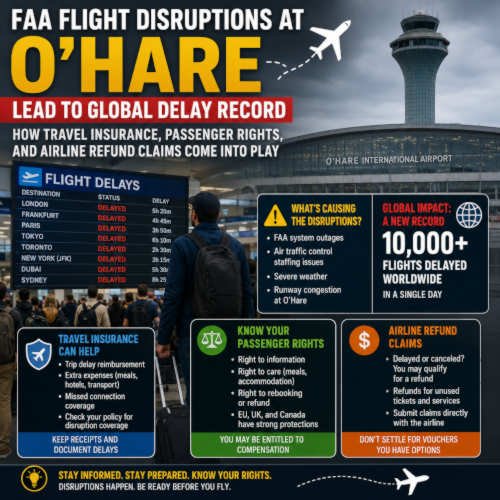
CHICAGO — Severe summer weather across northern Illinois triggered back-to-back Federal Aviation Administration (FAA) ground stops at Chicago O’Hare International Airport (ORD) and Midway Airport (MDW), marking O’Hare with more flight delays than any other airport on Earth. By the end of the day, United Airlines logged five times as many flight cancellations as American Airlines.
The severe operational standstill has left tens of thousands of passengers searching for flight delay compensation, airline refund claims, and guidance on travel delay insurance claims to cover unexpected expenses.
Understanding the Massive FAA Flight Delays at O’Hare
The air traffic crisis began just before noon Central Time when the FAA issued an immediate ground stop for O’Hare. Unlike a standard traffic management program, an FAA ground stop freezes all incoming aircraft at their origin airports, preventing departures and holding grounded planes on the tarmac nationwide.
The initial ground stop lasted over three hours, lifting around 3:00 p.m. CT. However, average ground delays remained near 100 minutes throughout the afternoon, compounded by a second wave of evening thunderstorms that extended travel disruptions into the overnight hours.
Why United Airlines Faced the Worst Cancellations
The massive disparity in cancellations between major carriers came down to schedule saturation and seat dominance.
| Airline | O’Hare Summer Seat Capacity | Relative Flight Cancellation Impact |
| United Airlines | 48.0% | 5x higher cancellation volume |
| American Airlines | 34.3% | Moderate disruption baseline |
United Airlines controls nearly half of O’Hare’s scheduled summer seats. When an unexpected three-hour FAA ground stop hits a tightly banked hub, connecting aircraft and flight crews quickly exceed legal duty time limits. To prevent long-term network collapse, United was forced to initiate widespread cancellations, stranding travelers and triggering thousands of airline ticket refund requests.
Passenger Rights: Are You Entitled to Flight Delay Compensation?
When massive airport disruptions occur, understanding passenger rights for delayed flights is critical for recovering costs incurred for food, hotels, and emergency transport:
-
Department of Transportation (DOT) Refund Rules: Under U.S. federal guidelines, if an airline cancels your flight for any reason and you choose not to travel, you are legally entitled to a full cash refund—not just travel vouchers or future flight credits.
-
Weather vs. Airline Operational Fault: Because the disruptions were initially sparked by severe weather and FAA traffic holds, airlines are generally exempt from paying out direct extraordinary flight delay compensation. However, if your delay turned into a cancellation due to crew scheduling conflicts or mechanical problems, you may be eligible for meal vouchers or hotel accommodations.
-
Travel Delay Insurance Coverage: Travelers who paid for their booking using a credit card offering comprehensive travel insurance cover or a independent trip delay insurance policy can claim reimbursement for emergency lodging, meals, ground transportation, and lost prepaid booking fees (often up to $500–$1,500 per ticket).
Actionable Steps for Stranded Travelers
-
Request a Cash Refund or Free Rebooking: If your flight was canceled, use the airline app to secure a free flight rebooking or opt out of travel to claim your mandatory cash refund.
-
Keep Itemized Receipts: If you incur out-of-pocket expenses for hotels, meals, or rideshares, retain every itemized receipt to submit with your travel insurance claim.
-
File an Official Complaint: If an airline refuses to process a valid refund for a canceled flight, passengers can file an official consumer complaint directly with the U.S. Department of Transportation.