
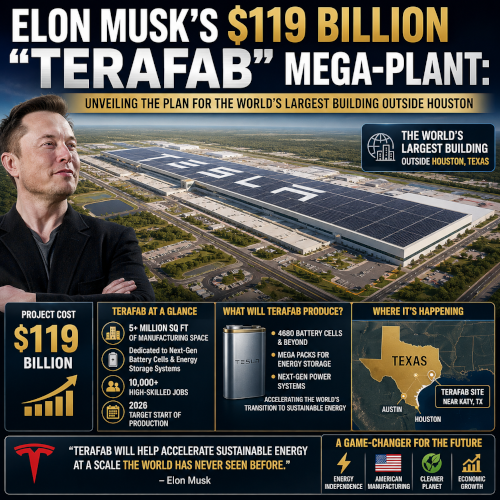
Elon Musk’s $119 Billion “Terafab” Mega-Plant: Unveiling the Plan for the World’s Largest Building Outside Houston

In one of the most audacious industrial ventures in modern history, Tesla and SpaceX have formally confirmed plans to construct Terafab a colossal 100-million-square-foot semiconductor megafactory located in Grimes County, Texas, roughly 75 miles northwest of Houston. Described by Elon Musk as “the largest and most valuable building on Earth by far,” the project carries an initial $16.8 billion first-phase commitment and an overall project investment ceiling that could reach $119 billion as multi-phase expansions roll out.
Designed to solve a severe global bottleneck in artificial intelligence hardware, Terafab is envisioned as a fully vertically integrated semiconductor campus that houses every stage of chipmaking—logic, memory, advanced packaging, and testing—under a single massive roof.
Visualizing the Scale: Larger Than the Pentagon and Apple Park Combined
The planned footprint for Terafab is difficult to overstate. At 100 million square feet of planned manufacturing space, the campus exceeds the floor area of major global landmarks combined:
-
Pentagon: 6.6 million sq. ft.
-
Giga Texas: 10 million sq. ft.
-
Mall of America: 5.6 million sq. ft.
-
Apple Park: 2.82 million sq. ft.
-
New Century Global Center (Chengdu, China): 18.9 million sq. ft.
Terafab’s proposed surface area would make it over five times larger than China’s New Century Global Center (currently the world’s largest building by floor space), effectively creating an industrial city dedicated entirely to silicon manufacturing in rural Texas.
The Financial Breakdown: Phase One Capital vs. The $119B Ceiling
While headlines highlight the $119 billion figure, corporate and county filings clarify the structured timeline and financial obligations:
| Project Metric | Financial / Operational Details |
| Phase 1 Commitment | $16.8 Billion committed jointly by Tesla and SpaceX |
| Phase 1 County Estimate | ~$55 Billion initial phase cost cited in Grimes County filings |
| Total Expansion Ceiling | $119 Billion total investment potential across all planned phases |
| Binding Local Minimum | At least $5 Billion invested by 2030; 1,800 full-time jobs by 2035 |
| Partner Involvement | Intel (INTC) joined the project, leveraging its 14A process technology |
| State Incentive Support | $30 Million grant from the Texas Enterprise Fund |
================================================================================
                     TERAFAB FINANCIAL & INVESTMENT MAP
================================================================================
 [$5 Billion]   ───► Legally Binding Minimum Local Floor (by 2030)
 [$16.8 Billion] ───► Firmly Committed Capital for Phase 1 Construction
 [$55 Billion]  ───► Estimated Full Phase 1 Buildout Cost (Grimes County Notices)
 [$119 Billion] ───► Maximum Multi-Phase Project Investment Ceiling
================================================================================
Why Build Terafab? Bridging the 1-Terawatt Compute Gap
The primary catalyst behind Terafab is the staggering compute demand generated by Musk’s sprawling technology portfolio. Tesla and SpaceX project that their combined internal demand for AI inference and processing chips will exceed 1 terawatt (TW) of compute per year—a figure far beyond the current capacity offered by third-party foundries.
Rather than relying entirely on contract chipmakers like TSMC or Samsung, Terafab aims to produce customized silicon tailored directly to Musk’s core initiatives:
-
Tesla Optimus Humanoid Robots: High-density AI inference processors optimized for real-time edge computing and physical spatial movement.
-
Cybercab Autonomous Vehicles: Custom silicon designed for Tesla’s next-generation autonomous driving compute stacks (AI5 and AI6 architectures).
-
SpaceX Space-Based Data Centers: Radiation-hardened, high-power processors meant to support orbital cloud computing and satellite data relay networks.
By integrating logic fabrication, memory production, lithography, packaging, and testing under one roof, the project aims to dramatically shorten production cycles and accelerate yield improvements.
Infrastructure, Environment, and Local Community Reaction
Constructing a megafactory of this magnitude in Grimes County—a rural area with a population of approximately 30,000—presents immediate infrastructure demands:
-
Power & Cooling: The campus is sited near the Gibbons Creek Reservoir, a man-made lake originally built in the 1980s for power plant cooling. SpaceX noted that water for cooling and processing will be drawn directly from the reservoir rather than local groundwater aquifers.
-
Job Creation: The facility promises at least 3,000 direct jobs across Grimes and neighboring Brazos County, with target hiring benchmarks aiming for 60% to 80% local resident participation.
-
Community Pushback: Nearly 900 local residents signed a petition requesting heightened oversight regarding publicly subsidized AI infrastructure. Key concerns center on electrical grid stability, construction traffic, water usage, and emergency services capacity.
Technical Challenges Facing the Project
While the vision is ambitious, semiconductor analysts point out that chip manufacturing is among the most capital-intensive and execution-sensitive industries on Earth. Unlike building vehicle assembly lines, advanced semiconductor fabs require extreme environmental controls, long machinery lead times from suppliers like ASML, and flawless yield management.
Partnering with Intel provides established process engineering expertise, but translating a 100-million-square-foot design into working silicon remains a massive hurdle. Prototype operations are slated to begin testing near Austin, with early production at the Grimes County site targeted for 2027 and mass production anticipated by 2028.
If realized, Terafab will not only redefine the skyline northwest of Houston but could fundamentally reshape the global artificial intelligence hardware supply chain.