K-Shaped Economy Trend Shift: Treasury Secretary Scott Bessent Declares Widening Gap Between Rich and Poor ‘Dead’

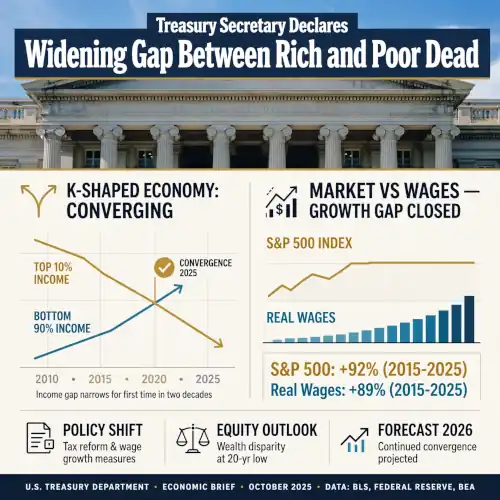
Economy updates: U.S. Treasury Secretary Scott Bessent declared that the “K-shaped” economy—a term describing the divergent financial paths of wealthy and lower-income Americans—is officially a thing of the past. Speaking on CNBC, Bessent argued that the economy is transitioning into a “C-shape,” where bottom-quartile wage earners are catching up. However, independent economic data and leading analysts challenge the administration’s stance, pointing to persistent wealth disparities, elevated living costs, and stock market gains concentrated among high earners.
Administration View vs. Independent Economic Data
| Economic Indicator | Administration Claim (Scott Bessent) | Independent Economic Data |
| Economic Shape | Shifted from “K” to “C” shape as low earners catch up. | “K-shaped” wealth divide remains firmly intact. |
| Wage Growth Trends | Bottom 25% of workers achieved a ~2% real wage gain. | Atlanta Fed metrics show top 25% wage growth (3.9%) outpacing bottom 25% (3.6%). |
| Consumer Spending | Relief delivered via tip, overtime, and Social Security tax cuts. | Real outlays for top earners ($200k+) grew ~4%, while bottom 80% outlays stayed flat. |
| Wealth Drivers | Tax cuts under the One Big Beautiful Bill Act. | S&P 500 record highs and AI-driven stock gains primarily benefit affluent asset owners. |
What Is Fueling the Administration’s “C-Shape” Claim?
-
Bottom-Tier Wage Growth: Bessent cited Treasury figures indicating a 2% real wage increase among the lowest 25% of wage earners.
-
Legislative Tax Adjustments: The administration points to tax policy changes under the One Big Beautiful Bill Act, including exemptions on tips and overtime, reduced taxes on Social Security benefits, and auto loan interest deductibility.
-
Midterm Messaging: With midterm elections approaching, officials are actively framing the economic narrative around middle-class relief to counter public dissatisfaction over elevated gas prices and broader cost-of-living pressures.
Why Economists Argue the K-Shape Persists
Despite the Treasury Department’s optimistic messaging, economic researchers emphasize that structural inequality remains deeply embedded:
-
Divergent Consumer Outlays: Moody’s Analytics data shows that inflation-adjusted spending by households earning over $200,000 grew significantly, whereas spending among the bottom 80% remained unchanged after adjusting for inflation.
-
Asset Concentration: Record highs across equity markets continue to accumulate overwhelmingly to top-tier wealth holders, widening the total net-worth gap regardless of short-term wage nudges.
-
Essentials Inflation: Lower-income households remain disproportionately impacted by essential expenses—such as groceries, housing, utilities, and auto insurance—preventing meaningful accumulation of discretionary savings.
While some financial institutions note minor spending convergence when excluding volatile energy costs, the broader consensus among private economists is that the fundamental division between asset-owning households and cash-strapped workers continues to define the U.S. financial landscape.