
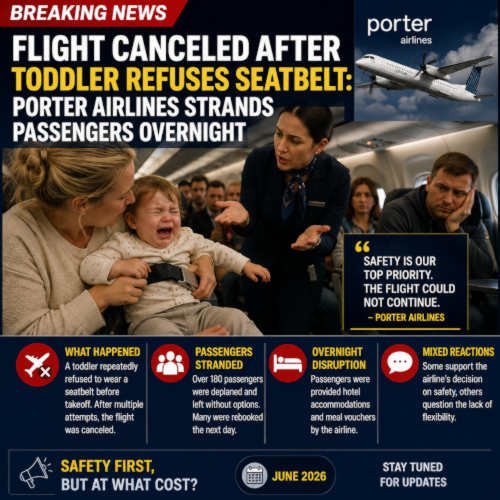
Flight Canceled After Toddler Refuses Seatbelt: Porter Airlines Strands Passengers Overnight

When air travel goes awry, passengers typically brace themselves for severe weather, mechanical failures, or air traffic control ground stops. However, passengers aboard a late-night flight out of British Columbia encountered an entirely unexpected obstacle to departure: a rebellious toddler refusing to put on a seatbelt.
What began as a routine late-night departure turned into an overnight nightmare for dozens of travellers when Porter Airlines Flight 444 was forced to cancel its flight entirely after an unrestrained child grounded the aircraft on the tarmac.
The Incident: How a Refusal Grounded Flight 444
The incident unfolded late in the evening at Victoria International Airport (YYJ) in British Columbia. Porter Airlines Flight 444 was scheduled to depart at 10:30 p.m. bound for Toronto Pearson International Airport (YYZ), an overnight route that relied on prompt departure to hit its arrival window.
As the aircraft pushed back from the gate and began taxiing toward the runway, flight attendants performed standard cabin safety checks. It was during this final walk-through that crew members spotted a young child standing up in their seat rather than sitting secured in their assigned position.
Flight attendants requested that the accompanying adult secure the child with the lap belt, as strictly required by federal aviation safety rules. However, the situation quickly stalled. Neither the child’s accompanying guardian nor the flight crew could convince or assist the toddler into sitting down and fastening the seatbelt.
With the aircraft already in motion on the taxiway, the captain was faced with an immediate decision under aviation safety codes.
Safety Regulations: Why Airlines Cannot Compromise
To stranded passengers, cancelling an entire commercial flight over a stubborn toddler might seem like an overreaction. However, from a regulatory and safety standpoint, the flight crew had virtually no legal alternative.
Federal Aviation Regulations on Passenger Restraints
Transport Canada and global aviation authorities such as the Federal Aviation Administration (FAA) mandate that all passengers aged two and older must be securely buckled into an approved seat during taxi, takeoff, and landing.
-
Taxiway Hazards: Unexpected braking, sharp turns, or collisions on the tarmac can easily throw an unbuckled passenger from their seat, posing a severe risk of injury—especially to young children.
-
Turbulence Risks: Initial climb-out represents one of the most volatile phases of flight. An unbuckled child could become airborne in the event of sudden wind shear or severe turbulence.
-
Cabin Safety Protocols: Flight crews are legally prohibited from initiating takeoff if any passenger is standing or unsecured in the cabin.
In an official statement provided to media outlets, Porter Airlines confirmed the chain of events:
The Cascade Effect: Overnight Stranded Travellers
Returning to the gate at Victoria International Airport after 10:30 p.m. created a logistical nightmare for both the airline and its passengers.
By the time the aircraft completed its return to the terminal and debarked the non-compliant family alongside the rest of the passengers, several operational constraints came into play:
-
Crew Duty Hour Limitations: Flight crews are subject to strict federal “duty time” limits to prevent fatigue. The delay incurred while attempting to resolve the situation pushed the crew past their legal operating window for the long journey to Toronto.
-
Late-Night Airport Curfews: Operating late-night departures often clashes with airport noise restrictions and reduced overnight staffing at destination terminals.
-
Lack of Alternative Flights: With the incident taking place on the final outbound flight of the night, no immediate replacement aircraft or crews were available to rescue the route.
As a result, Porter Airlines was forced to cancel Flight 444 outright, leaving a planeload of tired travelers stranded overnight in Victoria to seek hotel accommodations or rebook on morning flights.
The Debate: Parental Responsibility vs. Airline Policy
The unusual cancellation has reignited intense debate across social media and the travel industry regarding airline family policies, parental accountability, and passenger etiquette.
Public Backlash and Traveller Frustration
Travellers frequently express frustration over delays caused by unruly or non-compliant passengers. On public travel forums, commentary regarding the incident quickly divided into two primary perspectives:
-
Critique of Parental Prep: Frequent flyers argue that parents travelling with young children must be prepared to enforce safety rules, suggesting that allowing a child to stall an entire aircraft reflects a lack of parental authority.
-
Sympathy for Parents: Parents and child-behaviour specialists note that late-night flights (such as a 10:30 p.m. departure) are notorious for causing toddler meltdowns due to exhaustion, sensory overload, and disrupted sleep schedules.
Should Airlines Offer More Flexibility for Families?
Some aviation experts have questioned whether airlines should implement clearer protocols for handling distressed children prior to taxiing. While cabin crew members often try to de-escalate situations, aviation law leaves zero wiggle room once an aircraft leaves the gate; safety compliance must be absolute.
Tips for Flying With Toddlers: Preventing Seatbelt Meltdowns
For parents planning air travel with young children, experts recommend several proactive strategies to ensure compliance with mandatory airline safety rules:
-
Practice at Home: Practice sitting in a chair and buckling a pretend seatbelt days before the flight so the child becomes familiar with the sensation and rule.
-
Utilise Approved Child Restraints (CARES / Car Seats): Bringing an FAA/Transport Canada-approved car seat aboard can make a child feel like they are in a familiar car environment, making them far more likely to stay strapped in.
-
Manage Flight Timing: Avoid late-night “red-eye” or near-bedtime departures if your child is prone to overtired meltdowns.
-
Bring High-Value Distractions: Keep a brand-new toy, tablet, or favourite snack reserved exclusively for the moment the plane begins taxiing to keep the child distracted while the seatbelt sign is illuminated.
Looking Ahead
The cancellation of Porter Airlines Flight 444 serves as a stark reminder of the uncompromising nature of commercial aviation safety rules. While a stubborn toddler may seem like a minor cabin disruption, federal mandates dictate that safety must always take precedence over flight schedules—even when it leaves an entire aircraft stranded overnight.