
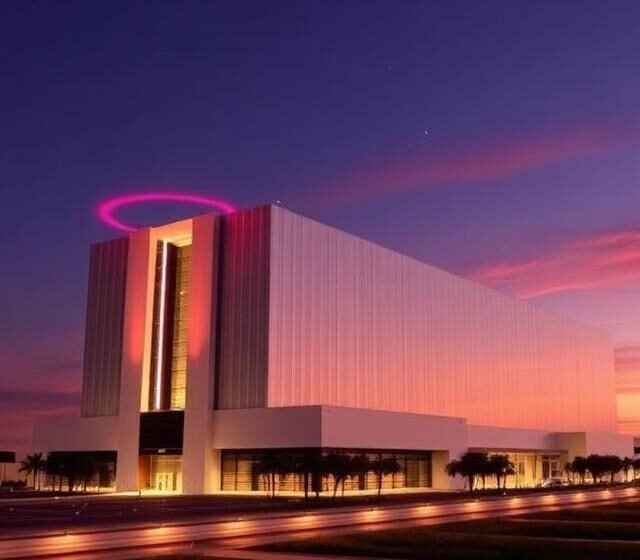
Elon Musk’s Largest Building Yet: SpaceX and Tesla Select Texas for World’s Biggest AI Chip Manufacturing Plant

GRIMES COUNTY, Texas — In what is being billed as the most ambitious industrial construction project in modern history, Elon Musk’s SpaceX and Tesla have officially selected Texas as the home for a colossal, multi-billion-dollar semiconductor manufacturing complex. Dubbed “Terafab Texas,” the proposed mega-facility is set to span more than 100 million square feet, securing its place as Elon Musk’s largest building and the single largest structure on Earth by floor area.
Located in rural Grimes County, just outside of Houston, the joint enterprise marks a monumental shift in semiconductor production. The facility will serve as a fully vertically integrated hub designed to design, manufacture, package, and test advanced logic and memory chips under one roof.
Taking to social media to celebrate the announcement, Musk expressed his visionary outlook for the mega-structure.
The massive venture represents an initial phase capital investment of $16.8 billion jointly backed by SpaceX and Tesla, with total long-term investments expected to reach up to $119 billion as future phases expand across the Lone Star State.
Inside Terafab Texas: A Megastructure Without Precedent
To put the sheer scale of Elon Musk’s largest building into perspective, a floor space exceeding 100 million square feet is equivalent to nearly 1,700 American football fields or roughly four times the size of the world’s current largest industrial buildings combined.
Historically, chip fabrication plants (fabs) have been fragmented across global supply chains. A single semiconductor wafer might be designed in the United States, fabricated in Taiwan or South Korea, shipped to Southeast Asia for advanced packaging and testing, and then returned to North America for integration into final hardware.
Terafab Texas breaks this mold entirely by consolidating every stage of advanced semiconductor manufacturing under a single roof:
-
Silicon Fabrication: Manufacturing cutting-edge sub-2-nanometer and 1.4-nanometer logic chips.
-
Memory Integration: Producing high-density, high-bandwidth memory (HBM) modules directly alongside compute cores.
-
Advanced Packaging & Testing: Stacking, bonding, and testing multi-chip modules instantly without shipping delicate wafers across continents.
By unifying these processes within a single physical facility, Terafab Texas aims to reduce supply chain latency from months to days, driving down costs and drastically accelerating product iteration cycles.
Why Musk Needs the World’s Largest Building
The decision for SpaceX and Tesla to build their own semiconductor plant—rather than relying solely on existing chip giants like TSMC, Samsung, or NVIDIA—stems from a critical bottleneck: global chip supply simply cannot keep up with Musk’s AI ambitions.
According to official releases from SpaceX and Tesla, the combined compute demand across Musk’s ecosystem is projected to exceed 1 terawatt (1 trillion watts) of processing power per year. Current and planned global semiconductor foundries are estimated to meet less than 5% of that demand.
In a statement posted by Tesla on X, the company explained:
“Both Tesla & SpaceX will require more chips than current & future global production can supply. This is why we are building the largest chip manufacturing facility ever, to produce over 1 terawatt of compute per year. The future is built in Texas.”
Powering the AI Ecosystem of Tomorrow
The chips coming out of Terafab Texas are tailored specifically for high-density AI inference and space-hardened computing. Key hardware targets include:
-
Tesla Optimus Humanoid Robots: Requiring ultra-compact, low-latency edge inference chips that allow autonomous robots to navigate real-world environments, perform complex physical tasks, and learn in real time.
-
Tesla Cybercabs: Powering fifth-generation (AI5) autonomous vehicle architecture capable of handling billions of miles of real-time camera processing for fully unsupervised self-driving networks.
-
SpaceX Orbital Data Centers: High-power, radiation-tolerant microprocessors designed to operate onboard next-generation satellite constellations, processing vast datasets directly in low-Earth orbit and deep space.
Economic Boom and Political Backing in Texas
The selection of Grimes County—located midway between Houston and College Station—is expected to transform the regional economy, turning rural Texas into a global epicenter for semiconductor innovation.
The initial phase alone is projected to create at least 3,000 direct high-paying jobs for software engineers, cleanroom technicians, and plant operators, alongside tens of thousands of indirect construction and local service jobs. Historically, 60% to 80% of hires at SpaceX and Tesla Texas operations have come directly from local communities.
Texas leadership has welcomed the historic investment with open arms. Governor Greg Abbott announced a $30 million performance grant from the Texas Enterprise Fund (TEF) to support the project, while qualifying Terafab under the state’s Jobs, Energy, Technology, and Innovation (JETI) program.
“The foundations for the most exciting future are being built right here in Texas,” Musk stated during the project launch. “The Terafab is bringing cutting-edge manufacturing back to America, creating thousands of high-paying jobs in the Lone Star State, and enabling us to produce AI chips at scale for use on Earth and in space.”
Addressing environmental concerns common with semiconductor plants, SpaceX and Tesla confirmed that industrial water needs will be drawn from the nearby Gibbons Creek Reservoir rather than local groundwater, supported by full on-site wastewater treatment and recycling systems.
Defending the Vision: An “American Success Story”
As Elon Musk’s footprint in Texas expands—joining the Tesla Gigafactory in Austin, SpaceX’s Starbase in Boca Chica, and the Starlink assembly hub in Bastrop—his growing influence and wealth have drawn national attention.
Appearing on FOX Business, U.S. Representative Kat Cammack (R-FL) defended Musk’s staggering infrastructure investments against political criticism, praising his willingness to re-shore critical manufacturing to domestic soil.
“Elon Musk represents a true American success story,” Rep. Cammack stated, criticizing proposals for wealth taxes targeting visionary entrepreneurs. “When you look at what SpaceX and Tesla are doing—bringing manufacturing back to the United States, creating thousands of high-wage jobs, and ensuring America leads in artificial intelligence and space exploration—this is exactly what free-market innovation looks like.”
The Road Ahead for Terafab Texas
Groundbreaking on early site preparations in Grimes County is already underway, building upon research and prototype fabrication trials established at Tesla’s Giga Texas campus in Austin.
With strategic partnerships involving industry leaders like Intel contributing sub-2nm process expertise, Terafab Texas aims to achieve small-batch chip runs as early as 2027, with full volume scaling anticipated shortly thereafter.
As construction commences on Elon Musk’s largest building, the project stands as more than just a massive factory—it represents a bold bet on American manufacturing dominance, vertically integrated AI hardware, and the infrastructure needed to support a multi-planetary future.