$11 Billion Student Loan Settlement: Court Orders Automatic Debt Relief for 170,000+ Defrauded Borrowers

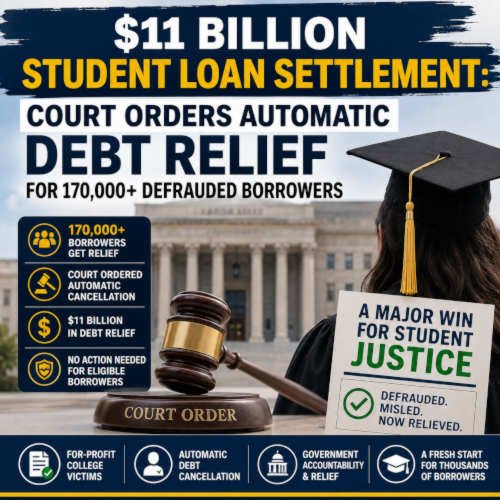
In a historic victory for American higher education consumers, federal judges have officially cleared the path for an $11 billion student loan settlement. The decision mandates full federal debt cancellation, payment refunds, and credit repair for more than 170,000 borrowers who were defrauded by predatory for-profit colleges and vocational institutions.
The landmark decision by the U.S. Court of Appeals for the Ninth Circuit rejected efforts by the U.S. Department of Education to delay processing fraud claims. This ruling expands the ongoing class-action litigation—historically known as Sweet v. Cardona (now Sweet v. McMahon)—pushing total federal debt discharge under the agreement to an unprecedented $23 billion for nearly 500,000 student loan borrowers across the nation.
Whether you are tracking student loan debt cancellation, searching for borrower defense relief, or evaluating options for federal loan refinancing and debt consolidation, this comprehensive report breaks down everything you need to know about this historical legal settlement.
The Ninth Circuit Ruling: How the $11 Billion Settlement Unfolded
The dispute reached a boiling point after the federal government sought an additional 18-month extension to evaluate pending claims filed by “post-class” applicants under the federal Borrower Defense to Repayment program.
A unanimous three-judge panel on the Ninth Circuit Court of Appeals firmly denied the extension request. The panel held that the government had failed to meet strict statutory and settlement deadlines, leaving tens of thousands of defrauded students in financial limbo for years while interest continued to accrue.
“Students who experienced fraud should not be required to pay back federal loans,” stated attorneys from the Project on Predatory Student Lending (PPSL), the legal advocacy group representing the student plaintiffs. “Because the Department repeatedly delayed these legal rights, the court’s action ensures full, automatic relief.”
Key Details of the $11 Billion Settlement Expansion:
-
Total New Debt Cancelled: $11 Billion
-
Impacted Borrowers in New Group: Over 170,000 post-class applicants
-
Cumulative Settlement Value: $23 Billion (making it the largest class-action settlement against the federal government in American history)
-
Total Class Members Benefiting: ~500,000 borrowers
What Does “Full Settlement Relief” Include?
For borrowers who qualify under this $11 billion student loan settlement, the financial relief goes beyond wiping out outstanding account balances. Under the court-approved agreement, Full Settlement Relief consists of three major components:
-
Complete Debt Discharge: 100% cancellation of all outstanding principal and accrued interest on federal loans associated with the fraudulent school.
-
Full Cash Refunds: A complete reimbursement of all payments previously made directly to the federal government toward those loans (including voluntary payments, wage garnishments, and tax refund offsets).
-
Credit Bureau Repair: Deletion of all credit tradelines associated with the discharged federal loans from major credit reporting bureaus (Experian, Equifax, TransUnion).
           +-------------------------------------------------------+
           |     FULL SETTLEMENT RELIEF BREAKDOWN                  |
           +-------------------------------------------------------+
           | 1. 100% Loan Cancellation (Principal + Interest)      |
           | 2. Full Cash Refund of Past Direct Payments           |
           | 3. Credit Bureau Deletion of Discharged Loan Records  |
           +-------------------------------------------------------+
Why the $11 Billion Student Loan Settlement Is a Game-Changer
The $11 billion student loan settlement represents a seismic shift in federal higher education accountability and consumer financial protection. For decades, predatory for-profit colleges utilized aggressive marketing campaigns, falsified job placement statistics, and inflated expected salary figures to trap low-income students into high-interest federal debt.
When deceived students attempted to seek relief through the Borrower Defense to Repayment federal program, their applications sat stalled in administrative backlogs for years without resolution.
This federal appellate court victory establishes a binding legal precedent: when administrative agencies fail to adjudicate fraud claims within statutory limits, affected consumers are entitled to swift, automatic financial relief.
Who Qualifies for the $11 Billion Relief?
Eligibility for relief under the expanded $11 billion student loan settlement depends on when you submitted your Borrower Defense application and which school you attended.
1. Main Settlement Class Members
Borrowers who submitted a Borrower Defense to Repayment application on or before June 22, 2022, and attended one of the dozens of approved institutions (often referred to as “Exhibit C Schools”). These individuals automatically receive complete loan cancellation, payment refunds, and credit repair.
2. Post-Class Applicants (The $11 Billion Expansion Group)
Borrowers who submitted their Borrower Defense applications between June 23, 2022, and November 15, 2022:
-
Exhibit C School Applicants: If the Department of Education failed to issue an individual decision on your claim by January 28, 2026, you are entitled to full automatic settlement relief.
-
Non-Exhibit C School Applicants: If the Department failed to issue a decision on your application by April 15, 2026, you are likewise entitled to full automatic relief under the latest court mandate.
Primary Schools Involved in Borrower Defense Litigation
While hundreds of institutions are affected, major schools tied to the litigation include:
-
ITT Technical Institute
-
Corinthian Colleges (Everest, WyoTech, Heald)
-
The Art Institutes
-
University of Phoenix
-
Career Education Corporation (Le Cordon Bleu, Sanford-Brown)
-
DeVry University
-
Minnesota School of Business / Globe University
What Affected Borrowers Must Do Now
If you are a member of the class or post-class group covered under the $11 billion student loan settlement, here are the critical steps you should take immediately:
-
Verify Your Contact Information: Log into your official StudentAid.gov account and ensure your current mailing address, phone number, and primary email address are up to date.
-
Check Your Loan Servicer Account: Contact your federal loan servicer (such as MOHELA, Nelnet, Aidvantage, or EdFinancial) to verify that your eligible loans are currently placed in administrative forbearance so no payments are due while your discharge is processed.
-
Monitor Official Notices: Check your email (including spam/junk folders) for official communications from the Department of Education or the Project on Predatory Student Lending regarding your Notice of Eligibility.
-
Track Balance Fluctuations: As loan servicers unwind your accounts, you may notice temporary balance fluctuations or zero-balance updates. According to legal counsel, temporary balance changes are normal during the unwinding phase.
Managing Other Debt: Loan Consolidation, Refinancing, & Legal Options
While the $11 billion student loan settlement brings immense relief to defrauded borrowers, millions of other Americans continue to manage high-interest private student loans, credit card balances, and non-eligible federal debt.
If you do not qualify for court-ordered loan discharge, several financial options remain:
1. Federal Direct Loan Consolidation
Combining multiple federal loans into a single Direct Consolidation Loan can simplify monthly payments and unlock access to income-driven repayment (IDR) plans or Public Service Loan Forgiveness (PSLF).
2. Private Student Loan Refinancing
Borrowers with high-interest private student loans or non-qualifying commercial debts may benefit from refinancing with a private lender. Refinancing at a lower fixed interest rate can potentially reduce monthly payments and save thousands of dollars over the loan term. (Note: Refinancing federal loans into private loans permanently waives federal protections, including Borrower Defense rights).
3. Consultation with Student Debt Relief Attorneys
If you attended a fraudulent or deceptive trade school but missed the settlement deadlines, consulting a qualified student loan attorney or consumer protection debt specialist can help you explore individual state-level lawsuits, unfair practice claims, or administrative discharge options.
Frequently Asked Questions (FAQs)
Q1: Is the $11 billion student loan settlement legit?
Yes. The $11 billion settlement expansion was officially upheld by the U.S. Court of Appeals for the Ninth Circuit. It is part of the broader $23 billion landmark Sweet v. McMahon class-action lawsuit.
Q2: Do I need to pay a fee to claim my loan discharge?
No. Federal student loan discharge under court settlements is completely free. Beware of third-party debt relief scams charging upfront fees for loan cancellation services.
Q3: How long will it take to receive my refund and loan cancellation?
The Department of Education and federal loan servicers are required to process full relief within one year from the date of your eligibility notice.
Q4: Will discharged loans affect my taxes?
Under current federal tax guidelines, debt discharged under Borrower Defense to Repayment or fraud settlements is generally exempt from federal income taxation.
Final Thoughts: A Historic Milestone for Consumer Protection
The court’s mandate enforcing the $11 billion student loan settlement stands as a landmark victory for consumer advocacy, higher education oversight, and justice for student loan borrowers. For over 170,000 defrauded students, years of financial stress and predatory debt burdens are finally coming to an end.
Stay tuned for further updates as loan servicers implement the court’s discharge orders over the coming months.