
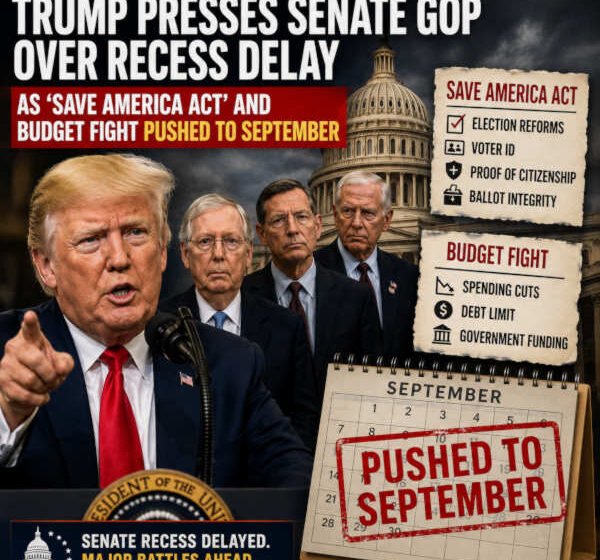
Trump Pressures Senate GOP over Recess Delay as ‘SAVE America Act’ and Budget Fight Pushed to September

WASHINGTON : HeardABOUT save America? Read now on this us daily breaking news portal all about it , what is it exactly. As you know Senate Republicans exited the nation’s capital early Saturday morning for their annual late-summer recess, leaving behind a heavily congested legislative agenda and an unfinished signature goal: President Donald Trump’s flagship voter integrity measure, the SAVE America Act.
Despite intense, weeks-long pressure from the White House—including explicit demands that senators remain in Washington through August until key measures were passed—lawmakers departed Capitol Hill with major items left hanging in the balance. Among the delayed initiatives are the Safeguard American Voter Eligibility (SAVE) America Act, critical national defense appropriations, a complex budget reconciliation framework, cryptocurrency regulatory standards, and landmark legislation addressing money in college athletics.
The last-minute legislative scrambles prior to recess revealed deep operational hurdles within the Republican majority as leadership navigated competing priorities, tight procedural clocks, and internal debate over Senate filibuster rules.
The SAVE America Push: What’s at Stake
The SAVE America Act—introduced by Senator Mike Lee (R-UT) and Representative Chip Roy (R-TX)—has emerged as a central legislative cornerstone for President Trump and congressional conservatives ahead of the upcoming midterm elections.
Building on earlier iterations of voter eligibility legislation, the expanded bill mandates strict federal election requirements, including:
-
In-Person Proof of Citizenship: Requiring individuals to present documentary evidence of U.S. citizenship (such as a valid passport, birth certificate, or REAL ID indicating citizenship) in person when registering to vote in federal elections.
-
Mandatory Photo ID: Requiring state election authorities to verify government-issued photo identification prior to issuing ballots for federal contests.
-
Voter Roll Maintenance: Requiring states to systematically audit voter rolls and purge non-citizens from existing databases.
Proponents argue the measure is vital to ensuring election integrity and protecting federal voting rights exclusively for American citizens. Opponents, including nearly all Senate Democrats, contend that existing laws already prohibit non-citizens from voting in federal elections and argue the bill imposes burdensome administrative hurdles that could disenfranchise eligible voters.
Recess Showdown: How Lawmakers Departed Without a Vote
Heading into the final days of the August session, President Trump repeatedly urged Senate Majority Leader John Thune (R-S.D.) and Republican leadership to keep senators in session until the SAVE America Act made it across the finish line.
Trump argued on social media and during public appearances that passing election integrity legislation was an urgent priority. He went so far as to suggest that leadership alter or terminate the 60-vote Senate filibuster threshold if necessary to overcome Democratic opposition.
A dedicated bloc of conservative senators, led by Sen. Mike Lee and Sen. Rick Scott (R-FL), signaled a willingness to block unanimous consent procedural motions that traditionally allow the Senate to adjourn for recess
However, as early Saturday morning arrived and the legislative clock ran down, leadership secured the necessary procedural clearance to wrap business for August. While several lawmakers had packed their bags ready for airport departures, key proponents insisted the legislative push was far from over.
Key Legislative Items Pushed to Mid-September
The adjournment leaves Capitol Hill facing an exceptionally compressed timeline upon lawmakers’ return during the third week of September. When the Senate reconvenes, leadership will have to untangle several major bills that failed to clear the chamber before the break:
1. Budget Reconciliation & Government Funding
Lawmakers must resolve overarching fiscal framework disputes and address defense spending priorities before key funding deadlines arrive in early autumn. The delay in finalizing reconciliation instructions leaves spending caps and policy riders in a delicate state.
2. Cryptocurrency Regulatory Framework
Long-debated digital asset legislation aimed at establishing clear statutory authority between the Commodity Futures Trading Commission (CFTC) and the Securities and Exchange Commission (SEC) remains pending on the Senate floor calendar.
3. College Athletics & NIL Oversight
High-profile legislation addressing Name, Image, and Likeness (NIL) regulations, transfer portal rules, and revenue-sharing frameworks in collegiate sports did not clear the floor before adjournment, pushing NCAA reform debates into the fall.
4. Defense Spending & National Security
Appropriations bills supporting federal defense programs and national security readiness remain stacked in the legislative queue, requiring bipartisan negotiations to prevent procedural bottlenecks.
Comparing Senate Legislative Priorities
| Bill / Agenda Item | Key Objective | Current Status | Expected Action |
| SAVE America Act | Requires proof of citizenship & photo ID for federal voting | Pending in Senate; stalled before recess | September floor debate |
| Budget Reconciliation | Fiscal spending priorities & defense funding allocations | Delayed prior to August recess | Mid-September negotiations |
| Crypto Regulation | Establishes SEC/CFTC jurisdictional rules for digital assets | Awaiting full Senate floor vote | Early autumn consideration |
| NIL College Sports Bill | Sets nationwide standards for college athlete revenue/transfers | Stalled in committee review | September calendar |
Strategic Realities Facing Senate Republicans
The decision to pause floor action until September reflects the arithmetic of the modern Senate floor. With a slim majority and procedural rules requiring 60 votes to advance most legislation over a filibuster, Republican leaders faced a choice: engage in an extended August standoff without guaranteed votes or regroup for an aggressive September push.
While President Trump continues to press for rapid action on election integrity legislation and structural procedural changes, party leaders remain mindful of the upcoming legislative calendar. September will require rapid execution on funding bills to avoid fiscal disruption, meaning floor time will be strictly rationed.
For conservative proponents of the SAVE America Act, the coming weeks will involve rallying public support and building procedural options to attach the bill to upcoming high-priority legislation.
What Happens Next?
As senators head back to their home states for district work and campaign events, negotiations behind the scenes will continue among committee staff and party leadership.
When Congress returns after Labor Day in mid-September, lawmakers will face a high-stakes, fast-moving calendar. Whether Senate Republicans can forge consensus on the SAVE America Act while navigating budget deadlines and regulatory bills will serve as a major test of legislative governance heading into the fall election season.