
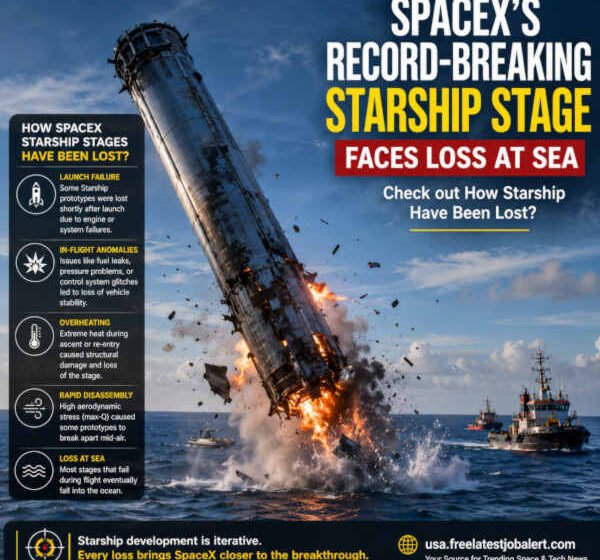
SpaceX’s Record-Breaking Starship Stage Faces Loss at Sea. Check out How spacex starship have been lost?

PERTH, AUSTRALIA. Read on this latest AUSTRALIAN Business updates all about Elon Musk SpaceX Starship lost and how it happened, and where it occured details. In an unprecedented chapter of spaceflight history, SpaceX’s massive Starship upper stage has spent two weeks floating intact in the Indian Ocean following its historic 13th test flight. But despite a heroic rescue operation off the coast of Western Australia, the 171-foot-tall (52-meter) stainless steel giant appears unlikely to make it back to dry land.
SpaceX founder and CEO Elon Musk confirmed the sombre outlook on social media platform X, tempering hopes of a full physical recovery while celebrating a massive technical win.
“Unfortunately, ship recovery is not looking good right now,” Musk stated. “Nonetheless, we were able to obtain close-up photos of critical regions of the heat shield and engines for future upgrades.”
While the floating rocket may ultimately slip beneath the waves, the sheer fact that Ship 13 survived re-entry, impact with the ocean surface, and a fortnight in harsh saltwater marks a major triumph for the world’s most powerful launch system.
A High-Stakes Splashdown in the Indian Ocean
The journey began on July 24, when SpaceX launched Starship Flight 13 from its Starbase facility in Boca Chica, Texas. Propelled into the sky by the 33 Raptor engines of the Super Heavy booster, the upper stage (“Ship”) separated cleanly and pushed into its planned suborbital trajectory.
Previous test flights saw upper stages disintegrate under extreme atmospheric heating or break apart upon ocean impact. Flight 13 broke that pattern entirely:
-
Atmospheric Re-entry: Ship traversed the atmosphere above the Indian Ocean, demonstrating improved thermal protection performance.
-
Controlled Soft Landing: The vehicle successfully executed its flip-and-burn manoeuvre, touching down vertically on the water’s surface before tipping over into the sea.
-
Structural Integrity: Unlike earlier iterations that exploded or broke apart on impact, Ship 13 remained completely intact after hitting the waves.
For two full weeks, the massive cylinder rode the ocean swells off Western Australia, defying expectations and surviving continuous structural stress from wind, waves, and buoyancy forces.
The Towing Operation: A Battle Against Nature
Recognising a rare opportunity to inspect a flight-proven vehicle, SpaceX dispatched recovery vessels equipped with specialised towing equipment to secure the 171-foot upper stage. The goal was ambitious: tow the giant vehicle hundreds of miles to an Australian port for detailed forensic examination.
Recovering a massive, hollow stainless steel structure from open water presents immense engineering challenges:
-
Massive Hydrodynamic Drag: A 30-foot-wide cylinder floating horizontally creates immense resistance against ocean currents and swells.
-
Saltwater Ingress: As seawater gradually leaks into tanks and engine cavities, internal weight distribution shifts unpredictably, increasing the risk of structural failure or sinking.
-
Rough Sea States: Ocean swells exert powerful bending moments along the hull, threatening to snap or collapse the thin-walled tanks.
Despite these hurdles, SpaceX recovery teams managed to pull alongside the floating vehicle. Personnel operated close enough to capture high-resolution photographic and thermal imagery of the vehicle’s exterior, focusing on areas critical to future reusable flights.
Inspecting Heat Shields and Raptor Engines
Although bringing the vehicle back to land was the dream scenario, aerospace engineers emphasise that the primary objective of recovery—data gathering—was largely accomplished.
The Heat Shield Challenge
Starship relies on thousands of hexagonal ceramic heat tiles to protect its stainless steel hull during atmospheric re-entry at speeds exceeding Mach 25. On earlier flights, tile loss led to localised burn-throughs on critical control flaps. Close-up photos of Ship 13’s heat shield provide invaluable real-world data on:
-
Tile adhesion and mechanical retention under extreme aerodynamic pressures.
-
Hot-gas plasma penetration near flap joints and hinge mechanisms.
-
Material degradation across high-heating zones along the vehicle’s leeward and windward sides.
Engine Inspection
Ship 13 was powered by six Raptor engines (three sea-level and three vacuum-optimised variants). Capturing close-up imagery of the engine skirt and nozzle extension rings provides SpaceX propulsion engineers with vital feedback on how the hardware withstood re-entry heating and the thermal shock of ignition during the landing burn.
From Ocean Splashdowns to Tower Catches
The survival of Ship 13 represents a rapid evolution in SpaceX’s iterative testing philosophy. In earlier test campaigns, surviving re-entry seemed a distant goal. Today, Starship is routinely surviving entry manoeuvres, landing burns, and ocean impacts.
The data gathered from Flight 13 directly feeds into SpaceX’s ultimate goal: returning Starship upper stages directly to the launch site to be caught in mid-air by the launch tower’s mechanical arms (“Mechazilla”).
Catching the upper stage at the launch site requires zero structural margin for error. Visual verification that the hull and flap control surfaces survived intact without severe warping gives engineers the confidence needed to clear Starship for land-based recovery attempts in upcoming flights.
Lastly, in the Conclusion
Here, as SpaceX turns the page on Flight 13, focus at Starbase has already shifted to Flight 14. Hardware for the next mission is undergoing static fire testing and system checks on the launch pads in South Texas.
Key objectives expected for upcoming test flights include:
-
Next-Generation TPS Tiles: Testing lighter, more resilient heat shield materials with under-tile backing layers.
-
In-Space Payload Bay Door Operations: Demonstrating the opening and closing of the “Pez dispenser” payload door designed for deploying Starlink satellites.
-
In-Space Engine Re-ignitions: Performing target burns in orbit to demonstrate precision de-orbit capabilities required for operational flights.
While Ship 13 may ultimately sink to the floor of the Indian Ocean, its two-week floating saga marks one of the most remarkable test achievements in modern rocketry. The data captured from its surviving heat shield and engines will directly inform the design of future vehicles intended to carry humanity to the Moon and Mars.