
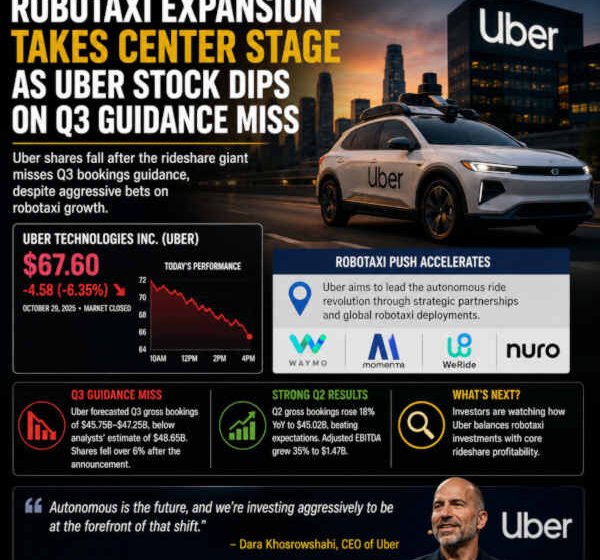
Robotaxi Expansion Takes Center Stage as Uber Stock Dips on Q3 Guidance Miss

NEW YORK : Shares of Uber Technologies Inc. (NYSE: UBER) slid over 5% following the company’s second-quarter earnings release. Despite delivering solid Q2 top-line beats across gross bookings and operational net income, Wall Street reacted negatively to a softer-than-expected third-quarter gross bookings outlook.
Amid the market volatility, CEO Dara Khosrowshahi reaffirmed Uber’s long-term strategic transformation, placing autonomous vehicles and large-scale commercial robotaxi integration at the forefront of the company’s future growth strategy.
Q2 Financial Highlights: Strong Execution Across Segments
Uber reported robust consumer engagement throughout the second quarter, driven by steady demand across its core Mobility and Delivery divisions. Total gross bookings—representing the aggregate dollar value of rides, delivery orders, and freight shipments on the platform—rose 22% year-over-year on a constant-currency basis to hit $58.02 billion.
Uber Q2 Financial Overview:
• Gross Bookings: $58.02 Billion (+22% YoY constant currency)
• Total Revenue: $14.19 Billion (+12% YoY)
• Non-GAAP EPS: $0.81 (vs. $0.60 in Q2 2025)
• Adjusted EBITDA: $2.82 Billion (+33% YoY)
• Free Cash Flow: $2.80 Billion ($10B+ trailing twelve-month record)
Monthly Active Platform Consumers (MAPCs) climbed 16% year-over-year to 208 million, while completed trips grew 18% to 3.87 billion. GAAP net income reached $2.39 billion ($1.17 per diluted share), boosted by a $1.6 billion pre-tax gain from equity investment revaluations.
Why Shares Slipped: The Q3 Bookings Guidance Miss
Despite the operational momentum, investors focused on the company’s forward guidance. Uber projected third-quarter gross bookings in the range of $58.25 billion to $60.25 billion, establishing a midpoint of $59.25 billion.
While this outlook reflects 18% to 22% constant-currency growth, the midpoint fell just short of the $59.32 billion consensus estimate compiled by Bloomberg. In response, UBER shares dropped 5.29% during regular trading, pulling down peer rideshare operator Lyft (LYFT) and self-driving competitors Alphabet (GOOGL) and Tesla (TSLA).
Q3 Guidance vs. Wall Street Estimates:
• Uber Q3 Bookings Outlook: $58.25B – $60.25B
• Midpoint Projection: $59.25 Billion
• Bloomberg Analyst Consensus: $59.32 Billion
The Robotaxi Blueprint: A $10 Billion Strategic Bet
To counter softening near-term growth concerns, Uber is positioning itself as the premier global marketplace for autonomous vehicle (AV) deployment. Khosrowshahi outlined plans to allocate more than $10 billion toward commercializing self-driving services over the coming years, aiming to expand robotaxi availability across more than 15 major metropolitan markets.
Rather than manufacturing proprietary hardware, Uber’s model relies on strategic partnerships with AV technology leaders like Waymo, Aurora, and international autonomous developers. By integrating third-party robotaxi fleets directly into the Uber app, the company aims to maximize vehicle utilization rates while lowering per-mile transportation costs.
“We are building the world’s largest platform for autonomous vehicles from a position of financial strength,” Khosrowshahi emphasized during the earnings call. “Trailing twelve-month free cash flow exceeding $10 billion gives us the flexibility to invest aggressively in next-generation mobility while reducing our share count.”
Insurance, Risk Management, and Legal Infrastructure
As autonomous ride-hailing transitions from experimental pilot programs to full commercial operations, it introduces complex legal and financial frameworks. Transitioning from human drivers to driverless fleets alters the risk profile for corporate fleet operators, rideshare platforms, and municipal regulators.
Key Regulatory and Risk Factors
-
Commercial Auto Insurance & Liability: Unlike traditional ridesharing where individual drivers carry personal policies supplemented by platform insurance, robotaxi operations require specialized commercial vehicle coverage and comprehensive fleet liability insurance to cover property damage and mechanical failure risks.
-
Auto Accident Attorney Scrutiny: Autonomous vehicle injury claims involve complex product liability questions. When a self-driving vehicle is involved in a collision, determining liability involves assessing software algorithms, sensor hardware, and remote teleoperation systems rather than human error.
-
Corporate Risk Management: Fleet managers must secure enterprise-grade cyber liability insurance to protect against potential software vulnerabilities, sensor spoofs, or network disruptions that could paralyze autonomous operations.
Frequently Asked Questions (FAQs)
Q1: Why did Uber stock fall despite beating second-quarter profit expectations?
Uber’s stock dipped because its third-quarter gross bookings guidance midpoint of $59.25 billion came in slightly below Wall Street’s $59.32 billion consensus estimate. Investors closely track gross bookings guidance as a primary indicator of demand across mobility and delivery services.
Q2: How much is Uber investing in robotaxi technology?
Uber announced plans to direct more than $10 billion over the coming years toward scaling commercial autonomous vehicle operations and expanding robotaxi access across major global markets.
Q3: How does the shift to robotaxis impact commercial auto insurance requirements?
The shift from human-driven vehicles to autonomous fleets transfers liability from individual driver policies to commercial auto insurance and product liability coverage held by fleet operators and AV technology providers.
Q4: What should passengers or third parties do if involved in a robotaxi auto accident?
In collisions involving autonomous vehicles, victims typically consult an experienced auto accident attorney specializing in product liability and commercial vehicle injury claims to navigate claims involving AV software developers, fleet owners, and insurance underwriters.
Q5: What are Uber’s main financial results for Q2?
Uber posted $58.02 billion in gross bookings (up 22% YoY in constant currency), $14.19 billion in revenue, and non-GAAP EPS of $0.81. Free cash flow reached $2.8 billion for the quarter, bringing trailing twelve-month free cash flow above $10 billion.