
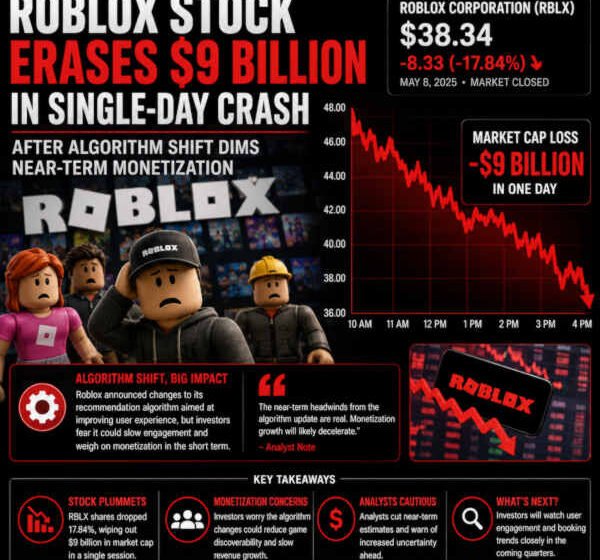
Roblox Stock Erases $9 Billion in Single-Day Crash After Algorithm Shift Dims Near-Term Monetization

SAN MATEO, Calif. — Roblox Corporation experienced one of the most drastic single-day market pullbacks in its public history, shedding roughly $9 billion in market valuation following its latest earnings report. The catalyst behind the sharp sell-off was not a decline in overall player activity, but an intentional, strategic decision by the company to overhaul its core recommendation system, a move that unintentionally severely curtailed short-term player spending.
For years, Wall Street’s infatuation with Roblox stemmed from its unique ability to scale like a social media platform rather than a traditional video game studio. Instead of spending tens of millions of dollars to develop individual titles internally, Roblox relies on millions of independent creators to build experiences on its platform. When a game goes viral, Roblox surges in popularity and captures a percentage of every microtransaction, generating expanding revenue streams that routinely delight investors.
However, that growth engine hit a significant speed bump in its latest quarterly results. After missing internal bookings projections by a wide margin and issuing cautious forward guidance, panic swept through the market, driving a brutal double-digit stock decline that erased billions in market cap in a single trading session.
Inside the Discovery Algorithm Overhaul
At the heart of the quarterly shortfall is a fundamental redesign of the Roblox discovery engine. Historically, the platform’s recommendation algorithms heavily favored games that produced immediate, aggressive monetization. Viral hits—often referred to internally as “2025 vintage” viral experiences—excelled at prompting players, particularly younger children, to buy digital items, pass upgrades, and cosmetic accessories early in their play sessions.
Recognising that aggressive cash-grabs can burn out players and damage long-term user retention, Roblox management made the conscious choice to re-engineer its recommendation systems. The discovery algorithm now explicitly measures and prioritises long-term platform retention over immediate hourly spend.
The Strategic Algorithm Shift:
• Legacy Approach: Promoted high hourly monetization & viral, short-term cash-grab games
• New Approach: Prioritizes organic long-term user retention, stickiness, and quality content
• Short-Term Result: Fewer algorithm impressions for viral titles → Drop in bookings per hour played
• Target Outcome: Higher multi-month user retention compounding into sustainable long-term spend
By directing players toward deeper, more sticky, and “evergreen” experiences that allow long play sessions without immediate paywalls, Roblox saw its key financial health metric—bookings per hour played—take a direct hit, particularly within its largest domestic demographic.
Executive Commentary: Choosing Retention Over Short-Term Cash
During the earnings conference call, Roblox leadership stood firmly behind the decision, framing the near-term revenue hit as a necessary short-term trade-off required to secure sustainable multi-year platform growth.
Chief Executive Officer David Baszucki explained the philosophical shift to analysts and investors:
“On the discovery side, in the last few months, we shared with our community our strategic decision to focus our discovery algorithms directly on measured long-term retention. We have seen this impact monetization, primarily in the U.S. under-13 cohort, and this has been exemplified by a lower frequency of impressions with games that emphasize short-term monetization rather than long-term retention. It’s still early, but our data shows a positive lift in quality, stickier engagement games, and the benefits of higher retention, we believe, outweigh the near-term impacts we’re seeing, as improved retention and engagement compound into future growth.”
Chief Financial Officer Naveen Chopra echoed these sentiments, providing further context regarding why the financial impact surpassed Wall Street’s internal modelling:
“We attribute the unforeseen monetization shortfall to a greater-than-expected shift of engagement from high-monetizing 2025 vintage viral games to a combination of new and evergreen experiences with lower hourly monetization.”
Chopra noted that internal testing reveals a “crossover point” where the gains in multi-week player retention will eventually eclipse the initial loss in hourly bookings, though management stopped short of providing a concrete calendar date for when that break-even horizon will occur.
Q2 Performance Highlights
Despite the sharp reaction in the equity market, Roblox’s underlying operational metrics revealed a paradox: while monetisation efficiency weakened, raw user activity and cash generation remained exceptionally robust.
| Financial / Operational Metric | Q2 Result | Year-Over-Year Growth | Performance Notes |
| Total Revenue | $1.5 Billion | +36% YoY | Strong topline expansion, beating some analyst EPS estimates |
| Total Bookings | $1.6 Billion | +8% YoY | Came in at the bottom of the company guidance & below internal targets |
| Daily Active Users (DAUs) | 123 Million | +10% YoY | High engagement; international markets like Japan (+67%) led growth |
| Hours Played | 29 Billion | +5% YoY | Broad user activity remains healthy despite lower per-hour spend |
| Free Cash Flow (FCF) | $294 Million | +66% YoY | Strong cash generation driven by disciplined operational cost control |
While revenue grew 36% year-over-year to $1.5 billion, total bookings—which reflect Robux currency purchases before they are recognised as revenue over time—grew just 8% to $1.6 billion, missing Wall Street expectations by hundreds of millions of dollars.
Impact on the Under-13 Cohort and Creator Ecosystem
The monetisation decline was heavily concentrated in the U.S. under-13 age demographic. Younger players are historically more susceptible to impulse microtransactions in fast-paced viral games. When the discovery engine reduced the visibility of those titles, spending dropped rapidly among younger cohorts.
Simultaneously, the algorithm shift creates a major realignment within the developer community:
-
Short-Term Monetizers Squeezed: Developers relying on aggressive pop-ups, pass sales, and pay-to-win mechanics saw their algorithmic reach plummet.
-
Evergreen Experiences Rewarded: Complex, immersive experiences with high replayability are receiving significantly higher impression volume on the front page.
-
Content Concentration Declining: The top 10 experiences on Roblox now account for only 20% of total platform hours, down from 30% three years ago, demonstrating a far more diversified content ecosystem.
Impact on Game Developers:
High Monetization / Low Retention  ──►  Reduced Algorithm Impressions  ──►  Lower Revenue
High Retention / Quality Playtimes ──►  Increased Discovery Impressions ──►  Growing Audience
Wall Street Scepticism and the Road Ahead
Wall Street’s reaction was swift and unforgiving. Investors generally dislike revenue volatility caused by internal policy changes, especially when management refrains from issuing full-year guidance due to ongoing platform experimentation.
Adding to investor anxiety, Roblox guided Q3 bookings to between $1.58 billion and $1.65 billion, representing an anticipated year-over-year decline of 14% to 18% as monetisation headwinds persist alongside tough year-over-year comparisons. Additionally, heavier investments in AI-powered creation tools (such as Build) and GPU data centre infrastructure threaten to temporarily compress operating margins.
Despite the near-term Wall Street backlash, Roblox management maintains that prioritising platform health, safety, and long-term user retention is the only path toward capturing 10% of the global video game market. Whether investors will have the patience to wait for the algorithm’s retention gains to pay off remains the multi-billion-dollar question hanging over Roblox stock.