
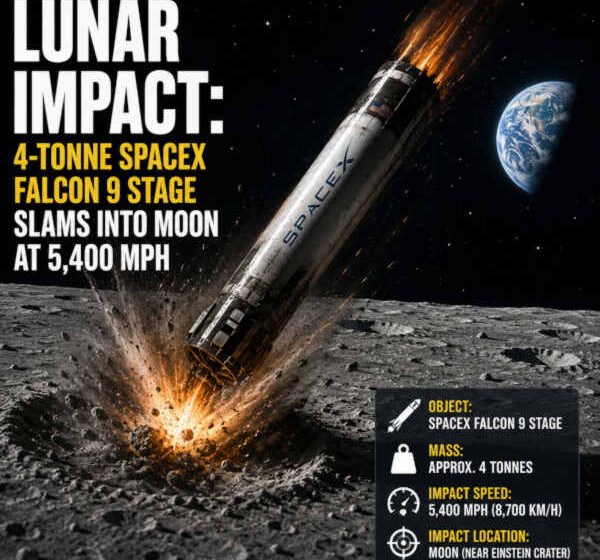
LUNAR IMPACT: 4-TONNE SPACEX FALCON 9 STAGE SLAMS INTO MOON AT 5,400 MPH

A discarded four-tonne rocket stage launched in January 2025 has unintentionally struck the lunar surface, gouging out a new crater and sparking conversations around deep-space orbit tracking and orbital debris management.
The Collision Details
The object—a building-sized second stage from a SpaceX Falcon 9 rocket—collided with the Moon at approximately 6:35 AM BST (2:35 AM EDT / 0635 UTC) on Wednesday, August 5, 2026. Travelling at roughly 5,400 mph (8,690 km/h), the spent rocket booster struck near the Einstein Crater on the western edge of the lunar disk.
+-------------------+----------------------------------------------------+
| Attribute         | Details                                            |
+-------------------+----------------------------------------------------+
| Hardware          | SpaceX Falcon 9 Upper Stage (launched Jan 2025)   |
| Object Mass       | ~4,000 kg (4 metric tonnes / 8,800 lbs)            |
| Object Length     | ~45 feet (13.8 meters)                             |
| Impact Speed      | 5,400 mph (8,690 km/h / 2.43 km/s)                  |
| Impact Location   | Near Einstein Crater (Western Lunar Horizon)       |
| Estimated Crater  | 60–90 feet (18–27 m) wide, 12–16 feet (4–5 m) deep |
+-------------------+----------------------------------------------------+
Why Did the Rocket Hit the Moon?
During standard low-Earth orbit missions, Falcon 9 upper stages execute targeted de-orbit burns to safely re-enter Earth’s atmosphere and burn up over open oceans. However, deep-space launches require significantly higher velocity.
When boosting its payload—carrying Firefly Aerospace’s Blue Ghost and ispace’s Resilience lunar landers—toward the Moon in early 2025, the stage expended its propellant. Left in a chaotic Earth-Moon transfer orbit, a combination of solar radiation pressure and complex gravitational tugs gradually nudged the dead rocket onto a collision course.
Scientific Opportunity and Space Debris Concerns
While the impact poses zero threat to Earth, planetary scientists are turning the accident into an active experiment:
-
Orbital Reconnaissance: NASA’s Lunar Reconnaissance Orbiter (LRO) and South Korea’s Danuri spacecraft are slated to examine the collision site. By comparing before-and-after imagery, scientists can study high-velocity impact mechanics in lunar soil.
-
Plume Modelling: The crash is estimated to have kicked up an ejecta dust plume extending tens of kilometres above the surface.
-
Astronaut Safety Data: Data gathered on how hypervelocity artificial debris excavates lunar soil will inform habitat shielding and hazard assessments for upcoming human missions under NASA’s Artemis program.
This marks only the second known unintentional crash of a human-made object on the lunar surface (following a spent booster collision on the far side in 2022), underscoring the growing necessity for strict international protocols surrounding deep-space hardware disposal.