
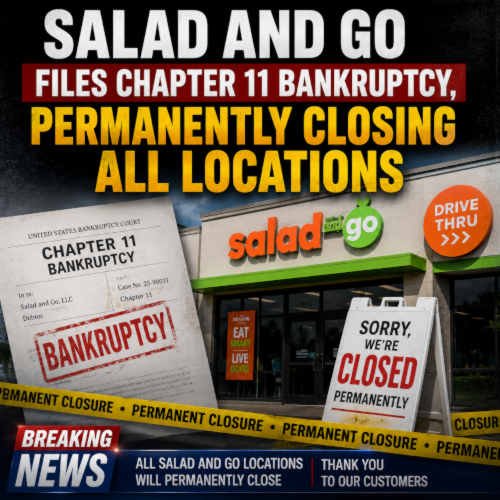
Salad and Go Files Chapter 11 Bankruptcy, Permanently Closing All Locations

PHOENIX, AZ : In a sudden and devastating blow to the fast-casual dining industry, Phoenix-based drive-thru chain Salad and Go has officially filed for Chapter 11 bankruptcy protection and announced the permanent closure of all its remaining restaurant locations.
The healthy fast-food pioneer, which operated 70 drive-thru locations across Arizona and Nevada, served its final customers on Wednesday, August 5, 2026. The voluntary Chapter 11 petition was filed in the U.S. Bankruptcy Court for the Southern District of Texas, Houston Division, marking the end of a 13-year journey that began in Gilbert, Arizona, and once saw the brand expand aggressively across the Southwest.
The announcement comes after months of mounting financial distress, strategic missteps under private equity ownership, and broader economic pressures that have crippled mid-tier dining chains nationwide.
Key Details of the Salad and Go Bankruptcy
| Metric / Detail | Official Information |
| Legal Filing | Chapter 11 Bankruptcy (U.S. Bankruptcy Court, S. District of Texas) |
| Final Day of Service | Wednesday, August 5, 2026 |
| Remaining Locations Impacted | 70 drive-thru units across Arizona and Nevada |
| Total Meals Served (Lifetime) | Over 60 million meals |
| Primary Causes Cited | Inflation/rising costs, overexpansion, industry-wide Cyclospora outbreak |
| Current CEO | Mike Tattersfield |
| Founding Year & Location | 2013 in Gilbert, Arizona |
Statement from Leadership
In an official statement released on Tuesday evening, Salad and Go Chief Executive Officer Mike Tattersfield expressed deep sorrow over the decision to wind down operations.
“This is a painful day for everyone who built, worked for, and loved Salad and Go,” said Tattersfield. “Our mission was brought to life every day by an extraordinary team and embraced by guests who made us part of their routines. We are proud of what we built together and grateful to every team member, guest, and partner who believed in it.”
According to court documents and corporate representatives, Chapter 11 status will provide a court-supervised framework allowing the company to realize the value of its remaining physical assets and equipment to satisfy creditor obligations in an orderly fashion.
Anatomy of a Failure: Why Did Salad and Go Collapse?
Salad and Go’s bankruptcy is the result of a complex interplay between macro-economic headwinds, rapid overexpansion, operational restructuring, and an unexpected food safety scare that severely weakened consumer sentiment.
1. Rapid Overexpansion and Private Equity Shifts
Founded in 2013 by husband-and-wife team Roushan and Tony Christofellis, Salad and Go was created with a disruptive vision: offer restaurant-quality organic salads, wraps, and breakfast burritos at price points competitive with traditional fast-food hamburger chains.
However, after private equity investors acquired a controlling stake and the founders exited the company in 2021, the new management team shifted the company’s headquarters to Texas and launched a massive multi-state expansion blitz. The chain expanded heavily into Texas and Oklahoma, constructing dozens of small-footprint, drive-thru-only units.
The aggressive build-out stretched corporate capital thin. By late 2025, signs of trouble began to show when Salad and Go quietly shuttered more than 40 locations. In early 2026, the company pulled out of Texas and Oklahoma entirely, retreating to its core markets in Arizona and Nevada. The sunk costs from those closed stores severely weighed down the company’s balance sheet.
2. Soaring Supply Chain Costs and Margin Compression
The core selling proposition of Salad and Go was high-volume, low-margin value. When wholesale fresh produce, protein, packaging, and labor costs surged post-pandemic, the company faced a difficult trilemma:
-
Raise prices and alienate its core price-sensitive customer base.
-
Cut portion sizes or ingredient quality, degrading brand trust.
-
Absorb shrinking margins until cash reserves were depleted.
While the chain attempted modest price adjustments, the rapid cost increases in fresh produce proved unsustainable for a model centered on $6 to $8 salads.
3. The July Cyclospora Outbreak Fallout
The final blow to the company arrived in July 2026. A widespread industry-wide outbreak of Cyclospora—a microscopic parasite commonly associated with contaminated fresh produce—dominated national headlines.
Although health authorities explicitly confirmed that Salad and Go was not implicated or linked to any contaminated supply lines, the broader public health warning caused a sharp, sudden collapse in regional demand for pre-packaged leafy greens and drive-thru salads. For a business already operating on razor-thin cash buffers, the sudden drop in July sales proved impossible to survive.
Original Founders Respond
Following the announcement, original founders Roushan and Tony Christofellis released a heartfelt statement reflecting on the brand’s original mission and its ultimate demise:
“Thirteen years ago, we started Salad and Go with a simple belief that great-tasting, good-for-you food should be affordable for everyone. We dreamed that anywhere there was a McDonald’s, there would also be a better and healthier alternative that people could afford. Although we exited in 2021, watching the company announce the closing of its remaining locations is heartbreaking.”
The founders noted that while the Salad and Go brand has come to an end, they remain committed to affordable food accessibility through their new venture, Angie’s Prime Grill.
Impact on the Southwest Fast-Casual Landscape
Salad and Go’s abrupt shutdown leaves hundreds of line workers, store managers, and supply chain employees without jobs across the Phoenix metropolitan area, Tucson, and Las Vegas. Local food banks and community partners who relied on excess produce donations from the chain’s central prep kitchens will also feel the void.
For the fast-casual industry, the bankruptcy serves as a stark warning about the dangers of PE-backed rapid scaling in low-margin concepts. Analysts point out that small-footprint drive-thru models require immaculate inventory control and massive volume to remain profitable—factors that become exceedingly precarious when consumer discretionary spending tightens.
Frequently Asked Questions (FAQs)
Why is Salad and Go closing permanently?
Salad and Go filed for Chapter 11 bankruptcy due to sustained pressures on consumer spending, rising supply chain and labor costs, financial liabilities from previous failed store expansions in Texas and Oklahoma, and an industry-wide decline in fresh produce sales following a July 2026 Cyclospora outbreak.
When is the last day to visit a Salad and Go location?
The last day of service for all remaining 70 locations in Arizona and Nevada was Wednesday, August 5, 2026. All stores are closed permanently as of Thursday, August 6, 2026.
Was Salad and Go responsible for the Cyclospora outbreak?
No. Official company statements and public health reports confirmed that Salad and Go was not implicated in the July 2026 Cyclospora outbreak. However, the general public health scare surrounding fresh produce severely reduced customer traffic across the entire salad category.
What happens to unused Salad and Go gift cards or app balances?
Because the company has entered Chapter 11 bankruptcy proceedings and completely ceased operations, gift cards and in-app rewards balances are generally non-refundable through store registers. Gift card holders may need to submit a proof of claim with the U.S. Bankruptcy Court for the Southern District of Texas, though recovery on unredeemed gift balances in liquidation scenarios is typically limited.
Are any Salad and Go locations remaining open in Texas or Oklahoma?
No. Salad and Go had already closed all of its Texas and Oklahoma locations in late 2025 and early 2026 prior to the final bankruptcy filing. The final Chapter 11 filing results in the total shutdown of all remaining stores nationwide.