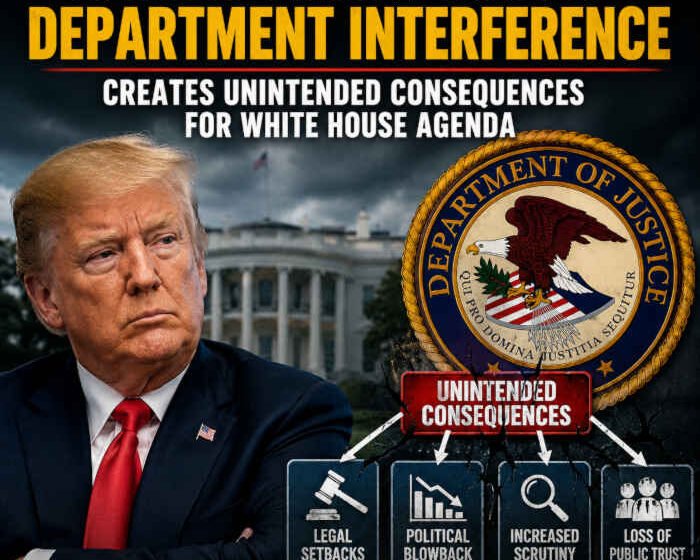
Donald Trump Justice Department Interference Creates Unintended Consequences for White House Agenda

WASHINGTON — President Donald Trump’s persistent efforts to direct operations within the U.S. Department of Justice are creating significant friction across the federal legal ecosystem, triggering self-inflicted setbacks for his administration.
In recent days, executive involvement in federal law enforcement operations has imperilled an active criminal prosecution, opened the door to court-ordered sanctions in another case, and complicated the Senate confirmation process for the White House’s nominee for Attorney General.
Executive Control vs. Prosecutorial Independence
Since returning to the office, President Trump has asserted direct oversight over federal agencies. His approach has drawn sharp scrutiny from legal scholars, former federal prosecutors, and lawmakers on Capitol Hill. Traditionally, the Department of Justice (DOJ) operates with strict independence from White House political influence—a boundary designed to prevent federal law enforcement from being weaponised or compromised by partisan interests.
“There is a reason the department in charge of federal law enforcement has traditionally stood outside of the president’s personal purview,” noted Norman L. Eisen, a veteran legal counsel who previously helped craft executive branch ethics standards.
                  DOJ INDEPENDENCE VS. EXECUTIVE OVERREACH

  Traditional Governance Model              Executive Direct Control Model
  ----------------------------              ------------------------------
  • Independent prosecutorial discretion    • Direct presidential directives
  • Strict "No-Contact" policy              • Intervention in active cases
  • Non-partisan career prosecutors         • Increased risk of court sanctions
  • Preserved evidentiary integrity         • Compromised Senate confirmation paths
However, recent legal filings and public disclosures indicate that direct executive involvement is triggering unintended legal challenges in federal courtrooms.
Three Key Legal Complications Emerging from Executive Meddling
The consequences of White House involvement in DOJ affairs have manifested across three primary legal fronts:
1. Imperilled Criminal Prosecutions
In an active federal criminal case, defence attorneys have moved to dismiss charges, citing improper influence and selective prosecution. Federal judges are scrutinising whether prosecutorial decisions were made based on objective evidentiary standards or executive directives. When public statements or White House actions suggest pre-judged outcomes, defence teams gain substantial leverage to argue that due process rights have been compromised.
2. Potential Judicial Sanctions
In a separate civil-criminal matter, federal judges have raised concerns over procedural irregularities and potential conflicts of interest. Legal representatives face mounting pressure to explain sudden shifts in department posture that coincide with public statements from the White House. Judges overseeing these proceedings have warned that failure to maintain professional prosecutorial standards could result in formal court sanctions against government attorneys.
3. Stalled Attorney General Confirmation
The political fallout from DOJ interference has reached the United States Senate. Moderate lawmakers whose votes are essential for confirmation have expressed concern over the nominee’s commitments to uphold DOJ independence. The controversy has stalled confirmation hearings, forcing administration officials to lobby hesitant senators who demand assurances that the Attorney General will resist political pressure.
Impact on Federal Legal Precedent and Policy
| Impact Area | Traditional Standard | Current Executive Challenge | Potential Long-Term Result |
| Prosecutorial Discretion | Evidence-based grand jury indictment | Executive-directed investigation priorities | Increased defence motions for dismissal |
| Senate Confirmations | Bipartisan scrutiny on qualifications | Heavy focus on institutional independence | Extended vacancies in leadership roles |
| Judicial Oversight | Deference to government filings | Increased judicial scepticism and hearings | Expanded use of independent court monitors |
The ongoing friction highlights a broader debate over executive authority under Article II of the U.S. Constitution. While the president serves as head of the executive branch, legal experts argue that subjecting federal law enforcement to personal political direction undermines public trust in the rule of law.
For additional coverage on federal policy and government operations, explore our latest reports on White House Executive Actions and updates regarding Congressional Oversight Committees.
Frequently Asked Questions (FAQ)
What is the “No-Contact” policy between the White House and the DOJ?
The “No-Contact” policy is an administrative guideline established to restrict communication between White House officials and Department of Justice prosecutors regarding active criminal investigations. It ensures that law enforcement decisions are made independently without political influence.
Why does executive interference complicate criminal prosecutions?
When a president publicly demands or directs a prosecution, defence attorneys can argue that the case is driven by political animus rather than evidence. This can lead to court motions for dismissal based on selective prosecution or violations of due process.
How does DOJ interference affect Senate confirmation hearings?
Senate confirmation of presidential nominees, including the Attorney General, requires a majority vote. Concerns over political interference prompt senators to demand explicit commitments to independence, often delaying or blocking confirmation votes until clear boundaries are established.