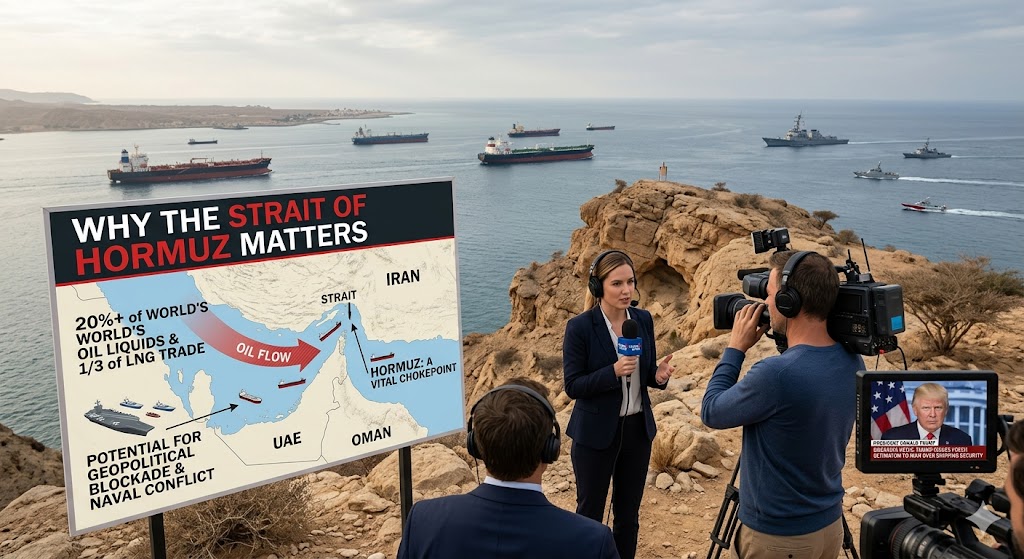


Global Tensions Rise Around the Strait of Hormuz
The Strait of Hormuz has once again become the center of global attention after a sharp escalation in rhetoric from Donald Trump toward Iran.
In a strongly worded message, Trump issued an ultimatum demanding that Iran allow unrestricted passage of vessels through the Strait of Hormuz. The warning included a firm deadline and threats of potential strikes on key infrastructure if compliance is not met.
This development has rapidly increased geopolitical tensions and triggered concerns across global markets. Energy traders, governments, and military analysts are closely watching the Strait of Hormuz, understanding that even a minor disruption in this region can have far-reaching consequences.
The Strait of Hormuz is not just a regional issue—it is a global economic lifeline.
What Makes the Strait of Hormuz So Critical
The Strait of Hormuz is one of the most strategically important waterways in the world. Located between Iran, Oman, and the United Arab Emirates, it connects the Persian Gulf to the open ocean via the Gulf of Oman.
At its narrowest point, the strait is only about 21 miles wide. Despite its size, it carries an enormous volume of global energy supplies every day.
Roughly 20 million barrels of oil pass through the Strait of Hormuz daily. This accounts for a significant portion of the world’s oil supply. In addition, about one-fifth of global liquefied natural gas shipments transit through this corridor.
The importance of the Strait of Hormuz cannot be overstated. It acts as a chokepoint—meaning any disruption can instantly affect global supply chains.
Energy markets depend heavily on uninterrupted flow through the Strait of Hormuz. If blocked or restricted, prices can surge within hours.
Trump’s Ultimatum and Escalation with Iran
Donald Trump’s ultimatum to Iran marks a significant escalation in already strained relations. His message demanded that Iran reopen the Strait of Hormuz fully to all vessels by a specified deadline.
Failure to comply, according to the statement, could result in military action targeting Iran’s infrastructure.
The language used in Trump’s communication was unusually aggressive. It reflected growing frustration over what the United States perceives as threats to freedom of navigation in the Strait of Hormuz.
Iran has historically maintained that it has the right to control activity within its territorial waters. However, the international community views the Strait of Hormuz as a critical global passage that must remain open.
This clash of perspectives has been building for years, and the latest ultimatum has brought tensions to a boiling point.
# Economic Impact: Fuel Prices Surge Worldwide
The impact of rising tensions around the Strait of Hormuz is already being felt across the globe.
Fuel prices have surged sharply in recent days. Gasoline, diesel, and jet fuel costs are climbing as markets react to the possibility of disruption in the Strait of Hormuz.
In the United States, average gasoline prices have risen significantly within a short period. On the West Coast, prices have reached particularly high levels, reflecting proximity to Pacific supply chains and market sensitivity.
Globally, airlines, shipping companies, and logistics providers are bracing for increased costs. Since a large portion of jet fuel exports passes through the Strait of Hormuz, aviation industries are especially vulnerable.
Even the mere threat of instability in the Strait of Hormuz is enough to trigger price spikes.
Military and Strategic Importance
Beyond economics, the Strait of Hormuz holds immense military significance.
Naval forces from multiple countries maintain a presence in and around the Strait of Hormuz to ensure freedom of navigation. The United States Navy, along with allied forces, regularly patrols the area.
Any conflict in the Strait of Hormuz could quickly escalate into a broader regional confrontation.
Iran has previously demonstrated its ability to disrupt shipping in the Strait of Hormuz through tactics such as deploying fast attack boats, mines, and missile systems.
This makes the current situation particularly sensitive. A single incident in the Strait of Hormuz could trigger a chain reaction involving multiple nations.
Why the World Is Watching Closely
The global focus on the Strait of Hormuz is driven by its unmatched importance to energy security.
Countries across Asia, Europe, and beyond rely heavily on oil and gas shipments that pass through this narrow waterway. Major economies such as China, India, Japan, and South Korea would be significantly impacted by any disruption.
For developing economies, rising fuel prices can lead to inflation, increased transportation costs, and economic instability.
The Strait of Hormuz is, therefore, not just a regional concern—it is a global pressure point.
The situation has been closely monitored by international organizations, energy analysts, and governments worldwide.
# Possible Outcomes and What Comes Next
Several scenarios could unfold in the coming days regarding the Strait of Hormuz.
One possibility is de-escalation. Diplomatic efforts could lead to an agreement that ensures continued access to the Strait of Hormuz without conflict.
Another scenario involves limited confrontation. This could include targeted actions that stop short of full-scale war but still disrupt shipping and increase tensions.
The most severe outcome would be a prolonged conflict affecting the Strait of Hormuz. This would have devastating consequences for global energy markets and economic stability.
At this stage, uncertainty remains high.
Final Thoughts
The Strait of Hormuz stands at the center of one of the most critical geopolitical developments of 2026.
Donald Trump’s ultimatum to Iran has intensified an already fragile situation. With global energy supplies at stake, the world is watching closely.
What happens next in the Strait of Hormuz will not only shape regional dynamics but also influence the global economy in profound ways.
In a world deeply dependent on energy flows, the stability of the Strait of Hormuz remains essential—and any disruption could be felt far beyond the waters of the Middle East.