
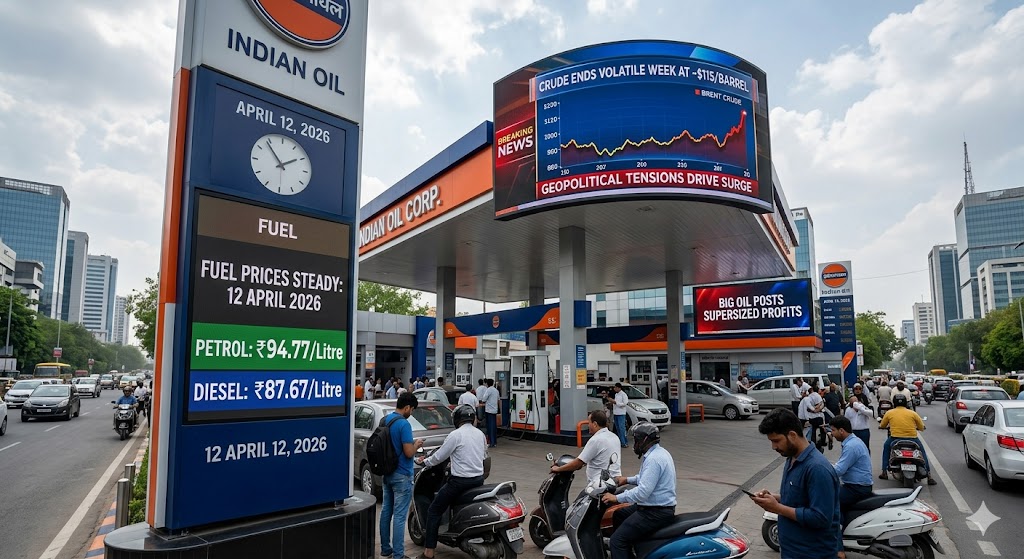
BUSINESS UPDATE USA – On Sunday, April 12, 2026, fuel prices across India’s capital remained unchanged, providing a brief moment of stability for consumers after a week of intense global market fluctuations. As of 6:00 AM, petrol in Delhi is retailing at ₹94.77 per litre, while diesel prices remain steady at ₹87.67 per litre.
While the local pumps show a flatline, the global energy landscape is anything but calm. The steady rates in India come on the heels of a massive surge in international crude prices, driven by geopolitical tensions in the Middle East that have seen Brent crude peak near $115 per barrel earlier this month.
Business Beat: Big Oil’s “Supersized” Profits Amid Consumer Pain
In the latest edition of Canada’s Business Beat with Bob Price, the narrative is one of stark contrast. As drivers across the globe—from New Delhi to Toronto—feel the “pain at the pump,” the world’s largest energy companies are reporting record-breaking financial hauls.
The Profit Paradox
For the first quarter of 2026, “Big Oil” has posted what analysts are calling “supersized” profits. This surge is attributed to the combination of elevated crude prices and increased demand as global supply chains continue to realign. In the United States alone, the Bureau of Land Management reported record revenues from oil and gas lease sales in Q1 2026, generating over $592.7 million—the highest ever for this period in history.
Predictions for Canada’s Oil Patch
North of the border, the Canadian oil industry is bracing for a “turning point year.” According to recent industry outlooks:
- Production Surge: Alberta’s economy is expected to outperform other provinces, bolstered by WTI prices hovering between $95 and $100 per barrel.
- Infrastructure Growth: 2026 marks the expected final investment decision for the Ksi Lisims LNG project, an Indigenous-led floating terminal that could significantly expand Canada’s export capacity to Asian markets.
- Drilling Activity: The Canadian Association of Energy Contractors (CAOEC) predicts an average of 213 active drilling rigs this year, up from 201 in 2025, supporting roughly 85,000 jobs.
Major Mining Merger: American Ocean Minerals & Odyssey Unite
The commodities sector saw a seismic shift this week as the merger between American Ocean Minerals Corporation (AOMC) and Odyssey Marine Exploration became official.
The all-stock transaction values the new entity at nearly $1 billion, creating a U.S.-controlled powerhouse dedicated to deep-sea mining. The company will focus on extracting polymetallic nodules—rich in nickel, manganese, and cobalt—from the Clarion-Clipperton Zone. These minerals are critical for the global transition to electric vehicles (EVs) and renewable energy storage.
“This merger occurs at a pivotal moment where regulatory clarity and rising demand for critical minerals are finally converging,” stated Mark Justh, CEO of the combined entity.
Air Canada’s Bold Plan to Tackle Passenger Backlog
Travelers frustrated by the “regulatory gridlock” in Canadian aviation may soon see some relief. Air Canada has officially launched a pilot program aimed at resolving a staggering backlog of 95,000 passenger complaints currently sitting with the Canadian Transportation Agency (CTA).
The 90-Day Resolution Goal
Air Canada’s plan involves a voluntary adjudication process handled by an independent third party, Canada Aviation Dispute Resolution.
- Target: The airline aims to settle disputes within 90 days, a massive improvement over the current CTA wait times, which can span two to three years.
- The Pilot: The program starts with 500 randomly selected passengers. If successful, it could set a new global standard for how airlines handle service failures, such as lost baggage or flight cancellations.
While the airline frames this as an effort to “rebuild trust,” consumer advocates like the Canadian Automobile Association remain cautious, questioning the lack of government oversight in a private arbitration model.
Summary Table: Fuel Prices & Economic Indicators (April 12, 2026)
| Metric | Region | Current Rate / Value |
|---|---|---|
| Petrol (Litre) | New Delhi, India | ₹94.77 |
| Diesel (Litre) | New Delhi, India | ₹87.67 |
| Brent Crude | Global | ~$115.00 (April Peak) |
| WTI Crude | North America | $95.00 – $100.00 |
| Mining Merger | Global / US | $1 Billion (AOMC & Odyssey) |
| Aviation Backlog | Canada | 95,000+ Complaints |
Looking Ahead
As we move deeper into April, the focus remains on the Strait of Hormuz. Market analysts warn that if the de facto closure of this vital transit point persists, Brent crude could remain elevated, eventually forcing domestic fuel prices in India and Canada higher. For now, Delhi residents can breathe a sigh of relief as prices remain steady, but with Big Oil’s profits soaring, the political pressure to provide consumer relief is only expected to grow.
Stay tuned to Business Beat for further updates on the energy sector and global market shifts.
About the Author