Truth Social Warfare: How Donald Trump’s “Narrative Airstrikes” are Shaping the Iran Conflict
WASHINGTON D.C. — In a departure from the secret wartime diaries of Churchill or the private memos of Roosevelt, the current global crisis is being narrated in real-time, one post at a time. Truth Social has become the primary rostrum for American foreign policy, as President Donald Trump utilizes his personal megaphone to wage a high-stakes narrative war against Iran, shocking allies and volatile oil markets alike.
Since the escalation began on February 28, the world has witnessed a new form of “viral diplomacy.” While traditional leaders kept their strategic fears under pillows, Trump unleashes his unfiltered thoughts daily—often hourly—firing “narrative airstrikes” that bypass the State Department and rewrite the rules of international engagement.
1. Diplomacy by “Blast”: The Truth Social Strategy
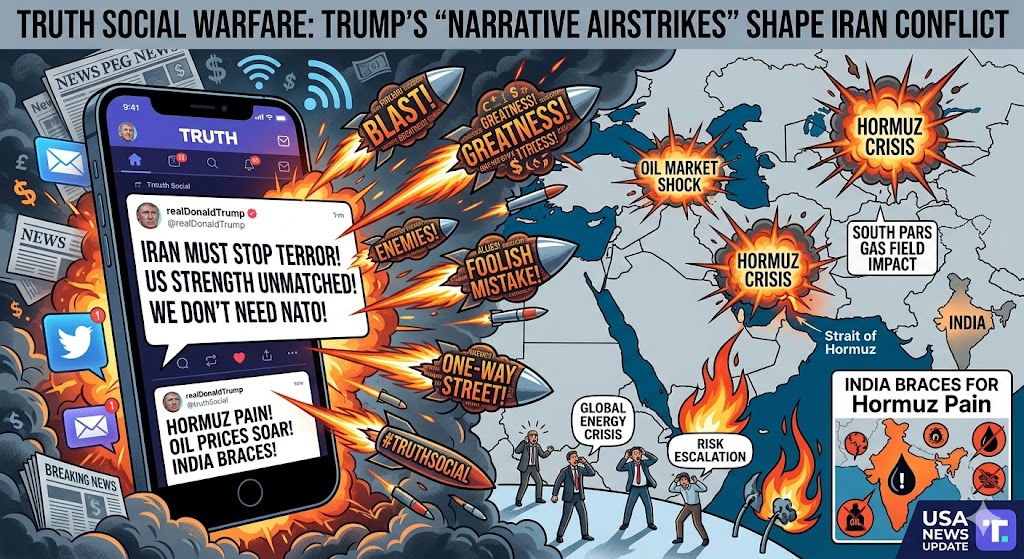
On March 19, following tit-for-tat Israeli-Iranian strikes on the South Pars gas fields, Trump took to Truth Social to deliver a dual-pronged message. In a lengthy post, he simultaneously distanced Washington from Tel Aviv’s specific strike while issuing a harrowing warning to Tehran.
He threatened a counter-strike at “an amount of strength and power that Iran has never witnessed before,” effectively using social media to set the “red line” for American military intervention. This “big, bigger, and biggest” showmanship reflects a president who views imagery and narrative as weapons as potent as missiles.
2. NATO and the Hormuz Crisis
The narrative war isn’t just aimed at enemies; it’s being used to browbeat allies. Trump has repeatedly trained his digital guns on NATO, Japan, and South Korea, demanding they send warships to seize control of the Strait of Hormuz.
- The Demand: Trump declared that countries receiving oil through the passage must take care of it themselves.
- The Flip-Flop: When European allies hesitated, Trump pivoted from a demand for cooperation to a total rejection of the alliance, famously posting: “WE NO LONGER ‘NEED,’ OR DESIRE, NATO… WE NEVER DID!”
3. Global Market Chaos and “Oil Pain”
The impact of these posts extends far beyond the screen. As India and the rest of the world brace for risk escalation, the oil market has reacted with extreme volatility. Each Truth Social blast concerning the Strait of Hormuz or South Pars gas fields sends prices into overdrive, leading to fears of a global energy crisis.
For many, this is the “Wag the Dog” scenario brought to life—where controlling the story is the key to winning the war.
Summary of the “Truth Social” Narrative War
| Date | Key “Truth” Blast Topic | Impact |
|---|---|---|
| Feb 28 | Announcement of US-Israel actions | Shocked oil markets; bypassed State Dept. |
| March 15 | Demand for NATO warships in Hormuz | Strained ties with UK, France, and Germany. |
| March 17 | Rejection of NATO alliance | Labeled US-NATO ties a “one-way street.” |
| March 19 | South Pars/Qatar supply crisis | Threatened “unprecedented” power against Iran. |
Frequently Asked Questions (FAQs)
Q: Is Truth Social now the official source of US Foreign Policy?
A: Effectively, yes. While the State Department still operates, President Trump’s posts frequently precede or contradict official briefings, making his social media feed the most watched source for real-time strategic shifts.
Q: How is India affected by this narrative war?
A: As a major oil importer, India faces “Hormuz pain”—the economic risk associated with supply disruptions in the Strait. The volatility caused by Trump’s posts makes it difficult for global markets to stabilize.
Q: Has Iran responded to these Truth Social threats?
A: Tehran has continued its retaliatory strikes despite the warnings, though they have also used their own state media to counter Trump’s digital narrative, resulting in a 24/7 propaganda loop.