
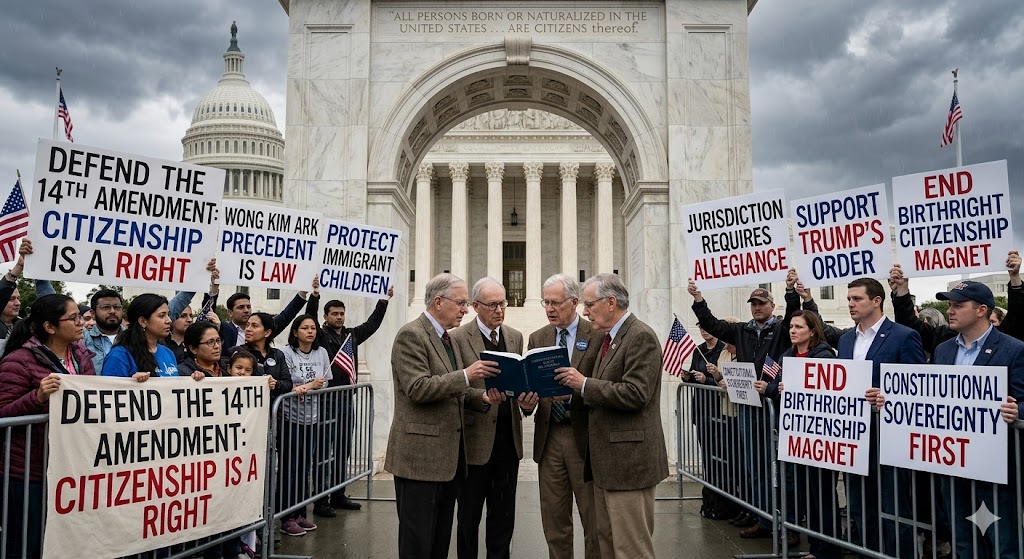
For generations, most legal experts and constitutional historians operated under a stable, if not singular, understanding of the American social contract: if you are born on U.S. soil, you are a U.S. citizen. This principle, known as jus soli (right of the soil), was seen as the definitive answer to the 14th Amendment’s opening command.
But as the Supreme Court prepares for oral arguments this week in the case of Trump v. Barbara, that long-standing consensus has fractured. The legal earthquake triggered by President Trump’s executive order to limit birthright citizenship has not only pitted the White House against civil rights groups but has also created a profound and bitter divide among the nation’s most influential conservative legal scholars.
The Death of Consensus
Before President Trump’s order, there was widespread agreement—even among many originalist and textualist scholars—that the 14th Amendment guaranteed citizenship for U.S.-born babies, regardless of their parents’ immigration status. This consensus was anchored by the 1898 landmark case United States v. Wong Kim Ark, which affirmed the citizenship of a man born in San Francisco to Chinese parents.
Today, that bedrock is being chipped away by a new, more aggressive school of conservative thought. The debate now centers on five words in the amendment: “and subject to the jurisdiction thereof.”
The “Allegiance” Argument
The administration’s allies, led by scholars like John Eastman and constitutional lawyers within the Federalist Society, argue that “jurisdiction” doesn’t just mean being subject to U.S. laws (the way a tourist is subject to speed limits). Instead, they contend it requires a “complete and undivided allegiance” to the United States.
Under this theory, children born to parents who are in the country illegally, or even those on temporary visas, do not fall under the “complete jurisdiction” of the U.S. because their parents owe allegiance to a foreign sovereign.
“The 14th Amendment was never intended to grant citizenship to the children of foreign nationals who are here in violation of our laws,” says Michael Cannon, a fellow at the Center for Constitutional Jurisprudence. “To suggest otherwise is to turn the American Citizenship Clause into a suicide pact for the nation’s borders.”
The Traditionalist Pushback
On the other side of the conservative rift are giants of the legal right who argue that the administration is playing fast and loose with history. These scholars—including former Fourth Circuit Judge J. Michael Luttig and various originalist professors—warn that redefining the 14th Amendment by executive fiat is a dangerous overreach.
“The text is not ambiguous,” Judge Luttig wrote in a recent amicus brief. “The phrase ‘subject to the jurisdiction’ was understood in 1868 to mean exactly what it says: being within the reach of the power of the U.S. government and its courts. To add a ‘status of parents’ requirement that isn’t in the text is a departure from the very originalism the conservative movement claims to champion.”
The Ghost of Wong Kim Ark
At the center of the scholarly storm is Wong Kim Ark himself. In 1904, a photo of Wong showed a man whose very existence defined the inclusive nature of the post-Civil War amendments. For over a century, his case was the final word.
However, the Trump administration’s legal team is attempting a surgical strike on this precedent. They argue that Wong Kim Ark only applied to the children of legal residents, not those whose presence is unauthorized. By drawing this distinction, they hope to provide the Supreme Court’s 6-3 conservative majority a narrow path to uphold the President’s order without technically overturning a century of case law.
A High-Stakes Calculation
The split among scholars reflects a deeper tension within the conservative legal movement: a battle between traditional originalism (which follows the text and history as written) and nationalist originalism (which seeks to align constitutional interpretation with modern national sovereignty concerns).
As the justices take the bench on April 1st, they will not just be listening to arguments about immigration policy. They will be deciding which version of the American story—and which school of conservative legal thought—will govern the next century of citizenship.
Key Legal Milestones in Birthright Citizenship
| Year | Event/Case | Outcome |
|---|---|---|
| 1868 | 14th Amendment Ratified | Established citizenship for “all persons born or naturalized” in the U.S. |
| 1884 | Elk v. Wilkins | Denied citizenship to a Native American because he owed allegiance to his tribe. |
| 1898 | United States v. Wong Kim Ark | Confirmed citizenship for children of non-citizens born on U.S. soil. |
| 2025 | Executive Order 14160 | President Trump orders agencies to deny citizenship to children of undocumented parents. |
| 2026 | Trump v. Barbara | The Supreme Court hears the challenge to the 2025 Executive Order. |
Frequently Asked Questions
What is the core of the disagreement? The debate focuses on whether “subject to the jurisdiction” of the U.S. means simply following U.S. law (the consensus view) or owing exclusive political allegiance (the administration’s view).
Can a President change the Constitution with an Executive Order? Generally, no. A constitutional amendment is required to change the text. However, the administration argues they aren’t changing the 14th Amendment, but rather “correctly interpreting” its existing language for the first time in modern history.
Who is Barbara in Trump v. Barbara? The lead plaintiff is a New Hampshire mother representing a class of infants born in the U.S. to parents with varying legal statuses who were denied citizenship documents following the 2025 order.
Reference Links
- The 14th Amendment Text – National Archives
- Analysis of United States v. Wong Kim Ark – Oyez
- Supreme Court Docket: Trump v. Barbara
Would you like me to analyze the specific “amicus briefs” filed by conservative scholars in this case to see exactly where the ideological lines are drawn?