
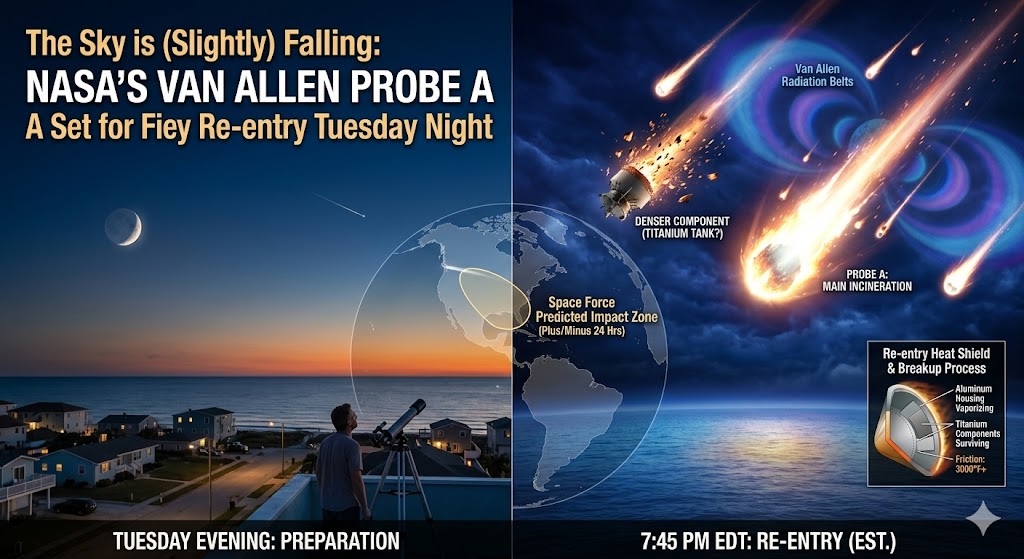
The Sky is (Slightly) Falling: NASA’S Van Allen Probe A Set for Fiery Re-entry Tuesday Night
The vast expanse of the Earth’s atmosphere is about to become a high-stakes incinerator. NASA and the U.S. Space Force are currently tracking a 1,323-pound (600kg) visitor from the silent suburbs of space: Van Allen Probe A. After 14 years in orbit and seven years of retirement, the spacecraft is scheduled to make its final, fiery descent toward Earth this Tuesday evening.
While the phrase “crashing satellite” often conjures images of Hollywood-style devastation, officials are urging calm. Here is everything you need to know about the re-entry, the science behind the mission, and why the odds of a piece of NASA history landing in your backyard are astronomically low.
The Final Descent: When and Where?
According to the latest calculations from the U.S. military’s Space Force, the spacecraft is estimated to re-enter Earth’s atmosphere at approximately 7:45 p.m. EDT on Tuesday, March 10, 2026.
However, predicting the exact “X” on the map is more art than science. Because the probe is traveling at thousands of miles per hour, even a minor change in atmospheric drag—caused by solar activity or the angle of the craft—can shift the landing zone by thousands of miles.
- Initial Uncertainty: Plus or minus 24 hours.
- The “Burn” Factor: Most of the 600kg probe will incinerate upon contact with the dense layers of the atmosphere.
- Survival Odds: While most of the aluminum housing will vaporize, denser components—such as titanium tanks or stainless-steel fittings—are designed to survive the 3,000°F heat of re-entry.
The Odds: Should You Be Worried?
Space Force and NASA scientists have run the numbers, and the statistical probability of a human being harmed by this debris is calculated at 1 in 4,200.
While that might sound high compared to winning the lottery, it is important to view it through the lens of global geography. Earth is a watery planet; roughly 71% of our surface is covered by oceans. Furthermore, the vast majority of the landmass is uninhabited or sparsely populated.
“The odds that you, specifically, will be hit are one in several trillion,” says Mark Matney, a scientist in the orbital debris program office at NASA’s Johnson Space Center. “It is quite low for any particular person.”
The Legend of Lottie Williams
In the history of the Space Age, only one person is famously known to have been struck by “manufactured” space junk. In 1997, Lottie Williams of Tulsa, Oklahoma, was walking in a park when a six-inch charred piece of a Delta rocket grazed her shoulder. She was uninjured, but her story remains the gold standard for “unlucky” statistical anomalies.
The Mission: A Farewell to the Radiation Hunters
To understand why Van Allen Probe A is falling now, we have to look back to August 30, 2012. Launched from Cape Canaveral, Florida, Probe A and its twin, Probe B, were sent into a very specific and dangerous part of space: the Van Allen Radiation Belts.
These belts are two donut-shaped regions of high-energy particles (mostly protons and electrons) trapped by Earth’s magnetic field. They are essential to study because:
- Satellite Safety: The radiation here can fry the electronics of GPS and communication satellites.
- Astronaut Health: Future missions to the Moon or Mars must pass through these intense radiation zones.
The probes were originally expected to last two years, but they proved to be incredibly resilient, operating for seven years before running out of fuel in 2019. Once the fuel was gone, the probes could no longer orient their solar panels toward the sun, effectively “dying” in orbit.
Space Junk: A Growing Global Concern
The re-entry of Van Allen Probe A highlights a burgeoning issue for the 2020s: Orbital Debris. Between 1960 and 2000, roughly 5,400 tons of space material survived re-entry and fell to Earth. Today, with the rise of “mega-constellations” like Starlink and the decommissioning of older NASA satellites, the traffic jam above us is getting crowded.
| Year | Significant Re-entries | Total Mass (Est.) |
| 2024 | 2,100 pieces | 800 Tons |
| 2025 | 2,450 pieces | 950 Tons |
| 2026 (YTD) | 410 pieces | 120 Tons |