
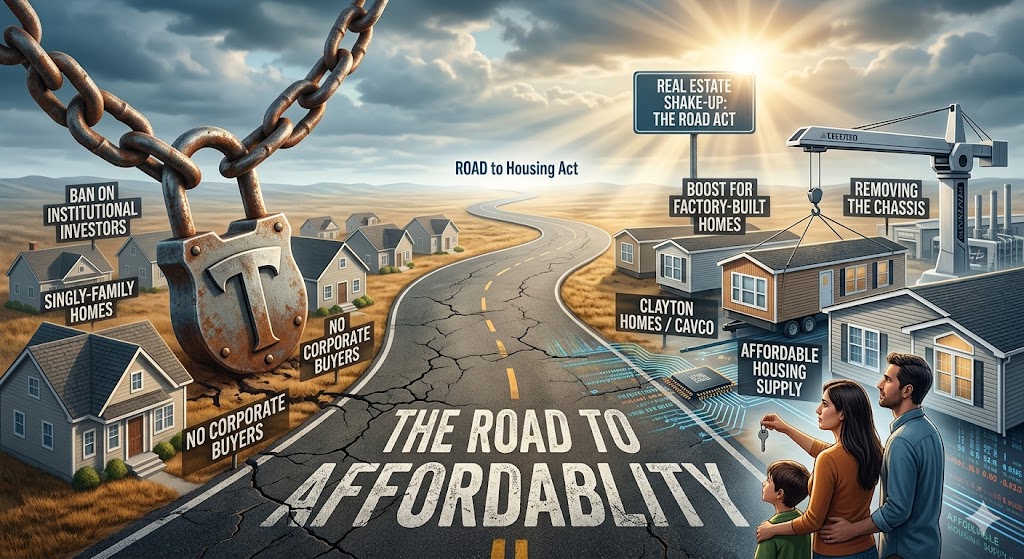
WASHINGTON D.C. — In a rare display of bipartisan alignment, the U.S. Senate has passed the 21st Century ROAD to Housing Act, a sweeping piece of legislation that seeks to dismantle the barriers currently paralyzing the American housing market. While the 89-10 vote signals a desperate hunger for reform, the bill now heads to the House where a high-stakes standoff over institutional investors threatens to derail the most significant housing deal in decades.
At the center of the storm is a controversial provision mirrored by President Trump’s January Executive Order: a total ban on large institutional investors buying and renting single-family homes.
The Investor Ban: A Populist Lightning Rod
Affordability has moved from a kitchen-table concern to a national crisis. With over 70% of Americans expressing deep anxiety over housing costs, both ends of the political spectrum have found a common enemy in “Wall Street Landlords.”
Progressive Senator Elizabeth Warren (D-Mass.) and President Donald Trump have formed an unlikely alliance on this front. Proponents of the ban argue that institutional buyers—entities like Blackstone or Invitation Homes—use their deep pockets to outbid first-time homebuyers, effectively “strip-mining” the American Dream for profit.
However, many economists warn that focusing solely on the investor ban may be a distraction from the bill’s more transformative elements. While the “build-to-rent” sector is a hot-button issue, it represents a relatively small slice of the overall market. The real power of the ROAD Act, experts argue, lies in its 40+ other provisions aimed at supply.
The “Chassis” Revolution: Breaking the Mobile Home Stigma
While the investor ban grabs headlines, a massive win for companies like Berkshire Hathaway’s Clayton Homes and Cavco Industries is tucked inside the bill. For 50 years, federal building codes required manufactured homes to be built on a permanent chassis—a restriction that often led to “mobile home” stigmas and strict zoning barriers.
The ROAD Act changes the game by:
- Removing Chassis Requirements: Allowing homes to be assembled without a permanent chassis, enabling designs that look indistinguishable from site-built homes.
- Relaxing Zoning: Stripping away the local regulations that often push manufactured housing to the outskirts of town.
- Increased Loan Limits: Raising federal loan ceilings to make these high-quality, lower-cost homes accessible to more families.
“We were constrained for half a century,” says Dr. Lesli Gooch, CEO of the Manufactured Housing Institute. “This bill finally allows us to innovate and offer the elevations and housing types that modern buyers want.”
Market Impact: Winners and Losers
As the bill moves back to the House, investors are closely watching the potential fallout.
| Stakeholder | Potential Impact |
|---|---|
| Institutional Investors | Facing a complete lockout from the single-family market; likely to pivot toward multi-family or industrial sectors. |
| Clayton Homes (BRK.B) | Poised for a massive surge in demand as manufactured housing becomes a primary solution for the middle class. |
| Redfin (RDFN) & Zillow | Could see increased transaction volume if the bill successfully triggers a wave of new inventory. |
| First-Time Buyers | Stands to benefit from lowered competition and a projected increase in affordable “factory-built” options. |
The Uphill Battle in the House
Despite the overwhelming Senate support, the ROAD Act faces a “blistering” reception in the lower chamber. House leadership has expressed concerns that the Senate’s version—specifically the aggressive investor ban—may overstep federal authority and disrupt the rental market for families who aren’t yet ready to buy.
The irony is palpable: the very provision designed to save the “American Dream” may be the one that kills the bill entirely. If Congress cannot find a middle ground on the investor ban, the 40 other reforms—including the vital supply-side fixes for manufactured homes—could wither on the vine.
Next Steps for the ROAD Act
- House Consideration: Scheduled for early April.
- Executive Action: President Trump has indicated he will sign the bill immediately if it reaches his desk, viewing the investor ban as a cornerstone of his “America First” housing policy.
Would you like me to track the House floor debate or provide a breakdown of how this bill specifically affects Berkshire Hathaway’s market position?