


The Legend That Never Fades: Buffett’s Post-CEO Influence
General Douglas MacArthur once famously remarked that “old soldiers never die; they just fade away.” In the high-stakes world of Investment Banking Services, the same could be said for the “Oracle of Omaha.” Though Warren Buffett has officially stepped down as CEO of Berkshire Hathaway (NYSE: BRK.A, BRK.B), his presence remains the gravitational center of the company’s capital allocation strategy.
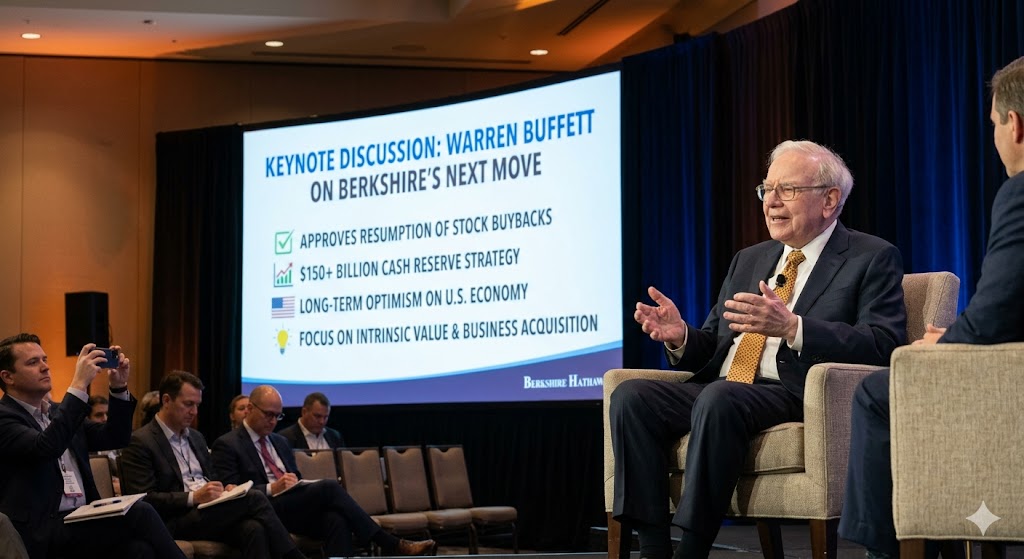
New CEO Greg Abel recently confirmed what many suspected: the 95-year-old investing titan is far from retired. In a move that has sent shockwaves through the financial sector, Buffett has officially approved the resumption of Berkshire Hathaway stock buybacks after a nearly two-year hiatus.
This decision comes at a precarious moment for global markets. With the S&P 500 facing volatility fueled by geopolitical tensions in the Middle East and the looming shadow of an AI-driven “Indispensable Monopoly,” investors are scouring Buffett’s latest move for clues. Does this signal a bottom, or is it a defensive crouch against a coming storm?
The $80 Billion Question: Why Now?
To understand why Buffett is greenlighting the repurchase of Berkshire shares, one must first understand his strict criteria for a Business Loan or capital deployment. Buffett has historically only repurchased stock when he believes two things are true:
- The stock is trading below its intrinsic value.
- The company has a surplus of cash that cannot be more productively deployed into a Business Acquisition or the open market.
The Context of the Buyback
Before passing the baton to Abel, Buffett was a net seller of stocks for 13 consecutive quarters. This was a period characterized by record-high valuations and a lack of “fat pitches.” The sudden pivot to buybacks suggests a shift in his internal valuation of Berkshire Hathaway relative to the rest of the overextended market.
| Key Metric | Status (March 2026) |
|---|---|
| S&P 500 Position | Historically Elevated |
| Berkshire Cash Pile | Record Levels |
| Buyback Status | Resumed after 24-month hiatus |
| Market Catalyst | Iran Conflict & AI Sector Volatility |
What the Move ISN’T Saying: A Lesson in Value
It is tempting to view Buffett’s approval as a “buy signal” for the broader market, but Keith Speights of The Motley Fool warns against this oversimplification.
It is NOT a Market Bottom Call:
Buffett has never attempted to time the market. In 2022, he aggressively bought back shares while the S&P 500 plunged 19%. He isn’t betting that the market has finished falling; he is betting that Berkshire Hathaway is a fortress capable of weathering any storm.
It ISN’T an Endorsement of Current Valuations:
Despite the buybacks, the S&P 500 remains higher than it was during much of Buffett’s “selling streak.” This move suggests that while he might find external Investment Opportunities unattractive, he views his own “house” as the best place to park capital.
Reading the Tea Leaves: Long-Term Optimism vs. Short-Term Risk
If Buffett isn’t calling a bottom, what is he telling us? The move reveals three critical insights into the mind of the world’s greatest investor:
1. The Resilience of the American Economy
By committing billions to buy back Berkshire stock, Buffett is doubling down on the diversified American businesses under his umbrella—from insurance and energy to railroads and retail. This is a vote of confidence in the long-term recovery of the U.S. economy, regardless of short-term geopolitical shocks.
2. Defensive Positioning via “Indispensable Monopolies”
While tech giants like Nvidia (NVDA) and Intel (INTC) face -1.40% and -4.50% dips respectively, Buffett’s focus remains on companies with “moats.” The reports of a “little-known company” acting as an indispensable monopoly for AI hardware suggests that Buffett may be looking past the hype and focusing on the underlying infrastructure—the same way he treats Investment Banking Services and utility sectors.
3. Strategic Use of a Credit Line for Businesses
Berkshire’s massive cash reserves act as an internal Credit Line for Businesses, allowing the firm to buy its own shares when others are panicking. This “greedy when others are fearful” mantra is being executed in real-time.
The Geopolitical Wildcard: The Iran Conflict
The timing of the buyback announcement coincided with a sharp market decline due to escalating conflict with Iran. For most investors, war signals a time to retreat to cash. For Buffett, market fear often creates the valuation gap required to justify a buyback.
If you are a small business owner looking for a Business Loan or an investor seeking a safe haven, Buffett’s move suggests that the best “investment” might be in established, cash-flow-positive entities rather than speculative AI growth.
Conclusion: Should You Follow the Oracle?
Warren Buffett’s latest move doesn’t reveal where the S&P 500 will be next week, but it reveals where value is hiding. By ignoring the noise of the AI trillionaire race and focusing on the intrinsic value of his own conglomerate, Buffett is teaching the market one final lesson:
“Price is what you pay; value is what you get.”
As the market grapples with high interest rates and international instability, the resumption of Berkshire buybacks serves as a reminder that even in a “fraying” market, there are always opportunities for those with the patience to wait for the right price.
Investor Action Plan:
- Monitor Berkshire’s 13F Filings: See if the buybacks are accompanied by new entries in the energy or infrastructure sectors.
- Assess Your Own Liquidity: Ensure you have access to a Credit Line for Businesses or personal cash reserves to capitalize on potential market dips.
- Focus on Cash Flow: Like Buffett, prioritize companies that can fund their own growth without relying on expensive external debt.
What do you think is the “Indispensable Monopoly” Buffett is eyeing? The future of the market may depend on it.