

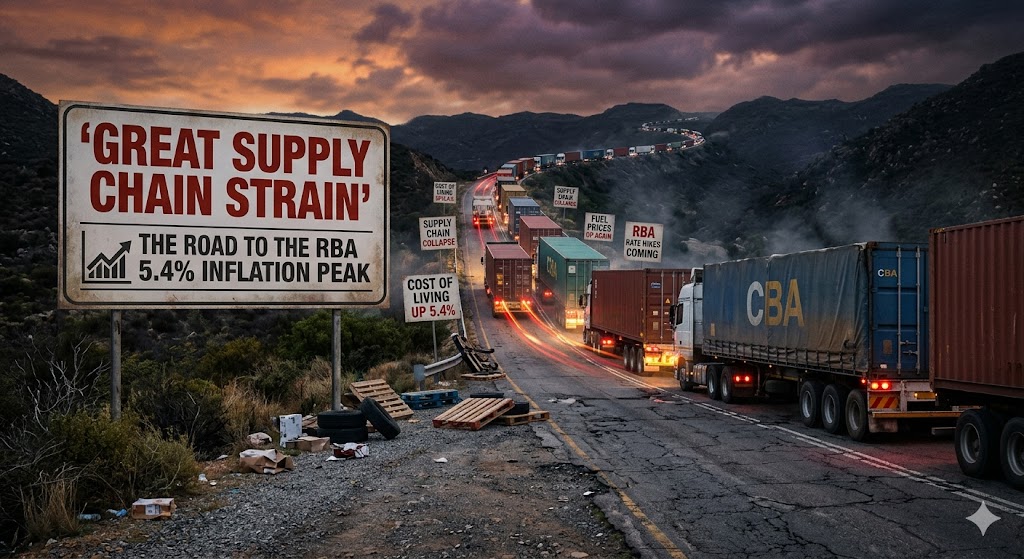

Latest Breaking News updates: Australia’s largest lender, the Commonwealth Bank (CBA), has issued a sobering update to its economic outlook, warning that the nation’s headline inflation is on track to hit a staggering 5.4% by the end of the June quarter. This upward revision—a significant jump from the bank’s previous 4% forecast—comes as global supply chains buckle under the weight of a prolonged and intensifying conflict in the Middle East.
With the Reserve Bank of Australia (RBA) already on high alert, the “inflation genie” appears to be well and truly out of the bottle, forcing households to brace for a winter of record-high living costs and the very real possibility of further interest rate hikes.
The Catalyst: A War Without an Exit Strategy
The primary driver behind this “dire warning” is the escalating Iran war. While initial market hopes leaned toward a swift resolution or a successful ceasefire brokered by international powers, those hopes are rapidly fading. CBA’s head of Australian economics, Belinda Allen, noted that the bank’s central case now assumes the conflict will persist much longer than markets had originally priced in.
A critical flashpoint is the Strait of Hormuz. As one of the world’s most vital maritime chokepoints—responsible for the passage of roughly one-fifth of the globe’s oil supply—its effective closure by Iran has sent shockwaves through energy markets.
- Oil Prices: CBA’s base case is now predicated on benchmark Brent crude sitting at $US120 a barrel for at least the next three months.
- Fuel Security: The closure has stranded oil and LNG exports, leading to what the International Energy Agency (IEA) describes as the “greatest global energy and food security challenge in history.”
- Shipping Costs: Major maritime carriers are rerouting vessels around the Cape of Good Hope, adding weeks to transit times and forcing “war risk” surcharges onto almost every imported good.
Breaking Down the 5.4% Peak
While the Australian Bureau of Statistics (ABS) recently reported that inflation had eased to 3.7% in the year to February, those figures are now viewed as the “calm before the storm.” Because that data predated the most violent escalations in the Middle East, it failed to capture the recent surge in pump prices and transport overheads.
Where the Pressure is Highest
According to CBA’s analysis, the inflation spike is no longer confined to a single sector. The “breadth” of the increase is what most concerns economists:
- Transport and Freight: With diesel and jet fuel prices doubling in some regions, the cost of moving goods—from groceries to construction materials—is being passed directly to the consumer.
- Energy and Utilities: Elevated gas prices are filtering through to household electricity bills and industrial inputs.
- Food and Staples: The disruption of fertiliser exports (specifically urea) from the Gulf region is threatening global agricultural yields, suggesting that “grocery supply emergencies” seen abroad could soon translate to higher shelf prices in Australia.
The RBA’s “Patience Has Run Out”
The timing of this supply shock could not be worse for the Reserve Bank of Australia. Unlike the post-pandemic inflation peak of 7.8%, which was met with a degree of patience, the RBA’s tolerance for above-target inflation is now exhausted.
In March 2026, the RBA Monetary Policy Board took the aggressive step of raising the cash rate to 4.10%. The board’s decision was driven by “home-grown” inflation pressures—such as a tight labour market and resilient consumer spending—which have now been supercharged by the offshore energy crisis.
“The RBA lifted rates because inflation was already rising,” Belinda Allen explained. “The energy shock only adds to the risk that inflation expectations become entrenched.”
Economists now see a 65% chance of another rate hike in May, as the central bank moves to prevent a “wage-price spiral” where workers demand higher pay to keep up with the 5.4% cost-of-living increase.
The Economic “Speed Limit” and Recession Risks
Australia is currently operating above its “speed limit.” When demand for goods and services outstrips the economy’s ability to supply them—a situation exacerbated by broken shipping lanes—prices inevitably soar.
CBA has slashed its GDP growth forecast for 2026 from 1.9% to 1.6%, warning that the “double whammy” of high prices and high interest rates will inevitably cool the economy. While Australian households entered this period with relatively strong financial buffers, the persistence of the conflict suggests those buffers will be tested.
The Bottom Line for Australians
As the June quarter approaches, the message from the nation’s economists is clear: the path to 2% inflation has become significantly steeper. For the average family, the 5.4% headline figure represents more than just a statistic—it is a forecast of tighter budgets, more expensive commutes, and a central bank that is no longer willing to look the other way.
Would you like me to analyse how these inflation figures might specifically impact the Australian housing market or mortgage repayment trends for the remainder of 2026?
CBA’s take on the Iran situation and inflation
This report provides a visual breakdown of how the Middle East conflict is directly threatening to reverse Australia’s recent progress in cooling inflation.