

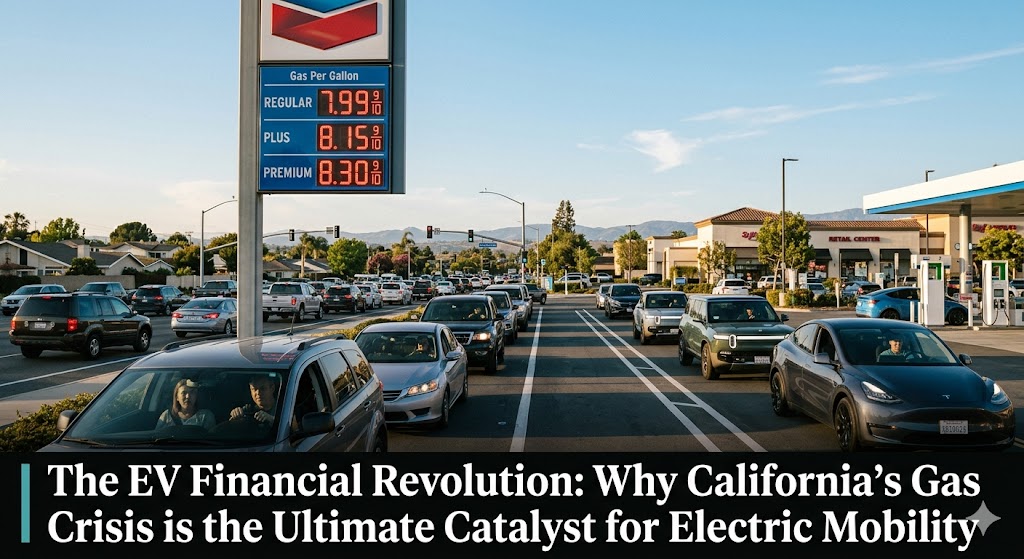

March 30, 2026 — The golden state is facing a leaden reality at the pump. As California gas prices surge to a staggering average of $5.83 per gallon this March, the traditional combustion engine is increasingly being viewed as a liability rather than a convenience. With a nearly $1.00 increase since May 2025, driven by persistent Middle East instability and global supply chain volatility, the “smart money” in the California real estate market and beyond is shifting rapidly toward electric vehicle (EV) infrastructure.
For the average commuter, the math has moved from theoretical to transformative. Those driving the statewide average of 1,203 miles monthly are now staring down $287 in monthly gas costs, compared to just $121 for residential EV charging. This creates an annual surplus of over $2,000, a figure that significantly impacts household debt management and disposable income trends in 2026.
The Comparative Breakdown: Fuel vs. Electrons
The economic divergence becomes even clearer when examining specific high-volume vehicle segments.
| Vehicle Model | Monthly Fuel Cost (Gas) | Monthly Charging Cost (EV) | Monthly Savings |
|---|---|---|---|
| Honda CR-V vs. Tesla Model Y | $234 | $90 | $144 |
| Toyota Corolla vs. Nissan Leaf | $201 | $109 | $92 |
| Average Statewide Driver | $287 | $121 | $166 |
Last year, the average monthly savings stood at $99. Today’s $166 delta represents a 67% increase in the value proposition for electric mobility in less than twelve months. For those looking for cheap electric companies or electricity price comparisons, the incentive to switch has never been higher.
Navigating the Utility Rate Minefield
While the savings are substantial, EV ownership in California requires a level of strategic planning that gasoline never demanded. PG&E customers and those under San Diego Gas & Electric (SDG&E) face some of the most complex time-of-use (TOU) rate structures in the nation.
- Off-Peak Advantage: Charging at 23 cents per kWh (typically overnight) keeps costs minimal.
- Peak-Hour Penalty: Rates can skyrocket to 62 cents per kWh, effectively erasing the EV discount.
- The “Garage Fueling” Strategy: Successful EV adopters treat their home charger as a personal gas station, utilizing smart scheduling to avoid peak-hour financial hits.
Public charging stations add another layer of complexity. With averages around 42 cents per kWh and premium fast-charging hitting 70 cents, exclusive reliance on networks like Electrify America during high-demand windows can result in “fuel” bills that mirror the very gas prices drivers are trying to escape.
The Total Cost of Ownership (TCO) in 2026
Looking beyond the plug, the used EV market is becoming more accessible. Prices for pre-owned electric models have dropped 8.8% year-over-year, now averaging $34,821. This price parity with internal combustion vehicles is a major milestone, yet secondary costs remain higher.
- Auto Insurance Premiums: EV insurance typically runs 20% higher due to specialized battery repair costs and advanced sensor technology.
- Registration & Fees: California’s registration fees for zero-emission vehicles often include additional weight-based surcharges to offset lost gas tax revenue.
- Home Infrastructure: While long-term savings are high, the upfront cost of home charger installation can range from $1,200 to $3,500 depending on the age of the home’s electrical panel.
Industry Insight: The psychological trade-off for Californians has evolved. It is no longer just “range anxiety” vs. convenience; it is now a battle between predictable electricity bills and the volatile pump prices dictated by global conflict.
Conclusion: The Strategic Shift
As regional tensions show no sign of cooling, the decision to plug in is moving from an environmental statement to a calculated financial asset protection strategy. For California drivers, the volatility of the pump is becoming a luxury they can no longer afford.
Would you like me to research the current rebates and federal tax credits available for EV home charger installations in California for 2026?