

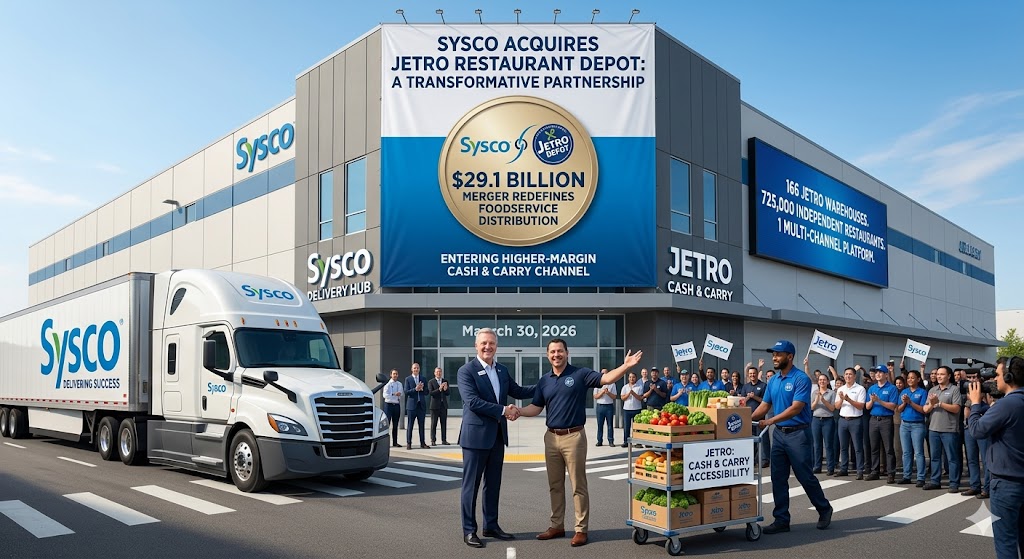

HOUSTON, TX and WHITESTONE, N.Y. — In a move that sent shockwaves through the global supply chain and hospitality sectors, Sysco Corporation (NYSE: SYY) announced today, March 30, 2026, that it has entered into a definitive agreement to acquire Jetro Restaurant Depot. The transformative $29.1 billion deal unites the world’s largest broadline food distributor with the undisputed leader of the U.S. “Cash & Carry” sector, creating an unprecedented multi-channel platform designed to dominate the “food-away-from-home” market.
The acquisition marks a strategic pivot for Sysco, providing an immediate and massive footprint in the high-margin, resilient wholesale segment that serves the backbone of the American culinary scene: small, independent restaurants.
The Anatomy of a Landmark Deal
Under the terms of the agreement, the transaction is structured as a mix of cash and equity. Jetro Restaurant Depot shareholders will receive $21.6 billion in cash alongside 91.5 million shares of Sysco common stock.
Based on Sysco’s closing price of $81.80 on March 27, 2026, the total enterprise value sits at approximately $29.1 billion. This represents a valuation multiple of 14.6x Jetro Restaurant Depot’s 2025 operating income—a figure analysts describe as a premium reflection of Jetro’s rare consistency and “recession-proof” business model.
Jetro Restaurant Depot is not a small addition; it is a titan in its own right. In the 2025 calendar year, the company generated:
- $16 billion in revenue.
- $2.1 billion in EBITDA.
- $1.9 billion in free cash flow.
With a 30-year track record of uninterrupted EBITDA growth, Jetro provides Sysco with a stabilized, high-cash-generation engine that is expected to be immediately accretive to Sysco’s earnings per share (EPS) and overall margins.
Bridging the Gap: Delivery Meets Cash & Carry
For decades, Sysco has been synonymous with “white-glove” delivery service—the massive trucks seen outside hotels, hospitals, and large chain restaurants. However, a significant portion of the $60–$70 billion addressable Cash & Carry market remained out of reach.
Independent chefs and “mom-and-pop” bistros often prefer the Cash & Carry model for its:
- Immediate Access: On-demand product availability seven days a week.
- Price Transparency: Everyday low prices without delivery surcharges.
- Variable Volume: The ability to buy exactly what is needed for that day’s service without meeting high delivery minimums.
Jetro Restaurant Depot currently operates 166 large-format warehouse stores across 35 states, serving over 725,000 independent operators. By bringing Jetro into the fold, Sysco now owns the entire customer journey—from the massive stadium contract requiring 50 trucks a week to the local taco truck owner who needs two cases of limes at 7:00 AM.
Strategic Synergies and Future Growth
Kevin Hourican, Chair and CEO of Sysco, highlighted the “Tech and Logistics” marriage that defines this deal.
“Together, Sysco and Jetro Restaurant Depot will enhance value for small independent restaurants by expanding access to more affordable, fresh food products,” Hourican stated. “Jetro will benefit from Sysco’s best-in-class supply chain and logistics, while Sysco gains a new, resilient way to serve local customers.”
The “Long Runway” Strategy
The acquisition isn’t just about maintaining the status quo. Sysco sees a “long runway” for physical expansion. Currently, Jetro is in 35 states; Sysco intends to use its real estate expertise and capital to bring Jetro warehouses to hundreds of new communities. This expansion is expected to create thousands of new jobs and provide a localized “hub” for Sysco’s digital tools.
Operational Independence
Recognizing the unique culture and operational excellence of the brand, Sysco announced that Jetro Restaurant Depot will operate as a standalone business segment within the company. This move mirrors successful past acquisitions where the “secret sauce” of the acquired company was preserved rather than absorbed into the corporate monolith.
Financial Outlook and Market Reaction
Following the announcement, Sysco reaffirmed its full-year 2026 guidance. The company also shared a “sneak peek” into its Q3 2026 performance, noting that U.S. Foodservice (USFS) local volume growth exceeded 3.0%.
The financial community has responded with cautious optimism. While the $29 billion price tag is steep, the synergy potential is undeniable. The combined entity will have massive purchasing power, likely allowing Sysco to negotiate even lower COGS (Cost of Goods Sold) with global suppliers, passing those savings down to the end consumer—the restaurant guest.
Conclusion: A New Era for Foodservice
As the industry faces the “Low-Cost Crisis” and fluctuating energy prices (as seen in the Asian aviation markets and global logistics), Sysco’s move into Cash & Carry is a defensive and offensive masterstroke. By diversifying into a channel that thrives when delivery costs rise, Sysco has insulated itself against the volatility of the 2026 economy.
For the independent chef, today’s news promises a future where the inventory of a global giant is available with the convenience of a local warehouse. For shareholders, it represents a bold bet on the enduring American appetite for dining out.
Forward-Looking Statements: This report contains information based on the joint announcement by Sysco and Jetro Restaurant Depot. Transactions are subject to regulatory approvals and customary closing conditions.