
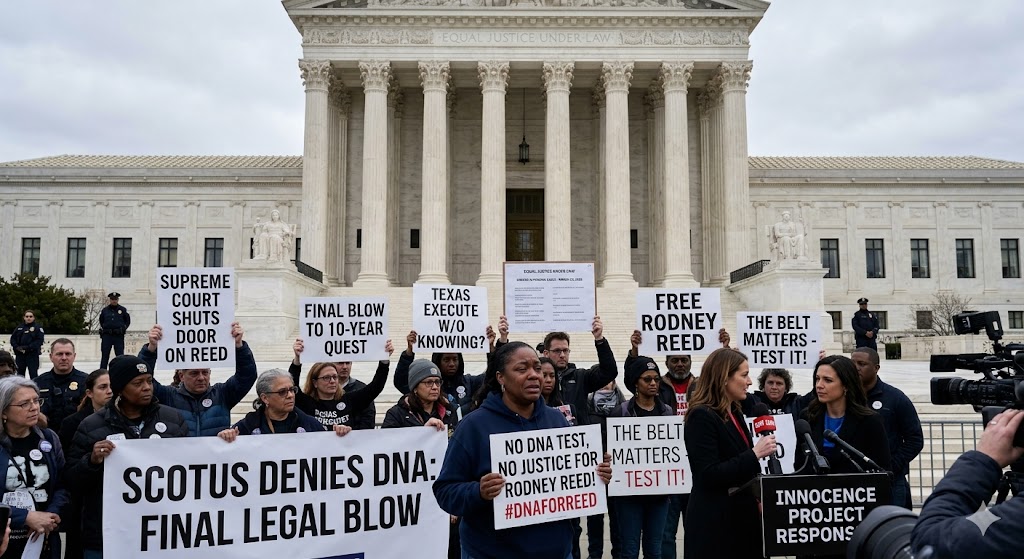
Supreme Court Shuts Door on Rodney Reed: The Final Legal Blow to a Decade-Long Quest for DNA Testing
WASHINGTON — In a move that likely seals the fate of one of America’s most high-profile death row inmates, the United States Supreme Court on Monday declined to hear the latest appeal from Rodney Reed. The decision effectively ends Reed’s years-long federal campaign to compel the State of Texas to release forensic evidence—including the murder weapon—for modern DNA testing.
The rejection comes despite a massive international “Free Rodney Reed” movement supported by lawmakers, human rights organizations, and celebrities like Rihanna and Kim Kardashian. With the highest court in the land now stepping aside, Texas authorities are cleared to move forward with execution proceedings for a crime Reed has adamantly maintained he did not commit for nearly thirty years.
A Divided Court: The Liberal Dissent
As is standard for routine orders, the conservative majority did not provide a written explanation for denying the petition. However, the court’s three liberal justices—Sonia Sotomayor, Elena Kagan, and Ketanji Brown Jackson—issued a sharp dissent, highlighting the moral and legal gravity of the refusal.
The dissenters argued that by turning away the appeal, the Court is allowing Texas to proceed with an execution while potentially dispositive evidence remains locked in an evidence locker.
“Texas is likely to execute Mr. Reed without ever knowing whether his DNA is on the murder weapon,” the justices wrote, “even though a simple DNA test could reveal that information.”
The Case That Polarized Texas
The saga began in 1996 in Bastrop County, Texas, with the brutal rape and murder of 19-year-old Stacey Stites. Stites was found strangled with her own belt.
- The Prosecution’s Case: Investigators found DNA inside Stites that matched Rodney Reed. At the time, Reed, who is Black, initially denied knowing Stites, who was white. This initial denial was used heavily by prosecutors to paint him as a predator who had encountered a stranger.
- The Defense’s Rebuttal: Reed later admitted to the encounter but claimed he and Stites were involved in a secret, consensual interracial affair—a dangerous dynamic in 1990s rural Texas. He argued that the DNA was a result of a consensual meeting and that the real killer was likely Stites’s fiancé, Jimmy Fennell, a local police officer at the time.
Evidence brought forward in subsequent years by Reed’s legal team at the Innocence Project included affidavits from witnesses who claimed Fennell had made threatening or incriminating statements about Stites before and after her death. Fennell has consistently denied any involvement.
The Procedural Quagmire
The Supreme Court’s decision on Monday was the culmination of a dizzying procedural journey.
In 2023, the Supreme Court actually handed Reed a temporary victory. At that time, the lower Fifth Circuit Court of Appeals had ruled that Reed’s request for DNA testing was “time-barred” because he waited too long to file his federal lawsuit. The Supreme Court overturned that, ruling that the clock for the statute of limitations didn’t start until the state-level appeals were fully exhausted.
However, that 2023 ruling was merely about timing, not about whether Reed was actually entitled to the testing. When the case went back down to the lower courts to be heard on its merits, judges again sided with Texas, citing the “unreliable chain of custody” of the evidence and arguing that even a favorable DNA result wouldn’t necessarily prove Reed’s innocence given the other evidence in the case.
The Evidence in Question
Reed’s team sought to test approximately 40 items, most notably:
- The Murder Weapon: The belt used to strangle Stites.
- Clothing: Items worn by Stites at the time of her death.
- The Vehicle: Forensic swabs from the truck Stites was driving.
The State of Texas argued—and the courts agreed—that because these items had been handled by many people during the original 1998 trial and subsequent storage, any DNA found now would be “contaminated” and legally meaningless.
Frequently Asked Questions (FAQs)
Q: Why won’t Texas just test the belt to be sure?
A: Prosecutors argue that the legal standard for post-conviction DNA testing is very high. They contend that the evidence has been handled by too many people (lawyers, jurors, clerks) over 28 years, making any results scientifically unreliable. They also argue the existing DNA evidence from 1996 is sufficient for the conviction.
Q: Does this mean Rodney Reed will be executed immediately?
A: Not immediately, but the primary legal “stay” mechanism has been removed. The State of Texas must now apply for a new execution date, which typically provides a window of several months.
Q: Can the Governor of Texas intervene?
A: Yes. Governor Greg Abbott has the power to grant a one-time 30-day reprieve. He can also grant clemency or commute the sentence to life in prison, but only if the Texas Board of Pardons and Paroles recommends it. In 2019, Abbott remained silent while the state appeals court issued a stay just days before the scheduled execution.
Reference Links & Further Reading
- The New York Times: Supreme Court Rejects Appeal From Death Row Inmate Seeking DNA Testing
- The Innocence Project: The Case of Rodney Reed – Facts and Affidavits
- Supreme Court of the United States: [Orders in Pending Cases – March 23, 2026]