
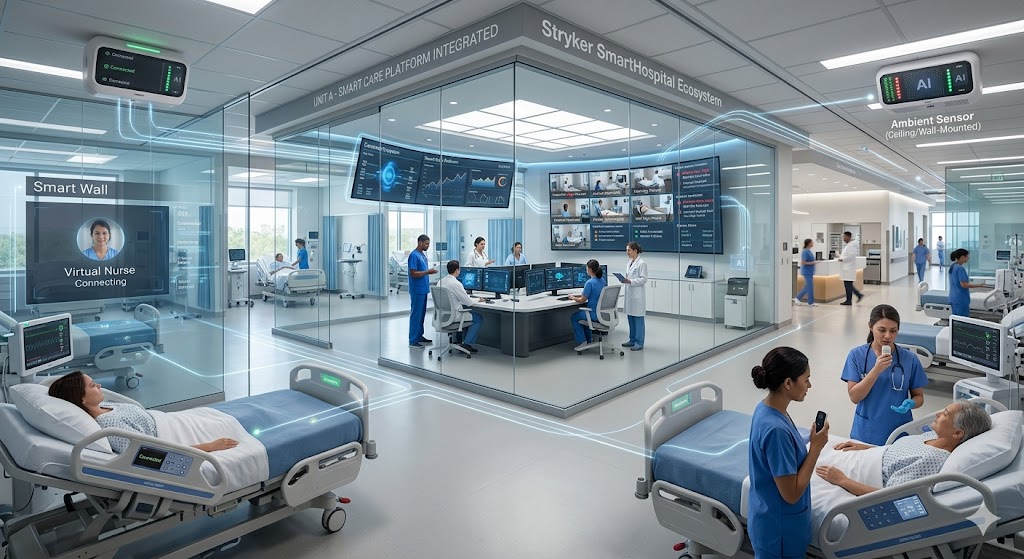
Stryker Disrupts Healthcare Infrastructure: The Dawn of the AI-Driven “SmartHospital Platform”
ORLANDO, FL — In what industry analysts are calling a “watershed moment” for medical technology, Stryker has officially unveiled its SmartHospital Platform at the 2026 HIMSS Global Conference and Exhibition. The launch marks a fundamental shift in how hospital environments are constructed, moving away from a collection of isolated gadgets toward a singular, living digital nervous system.
For decades, the “hospital of the future” has been a fragmented promise. While individual devices—beds, monitors, and imaging tools—have become smarter, they have largely remained “siloed,” unable to speak the same language. Stryker’s new platform aims to end this era of digital isolation by using ambient AI and edge computing to unify devices, data, and clinical workflows into one connected ecosystem.
The “Missing Middle” of Healthcare Technology
The strategy behind the SmartHospital Platform is led by Stryker’s newly minted Smart Care business unit. According to Scott Sagehorn, Vice President and General Manager of Smart Care, the platform was designed to occupy a critical, yet historically neglected, space in the healthcare stack.
“Traditionally, hospital IT has been dominated by Electronic Health Records (EHR) on one side and Revenue Cycle Management (RCM) on the other,” Sagehorn explained during the HIMSS keynote. “But the actual ‘middle ground’—the space where care is delivered, where nurses move, and where patients breathe—has been a chaotic mix of disconnected hardware. We are building the digital foundation for that middle ground.”
By focusing on the physical environment of care, Stryker is addressing the three most “stubborn” challenges facing modern medicine: system fragmentation, extreme staff burnout, and skyrocketing patient volumes.
The Anatomy of a Smart Ecosystem
The SmartHospital Platform isn’t just a software update; it is a comprehensive integration of hardware and artificial intelligence. The platform brings together several high-tech capabilities that, until today, lived in separate boxes:
1. Ambient Sensing and “Edge” AI
At the heart of the platform are camera-based sensors equipped with dedicated on-unit GPU processors. Unlike traditional systems that send data to a central server for processing, these sensors run AI “at the edge.” This allows the room itself to “perceive” what is happening in real-time—such as a patient attempting to get out of bed unassisted or a clinician entering the room—without the lag of cloud processing.
2. Virtual Nursing and Monitoring
Building on Stryker’s acquisition of Care.ai approximately 18 months ago, the platform fully integrates virtual care. This allows a single “virtual nurse” to monitor dozens of rooms from a central hub, handling documentation, patient education, and discharge checklists, thereby freeing up bedside nurses to focus on physical clinical tasks.
3. Hands-Free Communication
The platform incorporates voice-activated, hands-free tools that allow care teams to communicate without breaking sterile fields or fumbling with mobile devices. By filtering and prioritizing alarms, the system ensures that only “actionable” notifications reach the clinician, directly attacking the “alarm fatigue” that plagues modern nursing.
The Care.ai Legacy: From Acquisition to Integration
The integration of Care.ai has proven to be the “secret sauce” for Stryker’s new venture. By marrying Care.ai’s ambient infrastructure with Stryker’s massive portfolio of medical hardware (from power-cots to surgical robots), the company has created a feedback loop.
In an Operating Room (OR) setting, for example, the platform uses a cloud-based interface to manage data flow. Outside the OR, on the med-surg floors, the Care.ai sensor infrastructure orchestrates workflows. This includes a newly adapted Quantitative Blood Loss (QBL) AI tool. Originally designed for surgical suites, this AI is now being deployed in ICUs to monitor patient stability with a level of precision previously impossible in a standard ward.
“Open by Design”: Avoiding the Vendor Lock-In Trap
One of the most surprising elements of Stryker’s announcement was its commitment to an Open Ecosystem. In an industry often criticized for “walled gardens” and proprietary data silos, Stryker has taken a different path.
The SmartHospital Platform currently integrates with more than 280 third-party technologies, including:
- Major EHR systems (Epic, Oracle/Cerner)
- Advanced Imaging platforms
- Third-party workflow and scheduling tools
- Niche point-solution products
“We don’t expect to be a hospital’s only technology provider,” Sagehorn noted. “Good workflow depends on connected and open systems. If we tried to lock hospitals into only using Stryker products, we would be recreating the very fragmentation we’re trying to solve.”
Scaling from the Ivy League to Rural Care
Stryker is launching the platform with a dedicated force of 60 software and AI specialists. While the primary target is the “C-suite” of large, technology-forward enterprise health systems, the company insists that the platform is not “luxury-only.”
The “SmartHospital” is sold modularly. Smaller or rural facilities can start with a single component—such as virtual monitoring—and scale up as their budget and infrastructure allow. This flexible go-to-market strategy ensures that the “digital divide” in healthcare doesn’t widen as AI becomes the standard of care.
The Future: From Ambulance to ICU
The 2026 HIMSS launch is only the beginning. Stryker is already eyeing hundreds of additional use cases for the platform. By utilizing the same AI-driven “brain,” the company hopes to track the patient journey from the moment they enter an ambulance, through the ER, into surgery, and eventually to recovery.
By unifying the “middle ground” of healthcare, Stryker isn’t just selling tools; it is selling clarity. In a world where every second counts, a hospital that can “see, hear, and think” alongside its staff might be the most important medical breakthrough of the decade.
Quick Look: The SmartHospital Platform
| Feature | Description |
|---|---|
| Core Technology | Ambient camera-based sensors with Edge-GPU AI. |
| Integrations | 280+ third-party platforms (EHRs, Imaging, etc.). |
| Primary Goal | Reducing staff overload and improving patient safety. |
| Key Acquisition | Care.ai (integrated ambient sensing architecture). |
| Deployment | Modular; available for large systems and rural clinics. |