
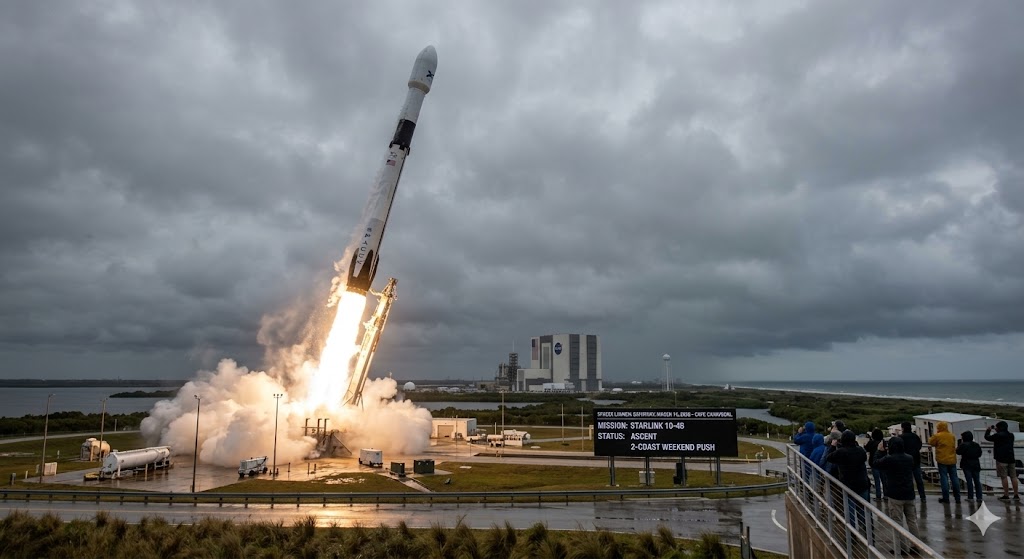
SpaceX Launch Schedule: Starlink Missions From Cape Canaveral Cap a Two-Coast Weekend Push
The aerospace industry witnessed a masterclass in operational logistics this weekend as SpaceX successfully executed a rapid-fire launch sequence that spanned the United States. In a display of what has become the company’s signature “high-cadence” rhythm, SpaceX completed a “two days, two coasts” surge, culminating in a successful Falcon 9 launch from Cape Canaveral Space Force Station on a gray, overcast Saturday morning.
The weekend’s activities centered on the relentless expansion of the Starlink megaconstellation. Identified as mission Starlink 10-48, the Saturday morning liftoff served as the anchor for a flurry of activity that saw three separate batches of satellites reach orbit in less than 48 hours. This relentless pace underscores a significant shift in the SpaceX launch schedule, moving away from isolated events toward a continuous, assembly-line flow of orbital delivery.
The Cape Canaveral Surge: Launching Through the Clouds
The highlight of the weekend for East Coast observers was the departure of a Falcon 9 from Space Launch Complex 40 (SLC-40) in Florida. Despite a thick layer of clouds that blanketed the Space Coast on Saturday morning, the mission—Starlink 10-48—proceeded without a hitch.
Observers at the Cape noted that while the visual spectacle of the climb was partially obscured by the weather, the characteristic roar of the Merlin 1D engines served as a thunderous reminder of the company’s reliability. The mission successfully deployed another batch of Starlink internet satellites into Low Earth Orbit (LEO), further densifying the shell of the constellation designed to provide high-speed, low-latency internet to the most remote corners of the globe.
Technical Precision in Starlink 10-48
The Starlink 10-48 mission utilized a flight-proven Falcon 9 first-stage booster, continuing SpaceX’s industry-leading reuse program. Following stage separation, the booster performed a precision landing on a drone ship stationed in the Atlantic Ocean. This recovery process has become so routine that it is often overlooked, yet it remains the economic engine that allows the SpaceX launch schedule to remain as tight as it is.
Two Coasts, Two Days: A National Operation
What truly distinguished this weekend was not just the Cape Canaveral launch, but the simultaneous operations taking place thousands of miles away at Vandenberg Space Force Base in California. The “two days, two coasts” framing used by industry analysts highlights the immense logistical burden of managing two active launch sites simultaneously.
- East Coast Operations: Cape Canaveral served as the hub for Starlink 10-48.
- West Coast Operations: Vandenberg facilitated back-to-back Starlink batch launches, targeting polar and high-inclination orbits.
Managing these “back-to-back” batches requires a near-continuous flow of hardware, personnel, and range coordination. For the United States Space Force and the Federal Aviation Administration (FAA), the ability to clear airspace and coordinate ground safety for multiple launches within such a narrow window is a testament to the maturing relationship between private industry and federal regulators.
Analyzing the Operational Rhythm
The current cadence of the SpaceX launch schedule is not merely about hitting numbers; it is about testing the limits of ground infrastructure. When SpaceX “stacks” missions close together rather than spacing them out, they are performing a live stress test of:
- Refurbishment Cycles: How quickly can a drone ship return to port and a booster be inspected for its next flight?
- Pad Turnaround: How fast can the ground crews at SLC-40 or SLC-4E (Vandenberg) reset the plumbing, fuel lines, and transporter-erector for the next rocket?
- Supply Chain: The constant manufacturing and delivery of Starlink satellites to keep up with the launch capacity.
This operational rhythm has a ripple effect. Launch watchers and local businesses in Florida and California now plan around a schedule that is increasingly fluid. A “Saturday morning launch” is no longer a localized event but a synchronized part of a national orbital strategy.
The Strategic Importance of the Starlink Megaconstellation
The driving force behind this weekend’s push remains the Starlink project. As of March 2026, the constellation has grown to become the largest satellite network in history. By launching in batches—often up to 23 satellites at a time—SpaceX is ensuring that their global coverage remains robust and capable of handling increasing subscriber demand.
Each successful weekend push, like the one witnessed on March 14th and 15th, adds critical capacity to the network. This capacity is vital for:
- Maritime and Aviation: Providing uninterrupted internet for ships at sea and planes in flight.
- Global Connectivity: Bridging the digital divide in developing nations and rural areas.
- Defense Applications: Supporting the Starshield initiative, which leverages Starlink technology for government and military security.
What To Watch Next: Maintaining the Tempo
With the “two-coast weekend” successfully capped, the industry now turns its gaze toward the rest of the month. The question for observers is whether SpaceX can maintain this “near-continuous” flow.
Historically, SpaceX has aimed for a launch every few days, but the clustering of missions over this past weekend suggests they are aiming for a higher gear. For those tracking the SpaceX launch schedule, the key signals to watch for include:
- Vandenberg Turnaround: How quickly can the West Coast site follow up on its recent flurry?
- Cape Canaveral’s Next Window: With 10-48 in the books, the next Starlink flight is likely already on the pad or in the hangar.
- Non-Starlink Missions: How will the company balance its internal Starlink needs with high-priority customer launches, such as GPS satellites or Crew Dragon missions to the ISS?
Conclusion: A New Era of Access to Space
The cloudy Saturday morning in Cape Canaveral was more than just another launch; it was the final note in a weekend-long symphony of aerospace engineering. By successfully launching Starlink batches from both the Atlantic and Pacific coasts within 48 hours, SpaceX has demonstrated a level of orbital access that was once considered science fiction.
As the company continues to stack missions and tighten the windows on the SpaceX launch schedule, the barrier to entry for space is being lowered one Falcon 9 at a time. For now, the takeaway is clear: the pace is accelerating, and the “two-coast push” is the new standard.
Visit the link on comment for the full mission gallery and real-time launch tracker!
