Port Arthur Refinery Crisis: Explosion and Fire at Valero’s Diesel Hydrotreater Unit
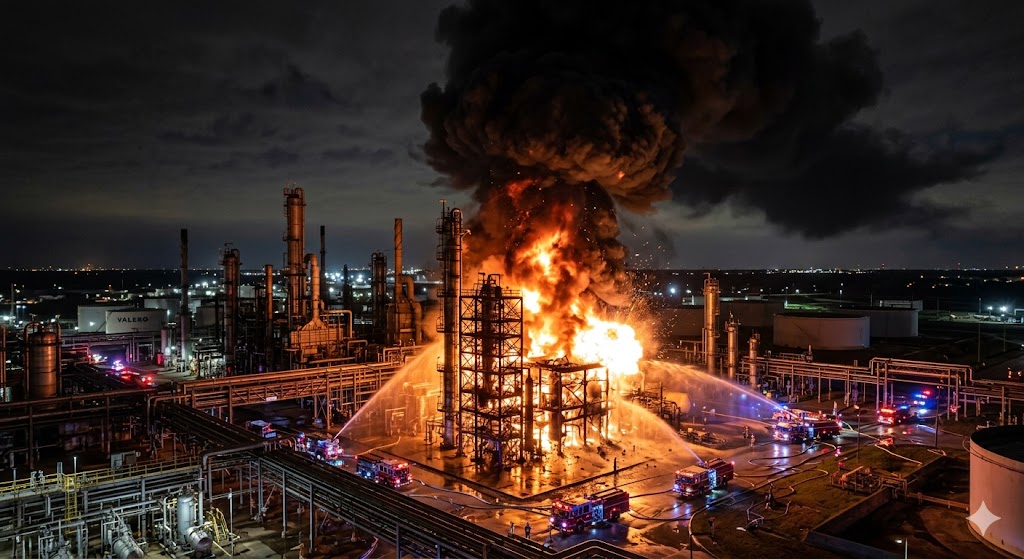
PORT ARTHUR, Texas — A major industrial incident unfolded at the Valero Energy Corp. refinery in Port Arthur late Monday, March 23, 2026, as a massive explosion and subsequent fire tore through a critical diesel hydrotreater unit. The event, which sent a towering plume of black smoke over the Gulf Coast and rattled windows for miles, has forced a partial shutdown of one of the United States’ largest refining complexes and raised immediate concerns regarding global fuel supplies.
The Incident: A “Huge Explosion”
The crisis began at approximately 6:30 p.m. local time when residents in Port Arthur, Groves, and Nederland reported a thunderous “boom” that shook homes. According to eyewitnesses and local authorities, the blast originated within the diesel hydrotreater unit—a high-pressure facility used to remove sulfur from fuel to meet environmental standards.
“It was a huge explosion, probably bigger than any I’ve experienced in almost 40 years in the industry,” one witness reported. The Port Arthur Fire Department and Valero’s internal emergency response teams fought the resulting blaze for several hours. By Tuesday morning, March 24, Valero confirmed that the fire was contained, though the unit suffered “severe damage.”
Operational Fallout and “Shelter-in-Place”
In the immediate aftermath, the City of Port Arthur issued a shelter-in-place order for residents on the west side of the city and for several local schools. Hazardous materials teams and the Texas Commission on Environmental Quality (TCEQ) were deployed to monitor air quality following reports of a heavy sulfur odor. While the order was lifted late Monday night after air monitoring stabilized, the environmental impact remains a concern; early estimates suggest the event could have released significant emissions, including particulate matter and sulfur dioxide.
Current Operational Status:
- Diesel Hydrotreater: Severely damaged and offline.
- Fluid Catalytic Cracker (FCC): Located near the fire; operations are being assessed for collateral heat damage.
- Refinery Capacity: The 435,000-barrel-per-day (bpd) facility is currently operating at significantly reduced rates.
- Shutdown Decision: Valero executives are currently weighing whether to proceed with a full plant-wide shutdown to facilitate safety inspections and repairs.
Economic and Global Impact
The timing of the fire is particularly sensitive. The Port Arthur refinery is a cornerstone of the U.S. Gulf Coast refining infrastructure and is uniquely configured to process heavy sour crudes, including recent large-scale imports from Venezuela.
- Fuel Price Surge: With U.S. diesel prices already at multi-year highs due to geopolitical tensions in the Middle East, the loss of secondary processing capacity at Port Arthur is expected to tighten supply further.
- Supply Chain Strain: The facility is a primary producer of gasoline, diesel, and jet fuel. Analysts warn that if the outage extends into weeks, it could trigger a “supply shock” across the Eastern Seaboard and West Coast markets.
- Jones Act Waivers: The federal government has already been utilizing Jones Act waivers to move fuel between U.S. ports to mitigate high prices; this outage may necessitate further emergency logistics measures.
Frequently Asked Questions (FAQs)
What is a diesel hydrotreater and why is it important?
A diesel hydrotreater is a refinery unit that uses hydrogen and catalysts to remove sulfur from diesel fuel. This process is essential for producing “Ultra-Low Sulfur Diesel” (ULSD) required by environmental regulations. Without it, the refinery cannot produce finished, saleable diesel.
Were there any injuries reported?
As of the latest update from Jefferson County Sheriff Zena Stephens and Valero officials, all employees and contractors have been accounted for, and no injuries have been reported.
Is there a risk to the public?
The initial “shelter-in-place” order has been lifted. However, residents are advised to stay tuned to local air quality reports from the TCEQ. If you smell a strong chemical or “rotten egg” (sulfur) odor, stay indoors and close windows until the air clears.
How will this affect gas prices?
While gasoline was not the primary unit affected, refineries are integrated systems. A disruption of this scale at a 435,000 bpd plant often leads to a localized spike in wholesale fuel prices, which can trickle down to the pump within 48 to 72 hours.
Reference Links & Sources
- Valero Energy Corp. Official Investor Relations
- Texas Commission on Environmental Quality (TCEQ) Air Quality Monitoring
- Energy Information Administration (EIA) – Refinery Outage Reports
- City of Port Arthur Emergency Management
Would you like me to track the impact of this outage on WTI and Brent crude oil prices for the remainder of the week?