

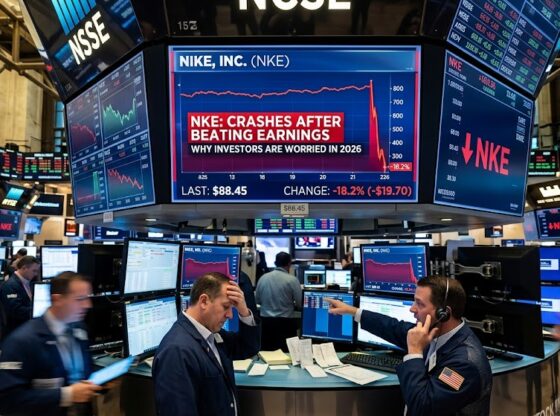

Business USA: Nike’s latest earnings report delivered what many investors usually celebrate—an earnings beat. Yet, the market reaction told a completely different story. Shares of Nike (NYSE: NKE) fell sharply—dropping more than 8% in after-hours trading—despite exceeding expectations on both earnings per share (EPS) and revenue.
So, what went wrong?
This deep-dive analysis explains why Nike stock fell despite strong results, what’s worrying investors, and whether this is a temporary dip or a sign of deeper structural challenges.
📉 Nike Stock Today: A Paradoxical Market Reaction
At first glance, Nike’s Q1 2026 earnings appeared solid:
- EPS: $0.35 (vs. $0.31 expected)
- Revenue: $11.3 billion (slightly above forecasts)
- Gross Margin: 40.2% (better than expected)
Under normal circumstances, these numbers would push a stock higher. But instead, the market responded negatively.
This paradox highlights a key truth about modern markets:
👉 Investors care more about future growth and momentum than past performance.
📊 Nike Earnings 2026: Breaking Down the Numbers
1. Earnings Beat — But Not Convincing Enough
Nike exceeded earnings estimates, showing operational efficiency and cost control. However, the beat was relatively modest.
Investors were hoping for:
- A stronger margin expansion
- Clear signs of accelerating growth
- Evidence of a successful turnaround
Instead, they saw a company still in transition.
2. Revenue Growth Remains Weak
While revenue came in at $11.3 billion:
- Growth was essentially flat year-over-year
- Adjusted for currency, revenue actually declined by 3%
This signals underlying demand issues—especially in key global markets.
🔄 Nike’s Turnaround Story Under Elliott Hill
Nike is currently undergoing a strategic reset under CEO Elliott Hill, who took over leadership in 2024.
His mission:
- Rebuild brand momentum
- Improve product innovation
- Strengthen distribution channels
- Restore profitability
The Problem?
The turnaround is incomplete and uneven.
As noted in reports from Yahoo Finance, analysts describe Nike as:
“In the middle of a turnaround… with little immediate excitement for investors.”
This lack of clarity is a major reason behind the stock decline.
🛍️ Nike Direct vs Wholesale: A Shift in Strategy
Nike Direct (DTC) Is Declining
Nike’s direct-to-consumer (DTC) business—once a major growth driver—showed weakness:
- Revenue: $4.5 billion
- Decline: -4%
This is concerning because:
- DTC offers higher margins
- It strengthens brand control
- It supports digital transformation
A decline suggests weakening consumer engagement or execution challenges.
Wholesale Channel Is Growing
On the positive side:
- Wholesale revenue grew 5% to $6.5 billion
This indicates:
- Strong retailer demand
- Better inventory flow
- Improved partnerships
However, wholesale margins are typically lower than DTC, limiting profitability gains.
👟 Converse Collapse: A Major Red Flag
One of the biggest shocks in the report:
👉 Converse sales dropped 35%
- Revenue: $264 million
- Far below expectations
This sharp decline signals:
- Weak brand demand
- Poor product cycles
- Possible competitive pressure
For a company like Nike, brand strength is everything. A collapse in one of its key subsidiaries raises concerns about broader brand health.
🌏 China Market Weakness: A Persistent Problem
Nike’s struggles in China continue:
- Revenue in Greater China: -11%
- Equipment sales: -27%
Why China Matters:
China is:
- One of Nike’s largest growth markets
- Critical for long-term expansion
- A key driver of premium product demand
Challenges in China:
- Increased competition from local brands
- Changing consumer preferences
- Macroeconomic slowdown
- Geopolitical tensions
Until Nike stabilizes China, investor confidence will remain shaky.
💸 Margin Pressure: Tariffs and Costs
Nike’s margins, though slightly better than expected, are under pressure:
Key Issues:
- Higher tariffs in North America
- Rising input and logistics costs
- Pricing challenges in competitive markets
Even though gross margin came in at 40.2%, investors worry about sustainability.
📉 Why Nike Stock Fell Despite Beating Earnings
Let’s break it down clearly:
1. Weak Growth Outlook
Flat revenue signals limited expansion potential.
2. Turnaround Uncertainty
Investors don’t see clear, fast progress under Elliott Hill.
3. China Concerns
Continued weakness in a critical market.
4. Brand Weakness (Converse)
A 35% drop is too large to ignore.
5. DTC Decline
A key high-margin segment is shrinking.
6. Margin Pressure
Tariffs and costs threaten profitability.
📈 Market Psychology: Expectations vs Reality
Stocks don’t move based on results alone—they move based on expectations vs reality.
What Investors Expected:
- Strong recovery signs
- Accelerating growth
- Clear strategic wins
What They Got:
- Mixed signals
- Uneven performance
- Ongoing challenges
👉 Result: Sell-off
🔮 Nike Outlook 2026: Can the Company Recover?
Nike’s leadership remains optimistic.
CEO Elliott Hill stated:
The company is taking “meaningful actions” and progress is being made—though uneven.
Positive Signs:
- Wholesale growth improving
- Margins holding up
- Core Nike brand still stable
Risks Ahead:
- China recovery uncertain
- Brand competition rising
- Execution risks in turnaround
🧠 Expert Analysis: Is This a Buying Opportunity?
Investors are divided.
Bull Case 🟢
- Strong global brand
- Long-term growth potential
- Turnaround could unlock value
Bear Case 🔴
- Slowing growth
- Execution uncertainty
- Competitive pressure
📊 Long-Term Investors: What Should You Watch?
If you’re tracking Nike stock, focus on:
Key Metrics:
- Revenue growth acceleration
- China market recovery
- DTC performance
- Margin expansion
Strategic Indicators:
- Product innovation
- Digital sales growth
- Brand engagement
📚 Conclusion: A Classic “Good Numbers, Bad Reaction” Scenario
Nike’s latest earnings show a company that is:
✔ Profitable
✔ Operationally stable
❌ Struggling with growth
❌ Still in transition
The stock drop reflects investor impatience, not failure.
👉 Nike is not broken—but it’s not fully fixed either.
❓ FAQs
1. Why did Nike stock fall after beating earnings?
Nike stock fell because investors were expecting stronger signs of growth and a clearer turnaround. Despite beating EPS estimates, weak revenue growth and ongoing challenges caused concern.
2. Did Nike beat earnings estimates in 2026?
Yes, Nike reported $0.35 EPS, beating expectations of $0.31.
3. What is the biggest concern for Nike investors?
The biggest concerns are:
- Weak growth
- China market decline
- Ongoing turnaround uncertainty
4. How did Nike’s China business perform?
Nike’s China revenue fell 11%, with equipment sales dropping 27%, making it a major drag on performance.
5. Why did Converse sales drop so much?
Converse sales fell 35%, likely due to weak demand, product issues, and increased competition.
6. Is Nike still a good long-term investment?
It depends on risk tolerance. Long-term investors may see value, but short-term uncertainty remains high.
7. What is Nike Direct and why is it important?
Nike Direct is the company’s direct-to-consumer segment. It’s important because it offers higher margins and stronger brand control.
🔗 Reference Resources (Free)
- Nike Investor Relations (official filings and earnings reports)
- Yahoo Finance – Nike stock analysis
- SEC Filings (10-Q, 10-K reports)
- MarketWatch & Bloomberg for real-time updates
If you want, I can also create SEO meta title, description, tags, and 10 Facebook posts for this article to boost traffic.