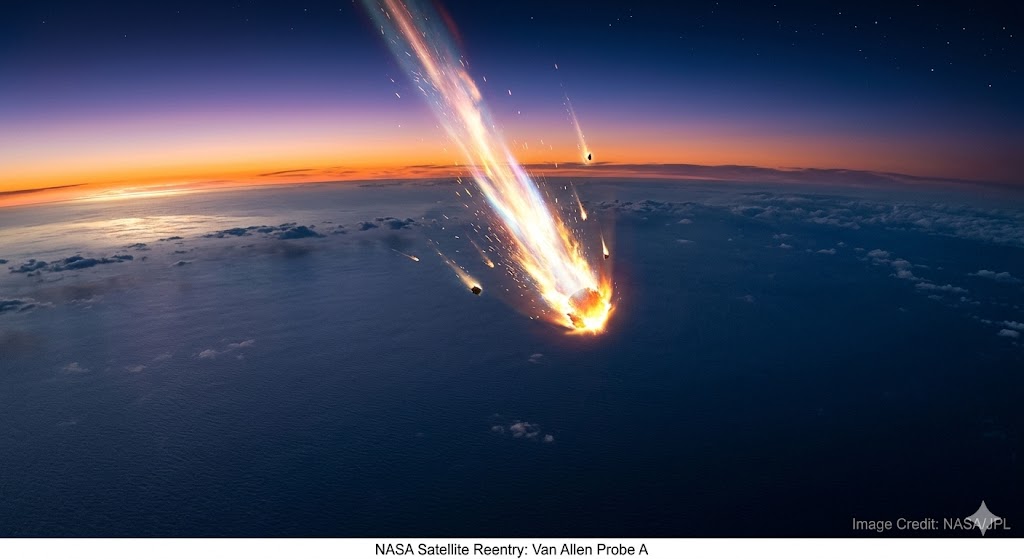
NASA Satellite Crashes: 1,300-Pound Van Allen Probe Reenters Earth’s Atmosphere Over Pacific Ocean. Watch Now
EASTERN PACIFIC OCEAN — A significant piece of space history returned to Earth with a literal splash on Wednesday morning. NASA officials confirmed that the Van Allen Probe A, a 1,323-pound (600-kilogram) satellite that spent over a decade deciphering the mysteries of our planet’s radiation belts, reentered the atmosphere and crashed into the Eastern Pacific Ocean.
The reentry occurred on Wednesday, March 11, 2026, at 6:37 a.m. EDT. The event marks the final chapter for one of NASA’s most successful heliophysics missions, ending a 14-year journey that fundamentally changed our understanding of the space environment surrounding Earth.
The Final Descent: Reentry Details
NASA tracked the spacecraft’s deorbit for several weeks as atmospheric drag slowly pulled the decommissioned satellite toward the surface. Because the Van Allen Probe A was a relatively dense, 1,300-pound object, it did not entirely burn up upon reentry.
- Location: Eastern Pacific Ocean (Remote uninhabited zone).
- Time: 6:37 a.m. EDT (10:37 UTC).
- Weight: ~1,323 pounds (600 kg).
- Impact: Most of the spacecraft disintegrated due to extreme friction heat, but specialized components likely survived the plunge into the sea.
NASA’s orbital debris experts had predicted the reentry within a narrow window, ensuring that the descent posed no threat to populated areas or air traffic.
A Legacy in the “Danger Zone”
Launched in August 2012 as part of the Living With a Star program, the twin Van Allen Probes (A and B) were sent into a region of space most satellites try to avoid: the Van Allen Radiation Belts.
These two donut-shaped regions of high-energy particles—trapped by Earth’s magnetic field—can be lethal to spacecraft electronics and dangerous for astronauts. The probes were specifically armored to survive this intense radiation, allowing them to provide unprecedented data on how the belts grow and shrink in response to solar activity.
Key Achievements of the Mission:
- Discovery of the Third Belt: Within weeks of launching, the probes discovered a temporary third radiation belt that appeared and disappeared, challenging decades of scientific theory.
- Solar Storm Analysis: The probes mapped how “killer electrons” are accelerated to nearly the speed of light during geomagnetic storms.
- Space Weather Forecasting: The data provided by Probe A has been vital for protecting GPS satellites, communication arrays, and power grids on Earth.
Why Did It Crash Now?
While the science mission officially concluded in 2019 when the spacecraft ran low on fuel and were deactivated, NASA’s “End of Mission” plan was designed for this exact moment.
To prevent the probes from becoming permanent “space junk” in high-traffic orbits, engineers used the remaining fuel in 2019 to lower the satellites’ perigee (the closest point to Earth). This ensured that atmospheric drag would naturally pull them down within 25 years, adhering to international space debris mitigation guidelines.
Van Allen Probe B is expected to follow a similar reentry path in the coming years.
The Future of Heliophysics
The fiery end of Van Allen Probe A doesn’t mean the study of Earth’s magnetic field is over. NASA is already moving forward with new missions, such as the TRACERS mission and the Geospace Dynamics Constellation (GDC), which will build upon the foundation laid by the Van Allen twins.
As we look toward the Artemis missions and putting humans back on the moon, understanding the radiation environment mapped by this 1,300-pound satellite is more critical than ever.
Frequently Asked Questions (FAQ)
Q: Was the reentry dangerous? A: No. NASA and the U.S. Space Command tracked the object closely. The Eastern Pacific is a standard “graveyard” for reentering debris due to its vast, unpopulated expanse.
Q: Did the satellite have nuclear components? A: No. The Van Allen Probes were powered by solar panels and chemical batteries.
Q: Can I see the crash site? A: Unlikely. The reentry happened at hypersonic speeds, and any surviving fragments are now at the bottom of the ocean.
BREAKING NEWS IN THE USA NOW
National Defense Emergency: Trump to Waive Jones Act to Combat Surging Fuel and Food Prices

WASHINGTON, D.C. — In a dramatic bid to stabilize a domestic economy reeling from the “Gulf Oil Shock,” President Donald Trump is moving to suspend the Merchant Marine Act of 1920, commonly known as the Jones Act. The move, confirmed by White House Press Secretary Karoline Leavitt on Thursday evening, marks a significant escalation in…
Bunker Busters Loaded: US B-1 Bombers Poised to Hit Iran’s Hidden Sites Amid Gulf Oil Shock
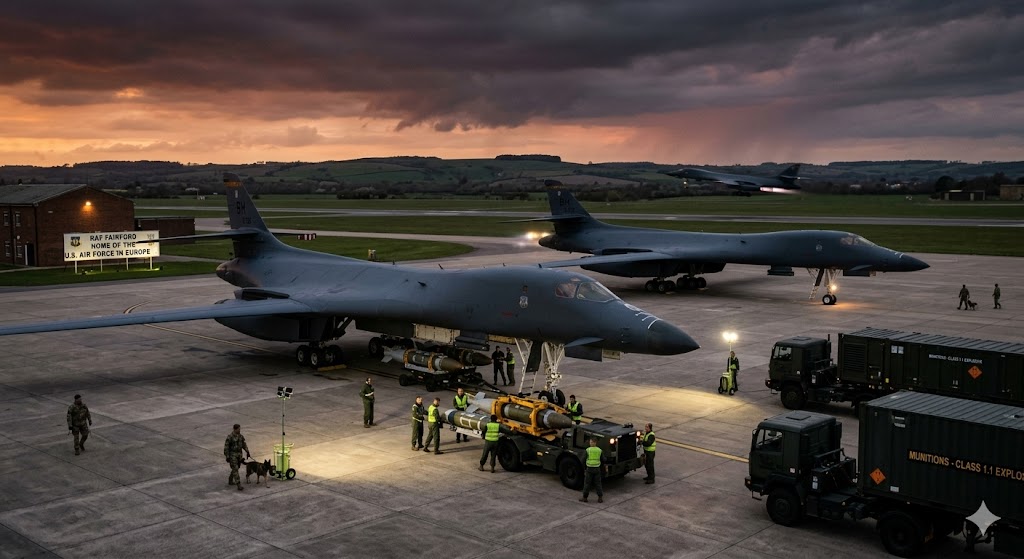
RAF FAIRFORD, United Kingdom — The strategic geography of the 2026 Iran war shifted dramatically this week as a fleet of United States B-1B Lancer bombers touched down at RAF Fairford in Gloucestershire. The deployment, which local witnesses and Al Jazeera teams confirmed on Thursday, March 12, signals a significant escalation in Operation Epic Fury—the…
Tragedy at TPC: Gunman Dead and Two Injured After Shooting in Old Dominion University’s Constant Hall

NORFOLK, Va. — A morning of academic routine was shattered by gunfire at Old Dominion University (ODU) on Thursday, leaving a gunman dead and two others hospitalized. The incident, which unfolded inside the university’s main business college building, triggered a massive multi-agency response—including federal agents from the ATF—and forced the immediate closure of the 24,000-student…