
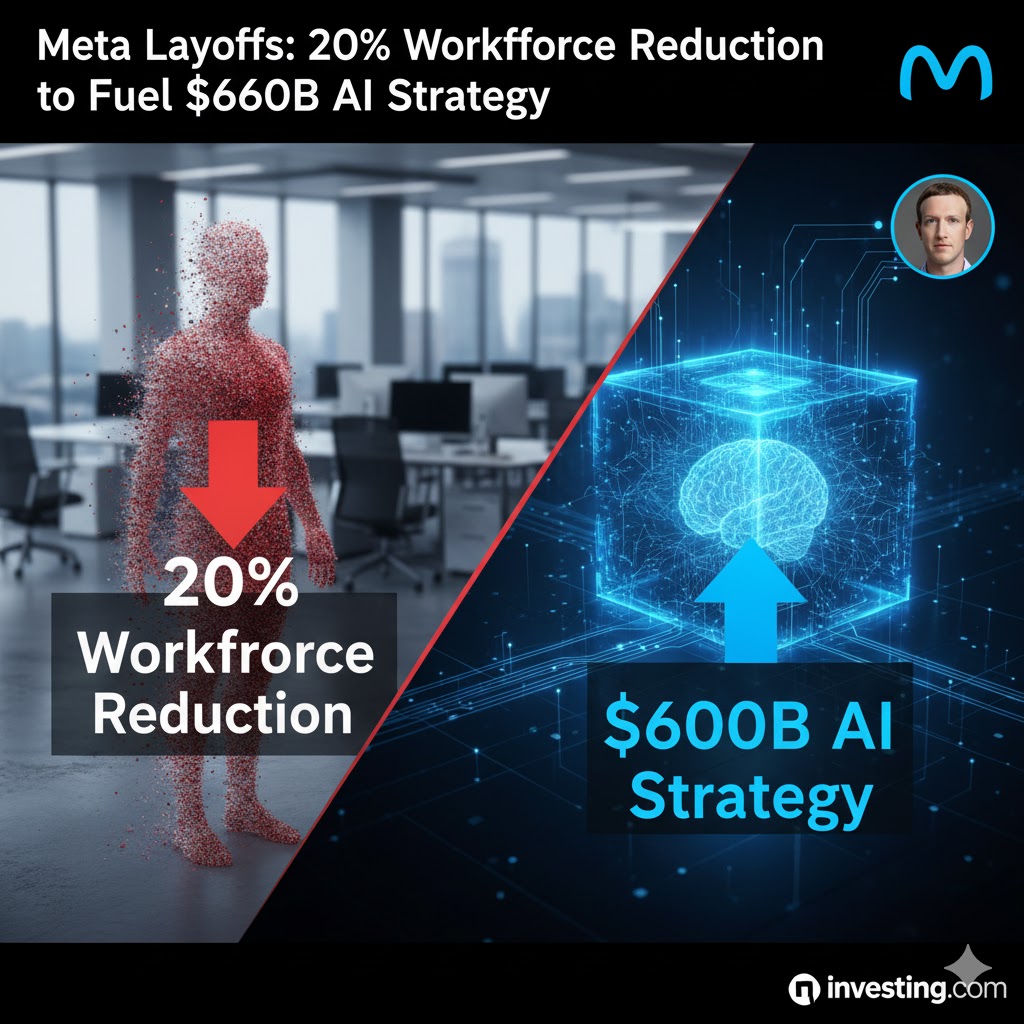









Meta Layoffs: 20% Workforce Reduction to Fuel $600B AI Strategy
Breaking US business News today: In a move that signals a seismic shift within the technology sector, Meta Platforms Inc. is reportedly preparing for its most aggressive organisational overhaul to date. Sources familiar with internal planning indicate that the social media giant may be gearing up for a workforce reduction of 20% or more, a decision designed to counterbalance the astronomical costs of its pivot toward “superintelligence.”
This potential cull, which could impact roughly 16,000 employees based on recent filings, comes as Mark Zuckerberg’s company navigates a critical juncture between its legacy as a social networking titan and its aggressive, capital-intensive pursuit of artificial intelligence leadership.
The Cost of “Superintelligence”
Meta has committed to a staggering $600 billion capital expenditure plan for AI infrastructure through 2028. This investment is primarily earmarked for the massive build-out of data centers, the procurement of over one million GPUs, and the pursuit of advanced AI research.
The financial pressure is palpable. Meta’s 2026 capital expenditure is projected to hit between $115 billion and $135 billion—nearly double the spending levels of the previous year. As the company redirects its vast resources toward building next-generation AI, internal efficiency has become the primary mandate. Executives have reportedly been asked to strategize on how to reduce their teams, with a new organizational structure aiming for manager-to-employee ratios as lean as 1:50.
The “Avocado” Model and Performance Hurdles
The urgency behind the restructuring is underscored by technical setbacks. Meta’s next-generation AI model, internally codenamed “Avocado,” has reportedly faced significant performance hurdles. Internal testing indicates that Avocado currently falls short of expectations, with capabilities hovering between Google’s Gemini 2.5 and 3.0.
As a result, Meta has postponed the model’s release from its originally planned first-quarter 2026 window to at least May. This delay is particularly concerning to investors, as it threatens to widen the competitive gap with rivals like OpenAI, Google, and Anthropic. In a move reflecting both flexibility and frustration, leadership has even reportedly discussed the possibility of temporarily licensing Gemini to bridge the performance gap while development continues.
A Broader Tech Industry Trend
Meta’s move is not an isolated incident but rather part of a broader “AI-first” labor shift gripping the Magnificent Seven and the wider tech ecosystem. As AI tools demonstrate the ability to handle tasks that once required entire departments—such as coding, data analysis, and customer support—major corporations are reconsidering the necessity of large human teams.
- Amazon.com: Recently slashed 16,000 corporate roles to streamline operations.
- Block Inc.: Reduced its workforce by nearly 50% to embed intelligence tools throughout its operations.
- Oracle: Has signaled intent to manage the financial pressures of AI infrastructure by cutting thousands of positions.
Mark Zuckerberg captured this sentiment in January, noting that projects once requiring entire departments are now being “accomplished by a single very talented person.” This shift marks a departure from the pandemic-era growth strategy, signaling a move toward a leaner, more automated corporate structure.
Investor Sentiment and the “Great Rotation”
The market’s reaction to these developments has been complex. While news of potential layoffs initially saw Meta shares tick higher in after-hours trading—reflecting a desire for leaner operations—long-term confidence is under intense scrutiny.
The tech sector is currently grappling with a “valuation reset.” Investors are increasingly questioning the long-term return on investment (ROI) for these massive proprietary model bets, particularly in an environment where the “Old Economy”—industrials, retail, and materials—is experiencing a resurgence. As capital flows toward companies that offer tangible, short-term fiscal stability, tech giants like Meta face mounting pressure to prove that their AI investments will eventually translate into concrete top-line growth.
As Meta prepares for this organizational overhaul, the immediate focus shifts to its execution. The company must balance its ambitious “superintelligence” goals with the need to maintain a competitive moat in an increasingly crowded and skeptical market. For the 16,000 employees potentially affected, these developments represent a stark reminder of the transformative—and often disruptive—impact of AI on the modern workforce.
The unfolding situation at Meta serves as a bellwether for the rest of Silicon Valley. Whether this aggressive pivot to AI-first efficiency will yield the promised productivity boom or lead to a long-term erosion of organizational capacity remains the defining question for the tech industry in 2026.
Godfather of AI Says 2026 Could Be the “Job Shock” Year
This video is relevant because it discusses the broader implications of AI advancement on the 2026 job market, providing expert context to the restructuring trends observed at Meta and other tech giants.
Meta Layoffs: Workforce Reduction to Fuel $600B AI Strategy
Meta Platforms, Inc. is reportedly preparing for a significant round of Meta layoffs that could impact 20% or more of its global workforce, according to multiple reports from March 2026. This potential restructuring, which could affect nearly 16,000 employees, is part of a strategic initiative to offset massive capital expenditures dedicated to artificial intelligence.
The Strategy Behind the Cuts
Meta has committed to investing approximately $600 billion in data center infrastructure by 2028. As the company redirects its financial resources toward building “superintelligence” and acquiring AI-focused platforms—such as Moltbook and the startup Manus—it is simultaneously pushing for a leaner corporate structure.
Mark Zuckerberg has signaled that AI-driven tools are enhancing internal productivity, allowing projects that previously required large teams to be completed by significantly smaller, highly talented groups. By integrating AI-assisted workflows, Meta aims to maintain operational speed while managing the high costs associated with its AI-first roadmap.
Market and Industry Context
The news of potential job cuts reflects a broader trend within the “Magnificent Seven” and the wider tech industry. Companies are recalibrating their workforces to prioritize AI-driven efficiency over the headcount-heavy models used during the pandemic.
While Meta spokesperson Andy Stone has described the reports as “speculative reporting about theoretical approaches,” the market remains sensitive to how these aggressive capital investments will yield long-term top-line growth. For now, the “year of efficiency” mindset appears to be returning, as investors weigh the promise of an automated corporate future against the immediate financial strain of unprecedented AI infrastructure spending.
Key Takeaways
- Scope: Up to 20% of the workforce, or roughly 16,000 roles, could be impacted.
- Driver: The need to offset a $600 billion investment plan in AI data centers through 2028.
- Rationale: Leveraging AI-assisted internal efficiencies to do more with fewer people.
- Status: No official timeline or finalized scale has been confirmed by Meta leadership.